
Bangladesh eyes global support to strengthen manufacturing sector

Bangla Press
Published: 26 September 2026, 10:50 AM
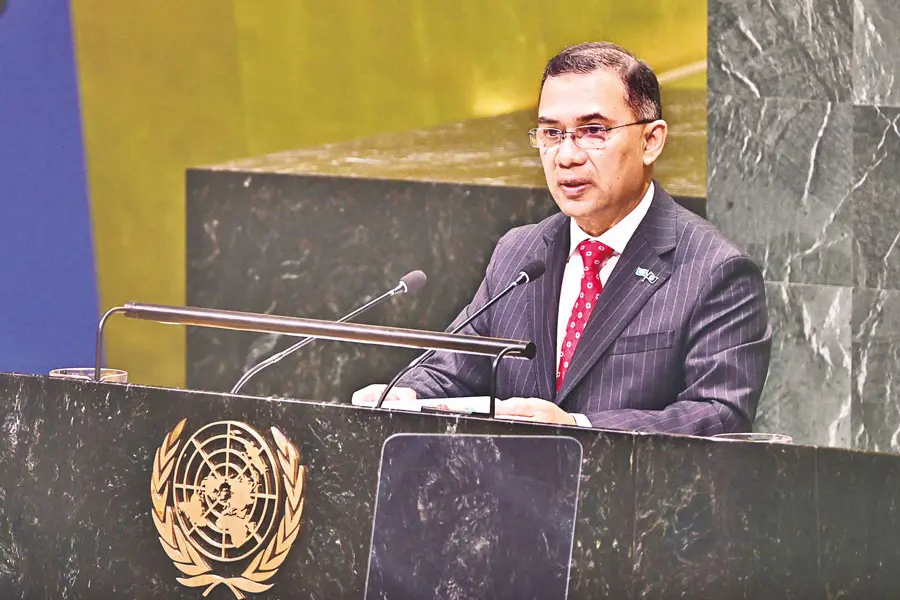
Bangla Press Desk: Prime Minister Tarique Rahman has sought international partners' support with adequate financing, greater market access, technology transfer and capacity-building assistance to transform Bangladesh into a global manufacturing hub.
He has stressed that such supports are also imperative to ensure Bangladesh's smooth and sustainable graduation from the least-developed-country (LDC) category.
Addressing the 81st session of the United Nations General Assembly at the UN headquarters in New York on Thursday evening local time, the prime minister said Bangladesh is implementing a broad range of programmes to turn its working-age population into a skilled workforce and create more employment opportunities.

"Bangladesh seeks the support of its development partners in this endeavour," he said in his maiden UNGA speech.
On Bangladesh's graduation from the LDC category, Mr Rahman stressed the need for continued international assistance to make the transition sustainable.
"Continued support in areas such as adequate financing, enhanced market access, technology transfer and capacity-building is essential to ensure a sustainable graduation for Bangladesh and other countries," he said.
Highlighting the importance of regional economic integration, he said countries could contribute to one another's prosperity through trade facilitation, improved connectivity and meaningful cooperation, particularly at the regional level.
He mentioned that his government has allocated $50 million in the current fiscal year to support start-ups led by young entrepreneurs, researchers and innovators.
The prime minister also called for greater access to advanced technologies, knowledge and research opportunities, saying that Bangladesh's large young population and expanding digital capabilities offered significant opportunities.
"We do not want today's digital divide to become tomorrow's artificial intelligence divide," he told the global forum to underscore the urgency of tech parity in the fast-advancing world.
He stressed the need to ensure that developing countries were not left behind in the rapid advances of science and technology.
"No country should be left behind in this journey of scientific progress," he said.
Mr Rahman also called on the United Nations to develop effective policy frameworks to ensure that the benefits of artificial intelligence and social media could be harnessed positively.
Turning to the Rohingya crisis on the home front, the prime minister said Bangladesh has hosted more than 1.2 million forcibly displaced Rohingyas from Myanmar for over nine years, which has put immense pressure on the country's resources, environment, security and host communities.
He noted that the crisis originated in Myanmar and its solution lay over there.
"The only solution to this problem is safe return of the displaced Rohingya population to their homeland in Myanmar," he said.
He called for firm and effective support from the United Nations and the international community to resolve the crisis, while urging continued lifesaving humanitarian assistance until repatriation became possible.
The prime minister also called for stronger global cooperation to ensure safe, orderly and regular migration, stressing the need to protect the rights, dignity and welfare of migrant workers.
Turning to climate change, he said Bangladesh contributed little to global carbon emissions but continued to bear the brunt of its adverse impacts.
He called for stronger global action on climate justice, climate finance and adaptation support ahead of the COP31 climate conference.
Mr Rahman also highlighted government plans to plant 250 million trees over the next five years, excavate 20,000 kilometres of canals and implement the Teesta Master Plan and the Padma Barrage project.
Outlining the government's development strategy, he said it has adopted a three-R approach centred on recovery, rehabilitation and reconstruction to rebuild the economy and society.
He said Bangladesh was entering a period of significant opportunities and was working to turn its demographic dividend into a skilled workforce.
"No state can become strong by keeping its people disempowered," he said.
The prime minister focused on his vision of building a prosperous, self-reliant, welfare-oriented democratic Bangladesh where all citizens, regardless of political affiliation, religion or ethnicity, could live with equal rights, dignity and security.
He said the government wants to build a country where young people could pursue their dreams without fear or barriers, women could live with confidence and every child could realise their full potential.
"Bangladesh First: Bangladesh for All," he said to encapsulate his UNGA speech.
[Bangla Press is a global platform for free thought. It provides impartial news, analysis, and commentary for independent-minded individuals. Our goal is to bring about positive change, which is more important today than ever before.]
YOU MAY ALSO LIKE


.jpg)
Sangeet Academy