Bangla Press Desk: The country has adequate fertiliser stocks, but distribution remains the main challenge, Prime Minister's Adviser for Information and Broadcasting Zahed Ur Rahman said at a weekly briefing at the Secretariat on Tuesday.
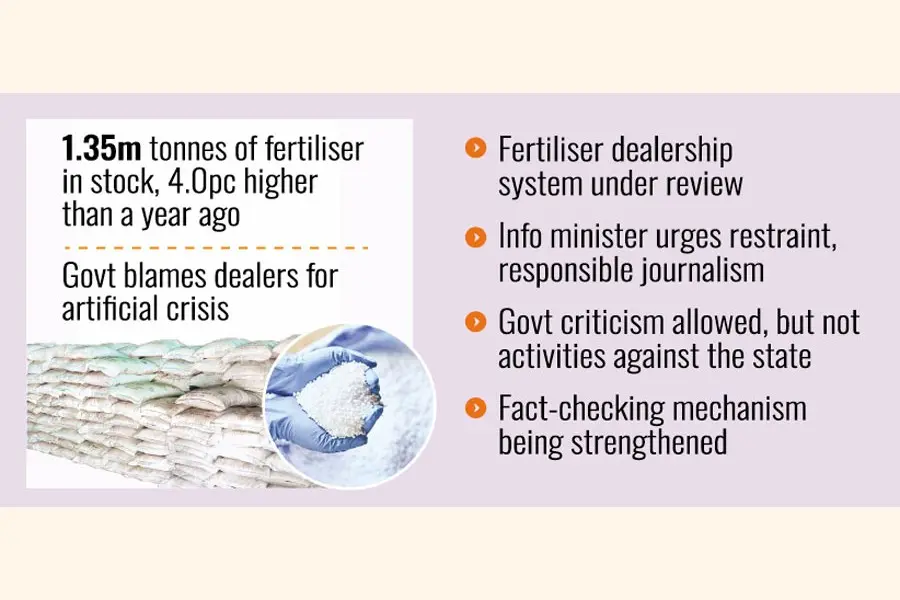
He said the country currently has around 1.35 million tonnes of fertilisers in stock, about 4.0 per cent more than the 1.3 million tonnes recorded during the same period last year.
Many dealers have created an artificial crisis, he said, adding that the situation would be resolved within a few days.
The government is also reviewing the decades-old fertiliser dealership system, which has contributed to some short-term distribution problems, the adviser said, expressing hope that the issues would be resolved soon.
On defence, Zahed said Bangladesh has prepared a draft agreement to purchase J-10CE fighter jets from China.
The induction of the J-10CE aircraft would mark a major leap in the history of Bangladesh's air defence, he said.
Experts say the new fighter jets would help Bangladesh Air Force move from an older-generation fleet towards modern air combat capabilities, including AESA radar, beyond-visual-range (BVR) missiles, electronic warfare, datalinks and network-centric operations.
The adviser also said incidents of mob violence had declined significantly under the current government compared with the interim government and Awami League periods.
He said the government was working to restore a more stable environment, while acknowledging that the country was still passing through a challenging period.
Information and Broadcasting Minister Andaleeve Rahman addressed concerns over press freedom and alleged support for fascist forces, saying journalism and political ideology should not be conflated.
He said intellectual support for fascism could be criticised and condemned socially, while journalism must remain free.
"We have to calm down," he said, urging all sides to exercise restraint.
The minister said security concerns and other pressing issues had at times forced the government to divert its attention. As a result, some programmes or activities might have to be cancelled in certain areas because of security considerations, he said.
Journalists at the briefing raised questions about media outlets accused of supporting the previous regime, alleged attempts to create an artificial fertiliser crisis and the activities of syndicates involved in spreading misinformation.
Responding to questions about misinformation and disinformation, Andaleeve said the government was strengthening its fact-checking mechanism to identify and counter false or misleading information.
Hundreds of cases of misinformation have been identified in recent months, he said, adding that a panel would begin working on the issue.
The government is also planning to develop Bangla Fact under the Press Institute of Bangladesh (PIB) to verify information and debunk false claims circulating through traditional and social media.
The minister urged journalists and media organisations to cooperate in exposing misinformation and disinformation rather than allowing unverified claims to spread.
State Minister for Information and Broadcasting Yasser Khan Choudhury called for a clear distinction between the government and the state in news reporting.
Journalists have every right to criticise the government, but should not undertake activities that undermine the state, he said.
"The government and the state are two different things. You can criticise the government, but you should not do anything against the state," Yasser said, stressing the importance of responsible journalism during what he described as a difficult period.
He said the country had not yet returned to normalcy and that the government was still working with largely the same bureaucracy and institutions.
The briefing also touched on the government's broader efforts to improve communication with the public, particularly as false information can quickly create confusion over food, fertiliser, security and political developments.
The officials said the government's objective was not to restrict legitimate criticism but to establish a clearer boundary between criticism of the government and activities that could harm state institutions or public security.
[Bangla Press is a global platform for free thought. It provides impartial news, analysis, and commentary for independent-minded individuals. Our goal is to bring about positive change, which is more important today than ever before.]

 E-paper
.jpg)

.jpg)