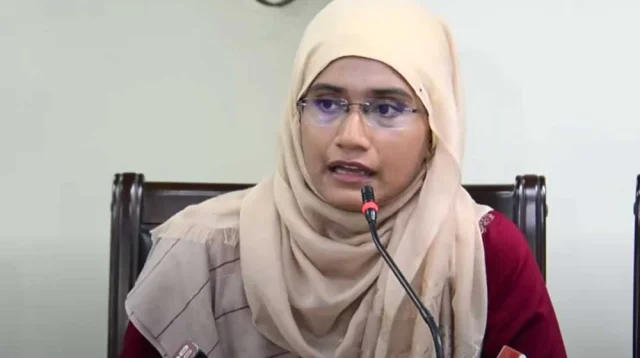
Bangla Press Desk: Samanta Sharmin, Senior Joint Convener of the National Citizens' Party (NCP), stated that sermons driven by popularity might not necessarily guide us on what is truly required of us as Muslims. Therefore, we should strive to enrich our Islamic knowledge, even if only to a small extent. If Allah wills it and our intentions are sincere, we might reap great blessings from even a modest effort.
She shared these thoughts in a post on her Facebook account late Thursday night (October 8).
In the post, Samanta Sharmin wrote, "I listened to a very timely sermon. Acquiring the necessary knowledge has been quite difficult for me, primarily because I do not know Arabic and lacked prior connection to the tradition of Islamic scholarship (such as through Madrasas or other Islamic educational institutions). My age certainly adds to this challenge."
She continued, "The beginning and the very end of the podcast featured such significant discussions that I felt it would be wrong not to listen to it again and share it. Many have tried to cause me deep hurt by mocking my conscious decision to embrace Islam. I am curious as to why there is such animosity towards Islam and those who practice it. People speak behind one's back, yet I never see anyone confront me directly; thus, my curiosity remains unsatisfied."
She added, "However, we should not succumb to social pressures—which are often fabricated or baseless—by becoming apologetic about Islam and its intellectual heritage, or by shying away from discussing them. Instead, the time has come for us, as Muslims, to appreciate the need for rigorous training in Islamic scholarship, rather than simply presenting childhood religious textbooks or easily accessible, common books as the definitive words of Allah and His Prophets. We should not disparage the necessity of traditional Islamic educational institutions or the efforts spanning centuries, simply out of fear of being ostracized by right-wing or secular circles." Samanta Sharmin writes that educational institutions in Bangladesh suffer from many shortcomings; however, these deficiencies stem not from Islam itself but from various political, economic, and other factors. Take, for instance, the annual Islamic book fair. Ever since I became a Muslim, I have visited it every year hoping to discover new books, yet I have never found anything remarkable—and this year was no exception. This is despite the fact that Muslim and non-Muslim scholars across the globe are writing extensively about Islam. Not only is there hardly a trace of such works available, but books from a decade ago are still being sold. Even the Islamic Foundation fails to offer new insights. Yet, I have observed certain politicians lavishing praise on the books at the Islamic book fair. They do this to project an image of being aligned with an Islamic milieu, not to genuinely expand their knowledge; appeasing a specific vote bank may also be a motivating factor.
She writes that such actions by politicians do nothing to benefit Islam. Instead, that attention could have been better utilized to highlight just how far behind we lag in the realm of Islamic literature.
She further notes that the situation is particularly challenging for those of us educated within the Western "modern" system. When a doctor, engineer, banker, or university professor prefaces their remarks by saying, "I haven't read the Quran, but at my age, I do know a thing or two," we—feeling somewhat insecure—often hesitate to articulate the proper, informed perspective on Islam. Yet, after that very introduction, the individual often proceeds to make the most irrational, sweeping generalization. For instance, I have heard it claimed more than once—following that very preamble—that Islam regards a wife as a slave to her husband.
May Allah keep the Muslim Ummah confident and grant us the ability to walk the *Sirat-ul-Mustaqim* (the Straight Path).
BP/TD
[Bangla Press is a global platform for free thought. It provides impartial news, analysis, and commentary for independent-minded individuals. Our goal is to bring about positive change, which is more important today than ever before.]

 E-paper
.jpg)