
.jpg)
Minnesota standoff fuels fears of civil war

Bangla Press
Published: 31 January 2026, 08:26 PM
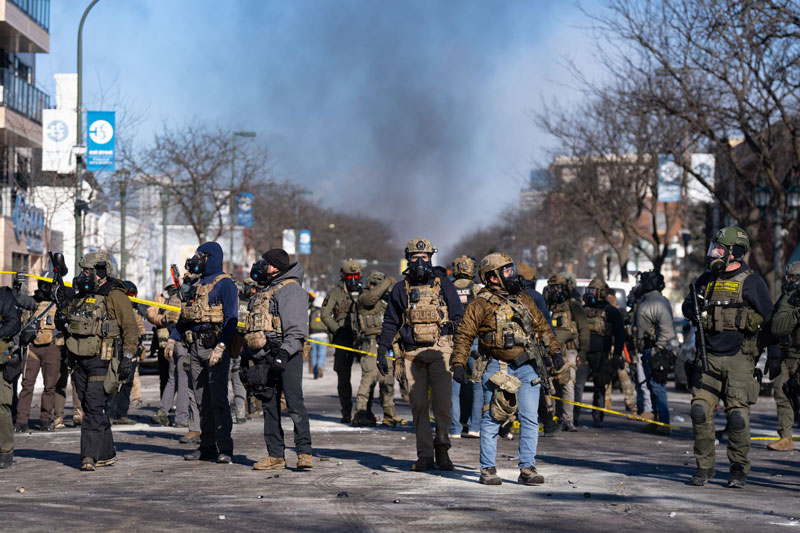
Immigration enforcement officers
Noman Sabit: Minnesota’s standoff with the Trump administration amid its immigration crackdown in the state has made a political tinderbox of the Twin Cities, as devolving clashes between protesters and federal agents stoke fears of a bigger brewing conflict.
Local officials have deemed the surge of immigration enforcement officers a “federal invasion,” doubling down in the courts and in public remarks as federal confrontations with Minnesota residents turned violent, then deadly.
The fatal shooting of 37-year-old intensive care nurse Alex Pretti brought the standoff to a cliff edge and both President Trump and the state seem to have changed course.
But as the federal government goes toe-to-toe with Democratic state leaders, experts warn of a pressure cooker for civil war.
“The problem is, these crises are like street cars there’s one coming along every five minutes,” said Steve Saideman, a professor at Canada’s Carleton University who studies civil-military relations. “And while we might be able to avoid severe violence once, twice, three times, at some point we’re gonna stop, okay, and something may happen.”
‘Fort Sumter moment’ or not
Thousands of immigration enforcement officers descended on Minneapolis and St. Paul’s streets amid the administration’s so-called Operation Metro Surge, spurred by a sprawling welfare fraud scandal involving the local Somali community.
Pretti’s fatal shooting followed the killing of Renee Good, a 37-year-old mom who was shot dead in her car after an apparent confrontation with ICE officers. The tragedies stoked fears of a worsening conflict with federal authorities.
Minneapolis Mayor Jacob Frey (D) has described being “on the front lines of a very important battle.” In an interview with The Atlantic published Wednesday, Minnesota Gov. Tim Walz (D) drew parallels to the 1861 battle that sparked the Civil War.
“I mean, is this a Fort Sumter?” the governor and 2024 vice-presidential candidate asked.
“It’s a physical assault,” he continued. “It’s an armed force that’s assaulting, that’s killing my constituents, my citizens.”
Kevin Waite, a Civil War-era historian and professor at the University of Texas at Dallas, said he thinks a path to civil war is neither inevitable nor lacking offramps. But in April 1861, when Confederate insurgents fired the first shots of the war on the South Carolina sea fort, there was a “much clearer sense that the Rubicon had been crossed” than today.
“This could be the Fort Sumter moment,” Waite said. “But in Fort Sumter, you had a rebel army firing on a federal military installation and federal soldiers there. Now in Minnesota, you’ve got federal agents firing on civilian protesters.
“The history lesson is that there’s often conflict between local and state authorities and the federal government in U.S. history,” he said. “That was really at the root of the Civil War, wrapped around the issue of slavery, and that seems to be the issue again today in Minnesota.”
Legal fight over state, federal power
The tug-of-war of state and federal power has been a feature of Trump’s presidency, amid immigration and crime crackdowns targeted at cities and states led by Democrats.
Minnesota state and local officials have sued to get Immigration and Customs Enforcement (ICE) out of the state. A judge is weighing whether to block the surge.
Frey has said that Minneapolis will not enforce federal immigration laws, which Trump described as “playing with fire.”
Matthew Pinsker, a historian and author of the Substack “What Would Lincoln Do?”, pointed to the exchange as an example of the “deeply rooted debate” over whether the federal government can direct state and local officials to enforce its laws, stemming from the 10th Amendment’s anti-commandeering doctrine.
It goes back to the 1850s and the Fugitive Slave Act, which both Pinsker and Waite referenced as a historical parallel to the conflict in Minnesota today.
The law required the return of enslaved people to their enslavers, even if found in free states. But many free states passed “personal liberty laws” that effectively obstructed the federal measure. The historians compared the efforts to sanctuary cities.
“It’s a serious legal debate that can’t be resolved by firing shots at each other on social media,” Pinsker said. “You have to let the process play out in the courts.”
Courts have weighed in on some legal fights between states and the Trump administration, most notably over the president’s bid to deploy National Guard troops to Democratic-led cities.
The Supreme Court in December rejected Trump’s bid to send troops to Chicago, saying the president must be unable to execute laws with the regular forces of the U.S. military to justify calling up the National Guard.
The administration pulled out of Chicago, in addition to Los Angeles and Portland, Ore., as a result. Illinois officials had argued that the efforts stepped on the state’s sovereignty.
Minnesota state Rep. Aisha Gomez (D) told The Hill in an interview that local officials and residents are “fighting on every front” and that the state’s attorney general’s office is using “every single lever that they have at their disposal” to oppose the operation.
She warned, however, against placing all odds on the courts.
“It takes everything that we have,” Gomez said. “We can’t collectively rely on the judiciary, obviously, to save us from what’s happening to our country, because this administration has just demonstrated a complete — they’re perfectly comfortable violating the law, flouting court orders and on down the line.”
Makings of a civil war
Despite the federal government’s use of force in Minnesota, it’s not a civil war, Saideman said. He explained that civil war requires a sustained campaign of violence by both the government and an opposing force.
“It’s not a civil war unless there’s two sides to it,” he said. “And so, the question really is, will the resistance to Trump lead to violence?”
A 2024 simulation run by the Center for Ethics and the Rule of Law (CERL) at the University of Pennsylvania determined that a violent confrontation between state and federal military forces in a major U.S. city could start a civil war.
Claire Finkelstein, a law professor and founder of the center, wrote in The Guardian that the state-of-play in Minnesota closely mirrors the exercise, which she said was seen as feasible by senior ex-military and government officials who participated in it — especially after the Supreme Court’s decision on presidential immunity for official conduct.
She noted that a crisis precipitating civil war might move faster than the courts can keep up, leaving state officials without effective judicial relief and service members defying unlawful orders as a last line of defense.
The political climate doesn’t help.
Former Rep. Marjorie Taylor Greene (R-Ga.), who last year repeatedly called for a “national divorce” between red and blue states, warned Republicans and Democrats to “take off their political blinders” to see the stirring conflict.
“You are all being incited into civil war,” she said this week, “yet none of it solves any of the real problems that we all face, and tragically people are dying.”
Ex-Minnesota Governor Jesse Ventura, a political independent, suggested the state should secede and “join Canada,” while Republican lawmakers accused Walz of fomenting civil war by authorizing his state’s National Guard to be “staged and ready” after Good was killed. The troops were not ultimately deployed.
“You can’t overstate the impact of this mainstreaming when it is coming from elected officials,” said Jon Lewis, a research fellow at the Program on Extremism at George Washington University. “When it’s coming from influencers, people with massive platforms, massive followings that that adds legitimacy.”
Turning down the temperature
Pinsker said a lesson from the 1850s, which he said is more like today than the 1860s but the beginning of the Civil War period, is that “words matter” and both rhetoric and “sporadic violence” can escalate.
Since Pretti’s death, both Minnesota officials and the Trump administration have taken steps to tamp down the tensions.
After phone calls with Walz and Frey, Trump pledged to pull some Border Patrol agents out of the state. Gregory Bovino, the commander of Border Patrol, was pulled out of the city and White House border czar Tom Homan was sent in to liaise with local officials.
Gomez, the Minnesota state representative, said her constituents continue to have their civil rights violated despite the outward shift, describing the administration’s efforts as a “PR campaign.”
“It is not my community members,” she said. “My neighbors and I are not doing anything wrong that we need to cool down.”
The state lawmaker said the city has responded by coming together.
Near where Pretti was killed, a Vietnamese restaurant passes out hand warmers, whistles and “know-your rights cards” part-business, part-space for community gathering. A resale shop gives some clothes for free, a cafe takes donations for meals and a sex store has become one of the “most major” mutual aid sites in the city, Gomez said.
“We don’t think of it as protests,” she said. “We think of it as just being who we are; being humans with each other, being neighbors with each other caring.”
(*This report is produced by Bangla Press. Republishing our content, images, or broadcasts in any other media outlet without permission is strictly prohibited.)
BP/SM
[Bangla Press is a global platform for free thought. It provides impartial news, analysis, and commentary for independent-minded individuals. Our goal is to bring about positive change, which is more important today than ever before.]
YOU MAY ALSO LIKE
.jpg)
International
CJP Gives Indian Election Chief 48-Hour Resignation Ultimatum
10 hours ago
by Bangla Press
International
Questions raised over UN Security Council's effectiveness; G-4 seeks immediate reform.
1 day ago
by Bangla Press
International
Pakistan petrol price may soar to PKR1,000 per litre: Minister
1 day ago
by Bangla Press
International
US-Venezuela oil deal will help lower fuel prices in the global market: Trump
1 day ago
by Bangla Press
Sangeet Academy