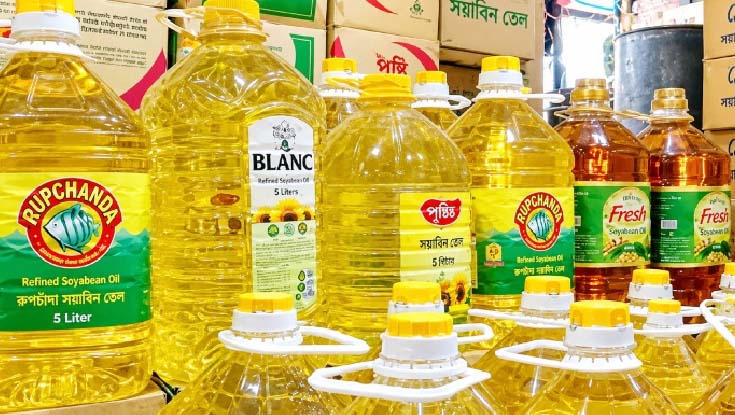
BanglaPress Desk: The price of soybean oil in the domestic market has reached a new record high. With an increase of three taka per litre, the price of bottled soybean oil has been set at 207 taka, while loose (unbottled) soybean oil is now priced at 188 taka. Previously, in 2022, the peak prices were 205 taka for bottled soybean oil and 185 taka for loose soybean oil; the new rates have surpassed those records.
At the beginning of this year, the price of bottled soybean oil was 195 taka per litre. It was raised by four taka to 199 taka on April 29, and by another five taka to 204 taka on September 2. With this latest increase of three taka, the price of bottled soybean oil has risen by a total of 12 taka per litre across three separate adjustments this year.
The government stated that the decision to raise prices was made after considering international market trends, import costs, and the supply situation. According to traders, the price adjustment is driven by rising booking costs for crude oil in the global market, the high value of the US dollar, and the need to ensure a steady supply ahead of the upcoming month of Ramadan. However, market analysts point out that while the 2022 price hikes were attributed to various global factors—such as the Russia-Ukraine war—traders have not provided equally compelling justifications for the current increase.
The new prices were determined on Thursday during a meeting at the Ministry of Commerce, which reviewed the overall supply situation of edible oils. Chaired by Commerce Minister Khandaker Abdul Muktadir, the meeting resulted in the price of bottled soybean oil being raised from 204 taka to 207 taka per litre, and loose soybean oil from 185 taka to 188 taka per litre. The price of loose palm oil, however, remains unchanged at 166 taka per litre.
Traders have cited conditions in the international market as the reason for the price hike. They claim that since the last price adjustment on September 2, the global market prices for both soybean and palm oil have increased. They argue that because domestic prices remained stagnant during this period, maintaining consistent imports and supply had become increasingly difficult. To ensure sufficient stocks and an uninterrupted supply during the upcoming month of Ramadan, it was necessary to recalibrate prices in alignment with import costs.
During the meeting, the Bangladesh Trade and Tariff Commission presented an overview of the country’s edible oil stocks, international and local market prices, the status of Letters of Credit (LCs), and the overall import situation. Following a review of this data, a decision to adjust prices was reached by consensus.
However, the implementation of these new prices has brought little relief to consumers. While bottled soybean oil is available at the mandated rates, loose (unbottled) oil is frequently being sold at prices exceeding those set by the government. In light of this, the Directorate of National Consumer Rights Protection and the district administrations have been directed to take legal action against the creation of artificial shortages, illegal hoarding, and overpricing. Furthermore, it has been decided to issue necessary directives to traders to ensure a stable market supply.
According to data from the Trading Corporation of Bangladesh (TCB), the price of loose soybean oil has risen by 10 percent, and bottled soybean oil by 7 percent, over the past year. During the same period, the price of loose palm oil also increased by 10 percent.
Data from the Bangladesh Trade and Tariff Commission indicates that 823,000 tonnes of edible oil were imported into the country between July 1 and October 25 of the current fiscal year—an increase of approximately 16.7 percent compared to the same period in the previous fiscal year.
The global supply of edible oil was severely disrupted following the onset of the Russia-Ukraine war in February 2022. The conflict hindered exports from Ukraine and Russia—both major exporters of sunflower oil—leading to market shortages. Concurrently, Indonesia temporarily halted palm oil exports to secure domestic supply. These factors drove up both the demand for and the price of soybean oil in the global market. Consequently, in 2022, edible oil prices in the domestic market reached record highs. Now, soybean oil has surpassed those previous records, climbing to a new peak.
[Bangla Press is a global platform for free thought. It provides impartial news, analysis, and commentary for independent-minded individuals. Our goal is to bring about positive change, which is more important today than ever before.]

 E-paper