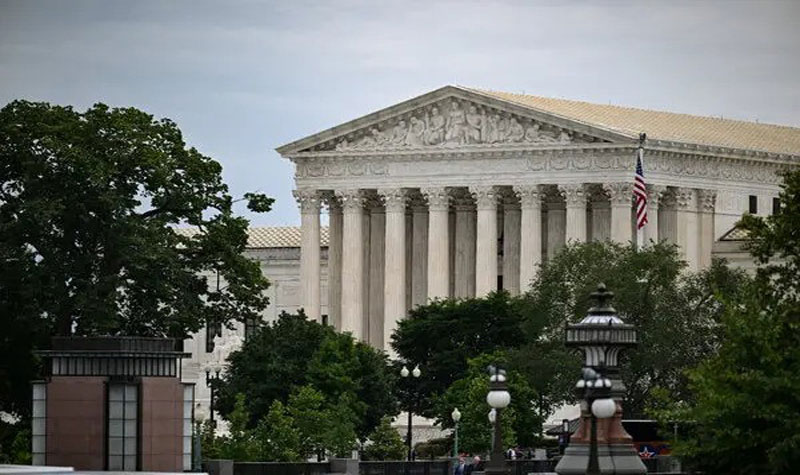
Abu Sabet: The Supreme Court on Tuesday cleared the way for Alabama Republicans to remove the state’s second majority-Black congressional district for the midterms, handing the party a pickup opportunity in an apparent 6-3 vote.
Alabama chastised a lower court for keeping its map blocked, insisting it should move ahead in the wake of the Supreme Court narrowing the Voting Rights Act.
The justices’ emergency order allows Republicans to do so over the objections of Black voters and other challengers, who contended the design should be halted for an independent reason and it was too late for the Supreme Court to intervene, anyways.
“While federal courts should not impose changes close to an election,” the justices wrote in their unsigned ruling, “States are free to decide for themselves whether last-minute changes to an election are in their best interests.”
The Supreme Court’s three liberal justices publicly dissented.
“Now the Court is squarely faced with a record of the turmoil it has caused and the harm it has wrought,” wrote Justice Sonia Sotomayor, joined by Justices Elena Kagan and Ketanji Brown Jackson.
“Yet just as Alabama doubled down on racial discrimination, the Court today doubles down on chaos. Because I choose to defend the rule of law and the right of all Alabamians to participate equally in democracy, I respectfully dissent.”
The Supreme Court’s decision has implications for control of the House majority as well as whether further litigation challenging majority-minority districts would remain successful.
Several of the groups that challenged Alabama Republicans’ map immediately slammed the ruling.
“The Court’s decision allowing Alabama to use a racially discriminatory map in its congressional elections this year cannot be squared with the Constitution or Voting Rights Act,” Davin Rosborough, deputy director of the ACLU’s Voting Rights Project, said in a statement.
“We remain committed to pursuing equal opportunities in Congress for our clients and Black Alabamians,” Rosborough said. “We will fight for those rights even in the face of those who continue to move the goalposts and undo our nation’s progress in realizing its promise as a multi-racial democracy.”
Kristen Clarke, general counsel for National Association for the Advancement of Colored People (NAACP), in her own statement accused the high court of continuing to unleash “chaos in our democratic process.”
“Our message to communities remains the same — the best way to express dissent is by showing up at the ballot box this election season,” Clarke said.
Alabama became ground zero for litigation over the Voting Rights Act and the extent to which race could be considered in redistricting. In 2023, the Supreme Court struck down the state’s congressional map that only included one majority-Black House district.
That decision paved the way for judges to take over the process, forcing the Yellowhammer State to create a second majority-Black seat currently held by Rep. Shomari Figures (D-Ala.) His 2nd Congressional District includes a southern swath of the state stretching East to West and includes Montgomery.
Alabama Republicans have looked to return to a design they proposed following the Supreme Court’s 2023 decision, which doesn’t outright create a second majority-Black seat. They say they can do so in the wake of the justices narrowing the Voting Rights Act this spring in a blockbuster case involving Louisiana.
Lower judges kept Alabama’s proposal blocked, however, by ruling it still intentionally discriminated against Black voters in violation of the Constitution. They ruled that was unaffected by the high court’s recent decision.
“Alabama, no different than Louisiana, may stick to its neutral political and policy goals. That’s not intentional racial discrimination,” Alabama Republicans wrote in their emergency plea to the justices.
But the Black voters and groups that have been challenging Alabama Republicans in court for years told the justices that it was too late, by the state’s own admission about deadlines for the upcoming elections.
“Because even Hercules himself could not complete the requisite task in that time, it is simply too late for Alabama to switch congressional map,” one group of challengers wrote.
The fight over Figures’s district is the difference between whether Democrats hold a congressional seat in the House or becomes another pickup opportunity for the GOP.
The fight for the House has been fierce — with both parties looking to pass new congressional lines in different states across the country — in an effort to cushion potential losses in the midterms, which have been shaping up to look akin to the anti-Trump 2018 midterms.
But the decision is also important because the Supreme Court’s decision also has implications for whether other states will face legal shield against restricting lawsuits over the consideration of the race in drawing new lines. A favorable Republican ruling would only further embolden other southern states to draw out majority-minority districts while a favorable ruling for Democrats could have underscored the restraints to which other states could apply the Supreme Court’s Louisiana redistricting case.
*Copyright 2026 Bangla Press. All rights reserved. This material may not be published, broadcast, rewritten or redistributed.
BP/SM
[Bangla Press is a global platform for free thought. It provides impartial news, analysis, and commentary for independent-minded individuals. Our goal is to bring about positive change, which is more important today than ever before.]

 E-paper