Bangla Press Desk: When the question of leadership, struggle, and sacrifice in the democratic history of Bangladesh arises, certain names are spontaneously uttered.
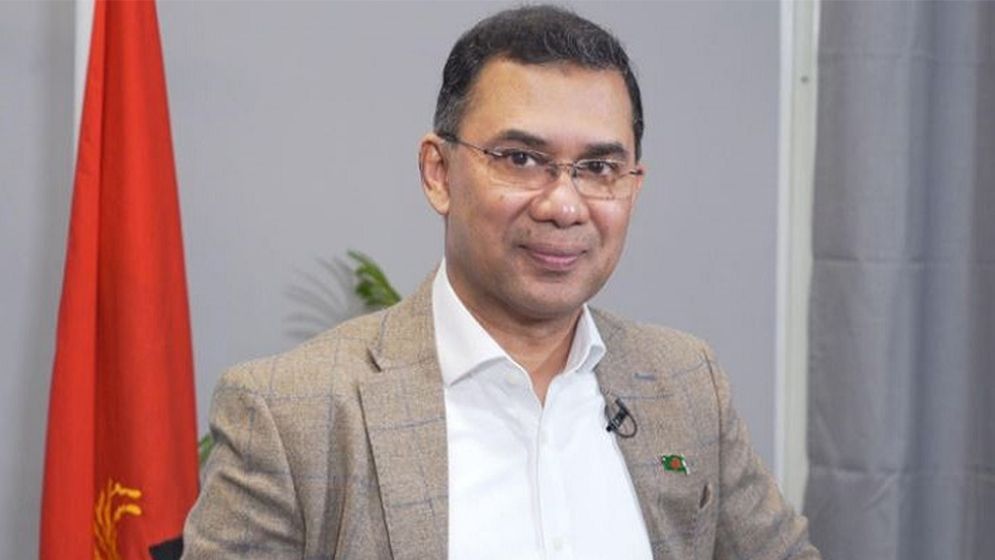
Tarique Rahman is one of those names. From becoming fatherless to enduring state repression, and through everything in his life, he stands today as a symbol of hope for millions of people.
In 1981, during the assassination of President Ziaur Rahman, the small, fatherless boy lost his father. It was then that he realized politics is not just about power; it is about serving the people, even risking one's life.
Although his mother, Begum Khaleda Zia, later became Prime Minister three times, the family could not remain free from the politics of revenge. This personal understanding made Tarique Rahman politically strong and resilient.
In the latter part of the 1980s, Tarique Rahman became actively involved in the student-youth movement against the autocratic Ershad regime.
Although he was not formally on the central stage of politics at the time, his role in inspiring and organizing the activists was noteworthy. Through this, his name emerged in the efforts to re-establish the democratic process.
In 1988, he began his political journey at the grassroots level as an ordinary member in the village of Gabtoli, Bogura, the home district. Tarique Rahman saw politics not merely as a competition for power, but as a part of the lives of ordinary people.
Inspired by his father's ideals, he walked miles after mile, traveling from one end of the country to the other. For the rural economy, the marginalized farmers, the hardworking laborers, the neglected youth, and women for whom politics is a struggle for economic emancipation and social dignity he became the symbol of grassroots and marginalized people's politics.
The BNP achieved a massive victory in the 2001 general elections. According to political analysts, Tarique Rahman's organizational competence and his role in engaging the youth were pivotal to this success. He activated the BNP in villages, brought new leadership forward, and employed modern campaign strategies. His role elevated the BNP to a new height.
Following the 1/11 incident in 2007, the caretaker government arrested him. Due to false cases, the inhumane prison environment, and physical torture, he nearly reached the brink of death. He was forced to leave the country for medical treatment.
Since then, he has been outside the country for nearly 17 years. Even in exile, he did not abandon politics; instead, he remained steadfast in his efforts to reorganize the party in a new way.
After the Awami League returned to power, widespread repression and oppression descended upon the BNP. Begum Khaleda Zia and Tarique Rahman were the main adversaries of the Awami camp.
There is virtually no conspiracy or slander be it personal, social, or political that they have not faced. Despite all this, Tarique Rahman managed the operations of the BNP from exile. In the 2018 election, with Khaled Zia incarcerated, the de facto leadership of the entire party rested on him.
In the 2024 mass uprising and the student-youth movement, he also emerged as the symbol of leadership.
The activists organized themselves by following his directives. Even without being physically present in the country, the movement was organized around his leadership and guidance. During this long period, he has proven that it is possible to keep a party united even from a life in exile.
Several important aspects clearly demonstrate the uniqueness of Tarique Rahman. Firstly, the long period of single-party rule and repression has created a vacuum in democratic leadership within the country.
In that vacuum, he has become the most acceptable name as an alternative leader to the people. Secondly, he carries a historical and prestigious political inheritance the legacy of Shaheed President Ziaur Rahman and Begum Khaleda Zia.
For this reason, the people see him not just as a political leader, but as a symbol of the family's continuous struggle. Thirdly, his life is full of struggle and sacrifice. He remained involved in politics despite ongoing false accusations, banishment, and persecution.
The people consider him a great hero because of his determination and selflessness. Fourthly, young people find inspiration in Tarique Rahman. His use of technology in organization, data-driven politics, and initiatives to create young leadership has set him apart from others. Finally, he has set a rare example even in exile.
For nearly two decades outside the country, he has kept the BNP united and filled the leadership void. All things considered, his political position is not just a matter of emotion, but his unique standing is also established by the realistic context.
Tarique Rahman's struggling life is a unique chapter in the democratic history of Bangladesh. He became fatherless, has been in exile, was tormented by false cases, but he has not been erased from the hearts of the people. Rather, he is today the symbol of hope for millions.
As Bangladesh moves towards a new horizon, the people await the day he will return to his own country to lead and fulfill the dream of Shaheed Zia and the fight for democracy. His struggling life is not just a story of the past, but a direction for the future.
BP/SP
[Bangla Press is a global platform for free thought. It provides impartial news, analysis, and commentary for independent-minded individuals. Our goal is to bring about positive change, which is more important today than ever before.]

 E-paper
-6ab3842955219.webp)