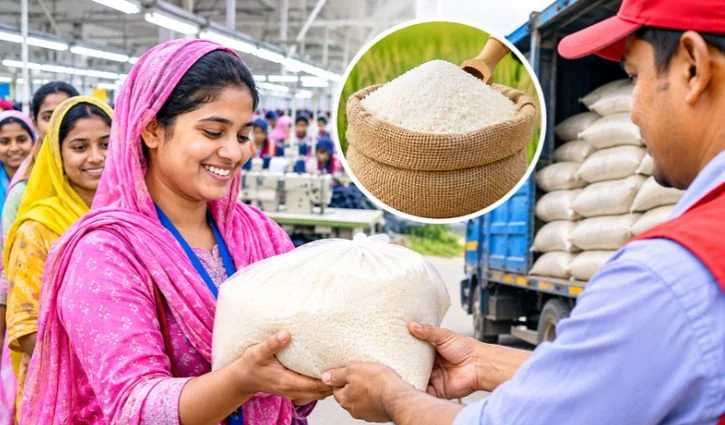
BanglaPress Desk: The government is set to launch a three-month Open Market Sale (OMS) program for garment workers, even before the finalization of a new wage structure. Under this initiative, each worker will be able to purchase 10 kg of rice per month at a price of 30 taka per kg. To implement this, the Ministry of Food has sent a letter to the Finance Secretary requesting an additional budget allocation from the relevant sector for the current 2026-27 fiscal year.
The Ministry of Food initially plans to roll out this special OMS initiative in the country’s primary garment industrial hubs, including Dhaka, Gazipur, Narayanganj, and Chittagong.
To ensure the successful execution of the program, the Ministry of Food has requested an additional allocation of 4,500 tonnes of rice, along with funding to cover operational costs such as truck deployment and transportation. The request was submitted to the Finance Division on November 11, seeking the necessary funds from the 2026-27 fiscal year budget.
According to the Ministry of Food, rice will be sold every Friday—the workers' weekly holiday—via 75 open trucks. With each truck carrying 5 metric tonnes, the plan is to sell a total of 375 metric tonnes of rice in a single day. In consultation with leading trade associations in the garment sector, factory owners will assist in monitoring to ensure that each worker purchases rice only once per month.
The government will bear the entire financial burden and operational costs of this social safety net program. Under the Ministry of Food’s standard OMS operational guidelines, the government provides a direct subsidy of approximately 18 to 19 taka per kg, covering the difference between the government’s procurement cost and the retail sale price.
For the 2026-27 Aman season, the government has decided to procure parboiled rice from millers at 49 taka per kg and non-parboiled (atap) rice at 48 taka per kg. Under the OMS program, rice is sold to the public at 30 taka per kg. Based on the government’s procurement price for parboiled rice, the direct cost difference for 4,500 tonnes of rice amounts to at least 8.55 crore taka. When additional expenses—such as transportation, warehousing, losses (wastage), and dealer commissions—are factored in, the total subsidy amount increases further. Subsidies to be Funded by Taxpayers’ Money
However, garment factory owners will not bear any portion of this subsidy. The government will provide this subsidy for workers using funds collected from taxpayers.
A senior official from the Ministry of Food, speaking on condition of anonymity, told TBS that this special Open Market Sale (OMS) program has been initiated in light of high inflation, labor unrest, and the overall economic situation. While the exact date for the commencement of rice distribution under this program has not yet been finalized, it is expected to be launched soon.
This government announcement follows a series of protests, road blockades, and acts of vandalism at factories by garment workers in major industrial hubs such as Savar, Ashulia, Mirpur, and Gazipur. With the costs of food, housing, transportation, and medical care having risen significantly—far outpacing the current minimum wage of 12,500 taka—garment workers are demanding a minimum wage of 30,000 taka.
Although data from the Bangladesh Bureau of Statistics (BBS) for October indicates that overall inflation has eased to 8.27 percent and food inflation to 6.40 percent, food prices in the retail market remain beyond the reach of many low-income households. By purchasing rice at the government-fixed price of 30 taka per kilogram—as opposed to current market rates—a worker could save between 20 and 35 taka per kilogram. Consequently, purchasing 10 kilograms of rice per month would result in savings of 200 to 350 taka.
The Need for Long-term, Permanent Solutions and Wage Structure Reform
Fahmida Khatun, a Distinguished Fellow at the private research organization Centre for Policy Dialogue (CPD), told TBS that the government’s initiative is both positive and timely. Prolonged high inflation has eroded the real income and purchasing power of workers. In such a climate, providing essential food items like rice at a subsidized price will help reduce the cost of living for workers and contribute to ensuring food security for their families. However, he emphasizes the necessity of ensuring efficiency and sound management in the implementation of this program. He stresses that it must be ensured that workers do not end up returning empty-handed after waiting in long queues for rice. Furthermore, he suggests expanding the program to include other essential food items—such as edible oil, lentils, and eggs—beyond just rice. This is particularly relevant given that the price of edible oil remains very high; meanwhile, the provision of lentils and eggs would help meet the nutritional (protein) requirements of the workers' families.
He notes that while the government may have taken this initiative in response to labor unrest and the broader prevailing situation, he views it as a positive step. It offers temporary relief to the workers and could also encourage them to return to their jobs, thereby helping to restore stability within the industry. This move also reflects the government's empathy toward the workers. Nevertheless, alongside this temporary food assistance, the government must ensure a fair wage structure to provide a long-term solution.
Mahmud Hasan Khan Babu, President of the Bangladesh Garment Manufacturers and Exporters Association (BGMEA), has commended the government's move. At the same time, he has called for the benefits of this special Open Market Sale (OMS) program to be extended to low-income, informal-sector workers outside the ready-made garment industry as well.
[Bangla Press is a global platform for free thought. It provides impartial news, analysis, and commentary for independent-minded individuals. Our goal is to bring about positive change, which is more important today than ever before.]

 E-paper