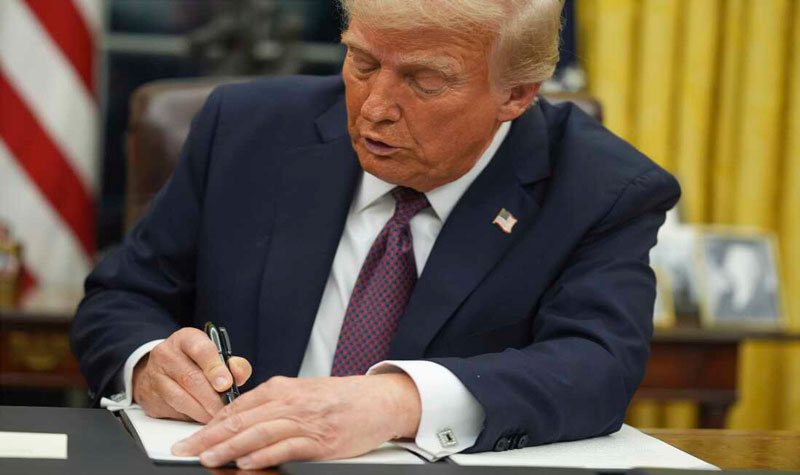
President Donald Trump signs new executive order
Abu Sabet: Repetitive sub-threshold cash withdrawals that line up with payroll cycles. Shell companies cycling money through real estate. Individual taxpayer ID numbers opening accounts without any verified legal status. These are among the specific red flags named in the executive order President Trump signed on May 19, 2026, titled “Restoring Integrity to America’s Financial System.” The order doesn’t freeze accounts immediately. What it does is set regulatory deadlines that will reshape how American banks screen customers over the next six to twelve months – and the financial crimes it targets have already cost hundreds of billions of dollars. Trump took to Truth Social on June 2, announcing the order as one of the administration’s most powerful tools yet against illegal immigration, cartel activity, and financial fraud. He stated that access to the nation’s financial systems “must be limited to those who have a Legal Right to be here,” and that bank accounts used to enable illegal immigration or hold welfare received by undocumented immigrants “will be shut down, and funds will ultimately face Impoundment and Seizure.”
The order is both narrower and broader than its headline suggests. It doesn’t immediately freeze anyone’s account. What it does is set off a chain of regulatory deadlines that will reshape how American banks screen customers over the next six to twelve months, and it uses the machinery of the Bank Secrecy Act, a 1970 law already requiring banks to report suspicious financial activity, as the mechanism. What the Trump Immigration Executive Order Actually Directs
The order directs Treasury Secretary Scott Bessent to issue guidance identifying suspicious financial patterns tied to payroll-tax evasion, labor trafficking, shell-company activity, off-the-books wage payments, and the use of Individual Taxpayer Identification Numbers to obtain financial services without verified legal presence.
Within 90 days, the Secretary of the Treasury must, in consultation with appropriate federal financial regulators, propose changes to Bank Secrecy Act regulations to strengthen risk-based customer due diligence requirements for covered financial institutions. Those changes should ensure that institutions collect and verify sufficient customer identity information to reasonably identify the nominal and beneficial owners of accounts.
Institutions should also maintain authority, where warranted by risk indicators or supervisory concerns, to obtain additional information, including information relevant to whether account holders possess lawful immigration status and employment authorization, as part of a risk-based due diligence program. A second, 180-day deadline requires Treasury and regulators to consider changes to customer identification program requirements, with specific attention to how foreign consular identification cards are used to open accounts.
Within 60 days, the Consumer Financial Protection Bureau is directed to consider clarifying that potential deportation and loss of wages are factors that could adversely affect a non-work authorized borrower’s ability to repay credit under existing ability-to-repay standards, and that lenders may consider such factors as part of a reasonable and good-faith underwriting determination. The order frames this directive in safety-and-soundness terms, noting that lending to individuals without legal work authorization or who face substantial loss-of-wage risk creates a structural “ability to repay” deficiency that undermines the safety and soundness of the national banking system.
*Copyright 2026 Bangla Press. All rights reserved. This material may not be published, broadcast, rewritten or redistributed.
BP/SM
[Bangla Press is a global platform for free thought. It provides impartial news, analysis, and commentary for independent-minded individuals. Our goal is to bring about positive change, which is more important today than ever before.]

 E-paper