
Bangla QR Delays Put Brakes on Cashless Payment Expansion

Bangla Press
Published: 02 August 2026, 03:57 AM
Bangla Press Desk: Bangladesh’s ambitious plan to build a cashless economy through the universal Bangla QR payment system is facing major implementation hurdles, with many merchants yet to adopt the platform despite its mandatory nationwide rollout on 1 July.
Although Bangladesh Bank (BB) has introduced a single interoperable QR code that allows customers to make payments through banks, mobile financial services (MFS) and payment service providers (PSPs), the system has yet to gain widespread acceptance among small and medium-sized businesses.
High transaction charges, a 1.15% merchant service fee, limited digital literacy, poor internet access, low merchant awareness and cumbersome onboarding procedures are slowing adoption, according to merchants, bankers and industry experts.
“I heard about it on TV. But no one has come to my shop with Bangla QR yet. Customers don’t even want to pay this way,” said Sajid Hossain, who runs a clothing store in Mirpur-10 in the capital.
His experience reflects the situation across much of the country, where many merchants remain unfamiliar with the unified QR system or continue using separate QR codes issued by individual banks or MFS providers.
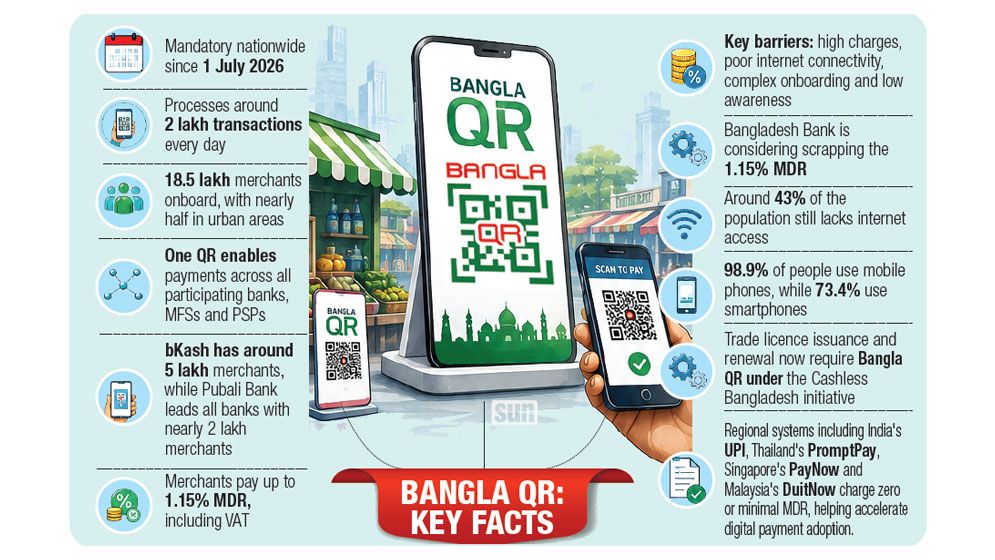
Despite these challenges, Bangladesh Bank says the platform is gradually gaining momentum. According to central bank officials, Bangla QR transactions have been rising steadily, with daily transactions now reaching around two lakh.
Bangladesh currently has about 18.5 lakh Bangla QR merchants, according to BB data. Around half are located in urban areas, while expansion in rural regions has been comparatively slow.
According to Bangladesh Bank and participating financial institutions, existing merchant QR codes have already been migrated to the Bangla QR platform.
These include around nine lakh QR codes issued by bKash, 4.5 lakh by Nagad, 2.7 lakh by Dutch-Bangla Bank (including Rocket), 1.9 lakh by Pubali Bank, 80,000 by Islami Bank Bangladesh PLC, 54,000 by Sonali Bank, 50,000 by Mutual Trust Bank and 38,000 by City Bank.
As a result, these QR codes are now fully interoperable, allowing customers to make payments through any participating bank, MFS or PSP application using a single Bangla QR code.
Among MFS providers, bKash has the largest Bangla QR merchant network with around five lakh merchants. Among banks, Pubali Bank leads with nearly two lakh merchants.
Bangladesh Bank Executive Director and spokesperson Arief Hossain Khan told the Daily Sun that the universal QR initiative has become a priority for both the government and the central bank.
“This is a massive undertaking. We are monitoring implementation regularly. We are collecting transaction data from MFS providers, reviewing the figures and asking them to increase both transactions and merchant participation. Meetings are being held almost every day,” he said.
He also said the central bank is considering withdrawing the existing 1% merchant service charge, acknowledging it as one of the main concerns raised by merchants.
“We are also working to bring people without internet access into this digital payment ecosystem,” he added.
High MDR discourages merchants
Despite strong policy support, the Merchant Discount Rate (MDR) remains one of the biggest concerns for businesses.
Bangladesh Bank has capped the MDR for Bangla QR transactions at 1.15%, including VAT, under the National Payment Switch Bangladesh (NPSB).
Previously, there was no minimum charge, while the maximum rate was also capped at 1.15%.
For many small businesses operating on thin profit margins, the fee discourages acceptance of digital payments.
Bangladesh Dokan Malik Samity President Helal Uddin said the charge directly reduces merchants’ earnings.
“If a merchant sells goods worth Tk1,000 through Bangla QR, he receives only Tk990. The amount may appear small, but why would a small trader willingly lose that money?” he said.
According to the association, Bangladesh has nearly one crore large, medium, small and micro business establishments, yet only a small fraction currently use QR-based payment systems.
Helal Uddin also criticised the implementation strategy, saying merchants were not adequately consulted before the mandatory rollout.
“They should have trained traders on how to receive payments, how settlements work, how long it takes to receive the money and what costs are involved. These issues should have been explained before making it mandatory,” he said.
Small business owners also complain that obtaining Bangla QR is more complicated than expected.
Although the QR platform itself is interoperable, many merchants say opening the required accounts is still not fully digital. Others lack the documentation required by financial institutions, making onboarding difficult.
Some traders say cash remains far more convenient than navigating paperwork and digital payment systems.
Awareness remains low
Visits to markets in Motijheel, Paltan and Mirpur-10 found that many traders are still unaware of Bangla QR or continue using separate QR codes issued by bKash, Nagad or individual banks.
Many merchants do not clearly understand that the interoperable system allows customers from different banks and MFS providers to make payments using a single QR code.
Motijheel street vendor Sujon Miah said digital payments could even slow business.
“I already struggle handling customers using cash. If I have to check my phone after every transaction, business will become slower,” he said.
Outside Dhaka, thousands of village shops, roadside vendors, market traders and informal businesses continue to rely almost entirely on cash.
Many still do not have bank accounts, while others remain unfamiliar with digital financial services.
Internet access remains a major obstacle
Experts say Bangladesh’s digital infrastructure is not yet ready for universal QR-based payments.
According to the latest Bangladesh Bureau of Statistics (BBS) data, 98.9% of the population uses mobile phones, but only 73.4% use smartphones.
More significantly, about 43% of the population remains without internet access.
Internet use remains particularly low in rural areas, chars, hilly regions, among low-income households, elderly citizens and marginalised communities.
Experts warn that making QR payments mandatory before ensuring reliable internet connectivity could widen the digital divide rather than strengthen financial inclusion.
Despite the slow adoption, bankers believe Bangla QR will eventually transform the country’s payment landscape.
Mutual Trust Bank Managing Director Syed Mahbubur Rahman said integrating banks and MFS providers under a single QR platform would simplify transactions for customers while reducing costs over time.
“In the future, QR-based payments will gradually replace card-based transactions. However, public awareness and technological infrastructure must be strengthened first,” he said.
Former Bank Asia President and Managing Director Arfan Ali described the initiative as timely, noting that countries such as India and Nepal have already made significant progress in digital payments.
However, he said Bangladesh must first strengthen internet connectivity and improve digital literacy, particularly in rural areas.
India’s Unified Payments Interface (UPI) charges zero MDR for most merchant transactions.
Thailand’s PromptPay, Singapore’s PayNow and Malaysia’s DuitNow QR also charge either no fee or only minimal fees for small merchants. Indonesia likewise maintains lower QR transaction costs than Bangladesh.
Bangladesh Bank launched Bangla QR as a pilot project in Motijheel on 18 January 2023. Following successful testing, interoperable transactions among banks, PSPs, payment system operators (PSOs) and MFS providers officially began on 1 November 2025, before the system became mandatory nationwide on 1 July 2026.
[Bangla Press is a global platform for free thought. It provides impartial news, analysis, and commentary for independent-minded individuals. Our goal is to bring about positive change, which is more important today than ever before.]
YOU MAY ALSO LIKE

Business
Government rolls out AVS for safer savings certificate transactions
5 days ago
by Bangla Press

Sangeet Academy