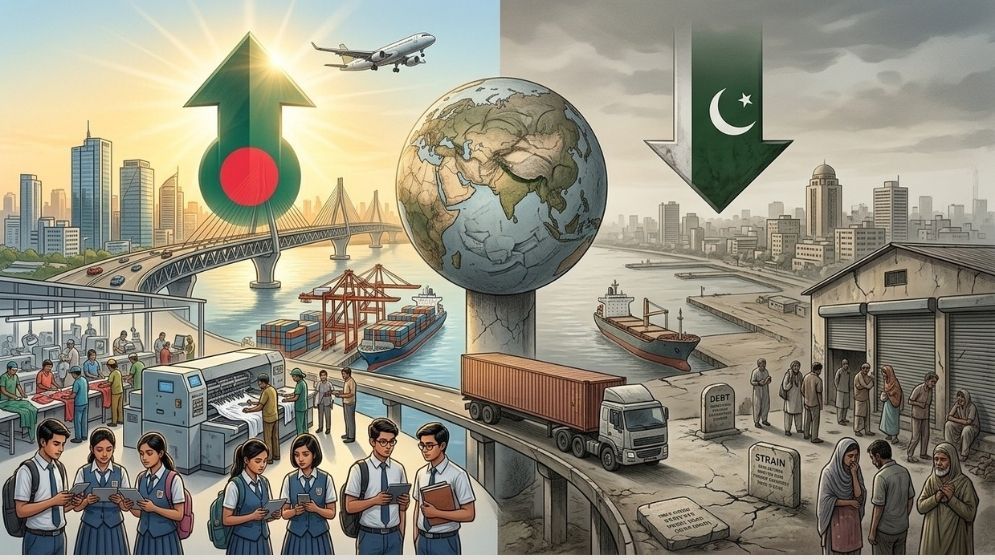
Bangla Press Desk: Bangladesh's economic journey since 1971 is perhaps the strongest rebuttal to the pessimism that once surrounded the new nation. Emerging from a devastating war, widespread poverty and the legacy of economic inequality under hegemony of Pakistan, Bangladesh chose to invest in its people, empower women, expand exports and build resilience. More than five decades later, the former East Pakistan has not merely survived independently; it has surpassed Pakistan on several important economic and social indicators. That achievement deserves recognition, but it also carries a warning: Bangladesh must not allow the pursuit of military or geopolitical strength to overshadow the economic foundations of national power.
That warning is particularly relevant in light of developments in Islamabad.Recently, Pakistan’s Senate Functional Committee on Devolution, chaired by Senator Zamir Hussain Ghumro, has called for the closure of around two dozen federal ministries and departments. Among the ministries identified are health, education, national food security, water resources, climate change, housing, planning and development, industries and petroleum. The committee argues that federal expenditure has risen to Rs19 trillion and should be reduced to Rs13 trillion, while many functions should be transferred fully to the provinces.
There is a legitimate argument for eliminating duplication following Pakistan's 18th Constitutional Amendment. But there is a crucial distinction between reducing federal bureaucracy and reducing a country's commitment to health, education and human development.
Indeed, Pakistan's own economic analysts make this distinction. In his Atlantic Council study Rescuing Pakistan's Economy, economist Aasim M Husain argues that "comprehensive structural reforms must go hand in hand with fiscal adjustment" and specifically says that the "quality and scale of social-sector expenditures" on health, education, population planning and income support must be strengthened.
That is the central lesson Bangladesh should take from Pakistan.
Pakistan's problem is not simply an oversised government. The World Bank says Pakistan's development has long been undermined by "policy and institutional weaknesses", with periods of rapid growth repeatedly followed by debt accumulation, trade imbalances and painful adjustments. Per-capita output has increased by only about 2.2% annually on average over the past two decades.
Husain's figures are even more sobering. Pakistan's interest payments have reached about 60% of government revenue, a level he describes as "clearly unsustainable". He argues that Pakistan needs broader tax mobilisation, federal-provincial fiscal reform, power-sector reform and stronger social-sector spending -- not simply austerity.
And then there is the question of priorities.
According to the Stockholm International Peace Research Institute, Pakistan's military expenditure increased 11% in 2025 to $11.9 billion, driven in part by new orders for aircraft and missiles.
Pakistan has genuine security concerns, and no responsible argument would suggest that national defence is unnecessary. But when a country faces crushing debt-service costs and weak public revenues, it is legitimate to ask whether national security is being defined too narrowly through military capability while economic security receives insufficient attention.
A missile may strengthen deterrence. A skilled engineer can strengthen an economy for generations. A soldier can defend a border; a healthy, educated and productive citizen can strengthen an entire nation.
Bangladesh's own history demonstrates this.
At independence, Bangladesh was among the world's poorest countries. Yet the World Bank records that GDP per capita rose more than twenty-fold, from $128 in 1971 to $2,742 in 2022. Primary-school enrolment reached 97 percent, gender parity was achieved in school enrolment, electricity access became universal and female labour-market participation increased substantially.
The transformation in human development is equally remarkable. The World Bank notes that average life expectancy rose from 46.5 years in 1972 to more than 70 today, while thousands of rural women entered the textile industry, helping make Bangladesh the world's second-largest ready-made-garment exporter.
These are not peripheral achievements. They are economic achievements.
The economic empowerment of women through the garment industry, investments in education and health, rural development, remittances and export-led manufacturing helped Bangladesh convert a vast population from a perceived burden into a productive asset.
This represents a profound departure from the economic experience of the Pakistan period.
Oxford economist Mohammad Niaz Asadullah, in his study Educational Disparity in East and West Pakistan, 1947–71, documents that the number of primary schools in East Pakistan actually declined during the period while West Pakistan surpassed it in both the number of schools and teacher-student ratios. His study examines discrimination as an explanation for this regional disparity.
The significance of 1971 was therefore not merely political. Independence gave Bengalis the opportunity to determine their own development priorities.
The results are visible today.
World Bank data show that in 2025 Bangladesh's GDP reached about $456 billion, compared with $407 billion for Pakistan. GDP per capita was approximately $2,597 in Bangladesh, against $1,596 in Pakistan.
This is not an argument for complacency. Bangladesh now faces serious challenges of its own: weak tax mobilisation, banking-sector vulnerabilities, inflation, inadequate investment, energy constraints and slowing growth. The country must also diversify beyond garments. The World Bank notes that RMG still accounts for 82 percent of exports.
But there is encouraging evidence that diversification can work. A World Bank-backed export competitiveness programme helped targeted non-RMG firms create nearly 180,000 jobs, far exceeding its original target of 60,000.
The lesson, therefore, is not that Bangladesh should reject fiscal discipline. It is that fiscal discipline must serve development rather than destroy its foundations.
Bangladesh should broaden its tax base, reform banks, eliminate waste, improve governance, make energy more efficient and demand greater accountability from public institutions. But savings should be channelled into better schools, healthcare, technical skills, climate resilience, infrastructure, technology and export diversification.
That is how economic strength becomes national security.
Pakistan's current predicament is a warning not because Pakistan lacks resources, talent or ambition, but because decades of instability, weak investment and difficult fiscal choices have repeatedly prevented those assets from becoming sustained prosperity. To be fair, Pakistan is now pursuing reforms. The World Bank's ten-year partnership framework recognises the need for fiscal, energy and business-environment reforms. The question is whether those reforms can be sustained and whether human development will remain central to them.
For Bangladesh, the choice should be clear.
The country that emerged from the ruins of 1971 and escaped the economic inequalities of the Pakistan period should not now mistake the symbols of power for the foundations of power.
A nation is not made secure merely by the weapons it possesses. It is made secure by the quality of its people, the competitiveness of its industries, the resilience of its infrastructure and the opportunities available to its young generation.
Bangladesh has already shown the world what is possible when development is placed at the centre of national purpose.
It should learn from Pakistan -- but it should not follow Pakistan.
The unfinished project of liberation is not merely sovereignty. It is prosperity. And the surest defence of that sovereignty is an economy strong enough to give every citizen a stake in the future.
[Bangla Press is a global platform for free thought. It provides impartial news, analysis, and commentary for independent-minded individuals. Our goal is to bring about positive change, which is more important today than ever before.]

 E-paper