Bangla Press Desk: The surplus in Bangladesh's trade in goods and services with the European Union rose by nearly 10 per cent in fiscal year 2024-25, underpinned by robust export growth, particularly in goods, despite rising outflows in services.
The development highlights both the strength of the country's export engine and its continued dependence on external markets.
However, economists caution that structural imbalances and looming changes to trade preferences could weigh on the sustainability of this surplus in the years ahead.
The EU has long remained Bangladesh's biggest export destination, while a large Bangladeshi diaspora living and doing business across the bloc also contributes to the surplus through remittances and related financial flows.
A current account surplus with a trading partner indicates that inflows exceed outflows, effectively making the country a net lender in bilateral transactions.
Bangladesh runs trade surpluses with only a handful of partners, such as the United Kingdom, the United States and the EU, while maintaining large deficits with countries including China, India and Indonesia.
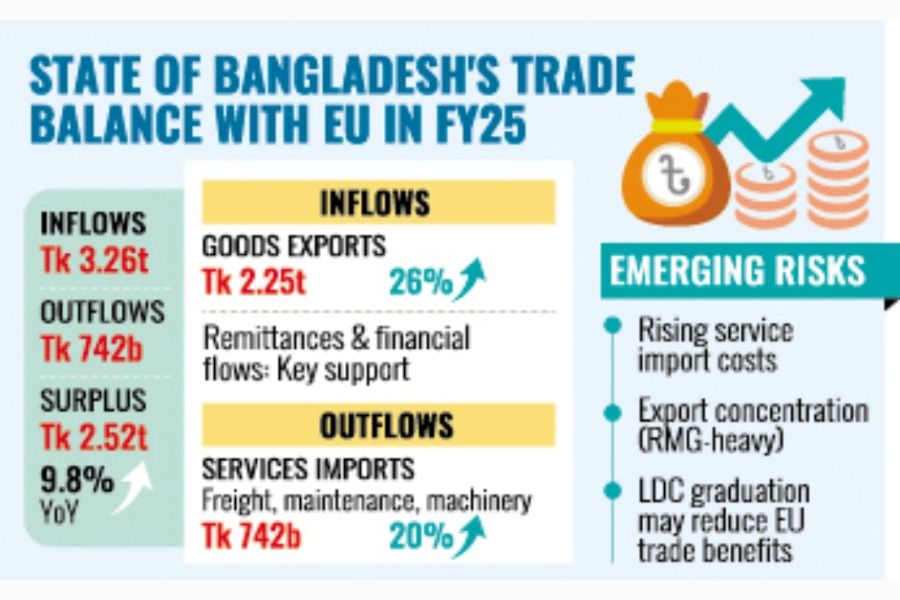
During the FY25, Bangladesh's current account surplus with the EU stood at Tk 2.52 trillion, marking a 9.8 per cent increase from a year earlier, according to data released by Bangladesh Bank last week.
Total inflows (credits) amounted to Tk 3.26 trillion, up nearly 12 per cent year-on-year. In contrast, outflows (debits) rose at a faster pace, increasing by nearly 20 per cent to Tk 742 billion.
Bangladesh typically incurs outflows on services such as freight, maintenance and repair of heavy equipment and machinery, which are largely sourced from abroad.
Goods exports to the EU, the main driver of the surplus, reached Tk 2.25 trillion during the period, registering a robust 26 per cent growth.
By contrast, the services account remained in deficit, although the gap narrowed sharply. Net services outflows stood at Tk 2.231 billion, down 92 per cent from the previous year.
The trade pattern underscores Bangladesh's structural reliance on goods exports to the EU, while continuing to depend on imported services from the bloc.
Economists say the surplus with the EU reflects the competitiveness of Bangladesh's export sector, particularly in ready-made garments, but caution that rising service-related outflows and concentration in a few markets pose medium-term risks.
They also note that as Bangladesh graduates from least developed country (LDC) status, it may lose some of its competitive edge in the EU market in the coming years, potentially leading to a contraction of the surplus.
[Bangla Press is a global platform for free thought. It provides impartial news, analysis, and commentary for independent-minded individuals. Our goal is to bring about positive change, which is more important today than ever before.]
 E-paper

.jpg)


.jpg)