
Escalating problems grip Dhaka

Bangla Press
Published: 20 January 2026, 01:10 AM
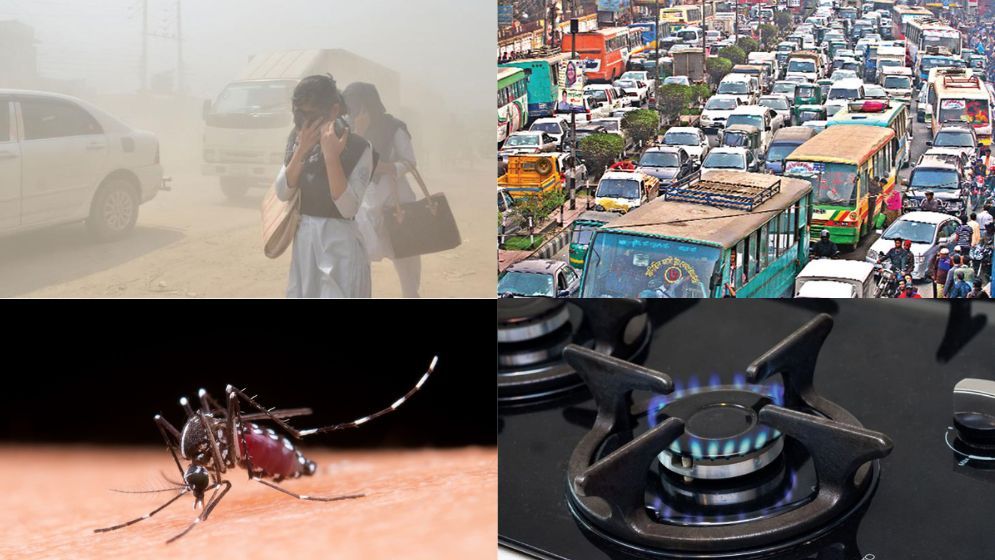
Bangla Press Desk: Dhaka’s name is appearing at the top of the list for air pollution almost every day. Noise pollution is making ears ring. Dirty, foul-smelling water often flows through WASA supply pipes. Germs from human waste are found floating in jar and bottled water. Due to frequent protests and a chaotic public transport system, city dwellers suffer from traffic congestion almost daily. Severe gas shortages mean kitchen stoves remain unlit throughout the day. On top of this, people are tormented day and night by mosquito bites. Caught in this web of five major challenges, the lives and livelihoods of the capital’s residents have become increasingly difficult.
City residents tormented by mosquitoes
City dwellers are being severely affected by the outbreak of Culex mosquitoes. Doors and windows are shut even before evening sets in, yet there is no escape from mosquito bites. When children sit down to study, mosquito bites leave marks on their hands, legs and faces, causing swelling and even blood spots. “We simply cannot get any relief from mosquito bites,” said Suraiya Alam, a resident of the capital’s Mohakhali area.
Entomologist Prof Kabirul Bashar of Jahangirnagar University said that data from the last week of December show that nearly 85 per cent of all adult mosquitoes collected in Dhaka belong to the Culex species. “This is not a statistical coincidence; rather, it reflects long-standing failures in urban management. Unplanned drainage systems, drains left uncleaned for years, and waterlogged basements and parking areas have collectively turned Dhaka into an ideal breeding ground for Culex mosquitoes,” he said.
Dhaka’s air pollution at an extreme level
Dhaka frequently ranks among the world’s most severely polluted cities in terms of air quality. Experts warn that if the situation continues, residents will face serious health risks, including an increase in skin diseases, lung cancer and respiratory problems. Professor Dr Atikur Rahman, a chest disease specialist at Bangladesh Medical University, said that air pollution directly damages the lungs. “It can cause serious illnesses such as bronchitis and asthma, as well as common conditions like colds, coughs and pneumonia. Over time, it weakens the lungs,” he said.
Water pollution
Dirty and foul-smelling water often comes out of WASA taps. Taiyab Ali, a resident of the Mogbazar area, said muddy water was frequently coming from the tap. “At first, I thought the water tank was dirty, but even after cleaning it, the problem continued. When I checked with neighbouring houses, I found they were facing the same issue. The problem was resolved only after everyone complained to the local WASA office,” he said.
Public concern has grown further as faecal contamination has been found even in jar water. Researchers from the Bangladesh Agricultural Research Council (BARC) found harmful levels of coliform bacteria—originating from human and animal waste—in 97 per cent of jar water supplied to homes, offices and courts in the capital. The study also revealed that bottled water from various companies failed to meet standards set by the Bangladesh Standards and Testing Institution (BSTI). As a result, cases of waterborne diseases such as diarrhoea, jaundice and typhoid are on the rise.
Chaotic public transport
Across the capital’s roads, buses continue reckless competition day and night, picking up passengers anywhere outside designated stops and forcing passengers to disembark from moving vehicles—longstanding practices that persist unchecked. Helpless commuters often end up becoming unwilling accomplices to this disorder.
In addition, residents are frequently stuck in traffic for hours due to protests in areas such as Shahbagh, Science Lab and the Press Club. Dhaka often comes to a standstill as roads are blocked at short notice. Transport expert Prof Dr Shamsul Hoque of the Department of Civil Engineering at Bangladesh University of Engineering and Technology (BUET) said an integrated development approach is needed to modernise and restore discipline in public transport. “Even though roads are not expanding, the number of vehicles is increasing every day, reducing average speed to just 6.4 kilometres per hour. Without widening roads, passenger capacity can be increased through double-decker buses. Science-based decisions are essential for road transport. No one has yet been able to bring the transport system under a single authority,” he said.
Severe gas shortage
Gas shortages have become a routine hardship in the capital. From 7am to 5pm, gas supply is virtually unavailable. Even when gas does come intermittently, the flame remains weak. As winter intensifies, so does the severity of the gas crisis, increasing public suffering and household expenses.
Sajia Akhtar, an official at a private university and a resident of Uttara Badda, said gas is unavailable from the morning and only comes slightly in the evening. “Yesterday, it took two hours just to cook chicken. Preparing three meals a day has become extremely difficult,” she said.
Rising theft and muggings
People are increasingly losing their lives after being attacked with sharp knives or blades by muggers. While police are working to prevent theft and muggings, maintaining law and order has become a major challenge.
On 20 December, a man named Ashish Joardar (33) was killed after being stabbed by muggers in Jatrabari. His mobile phone and cash were taken during the attack. Ashish, who was a garment trader, was returning home to Dhaka from Magura at around 2am when the incident occurred in front of the Jatrabari wholesale market.
Dhaka Metropolitan Police Deputy Commissioner (Media) Muhammad Talebur Rahman said that police remain alert at all times to suppress crimes such as theft and mugging. “Through regular preventive operations, we are addressing all challenges. If any incident occurs despite this, it is investigated with importance and those involved are brought under the law,” he said.
BP/TD
[Bangla Press is a global platform for free thought. It provides impartial news, analysis, and commentary for independent-minded individuals. Our goal is to bring about positive change, which is more important today than ever before.]
YOU MAY ALSO LIKE
.jpg)
.jpg)
Bangladesh
5 arrested in connection with the leaking of Youth Development exam questions
12 hours ago
by Bangla Press
.jpg)
Bangladesh
All flights from Dammam to Riyadh suspended until October 18
12 hours ago
by Bangla Press
Sangeet Academy