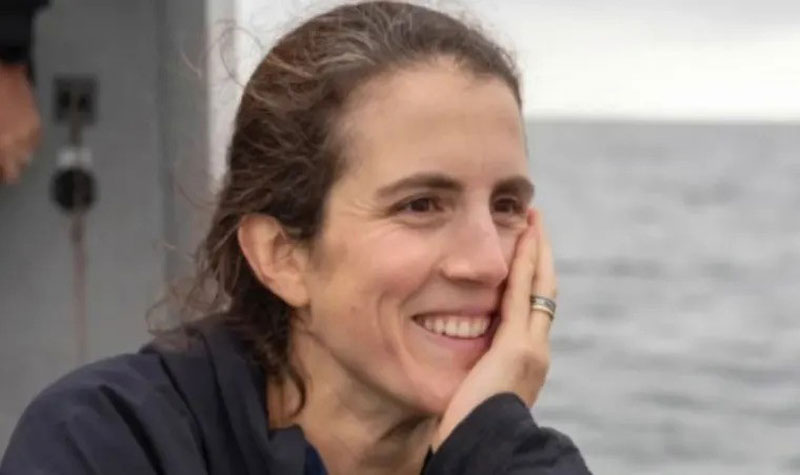
Minara Helen: Tatiana Schlossberg, an environmental journalist and granddaughter of former President John F. Kennedy, died Tuesday morning, a month after announcing her terminal cancer diagnosis. She was 35.
Her family announced her death in a post on social media, writing, “Our beautiful Tatiana passed away this morning. She will always be in our hearts.”
The post was signed by her husband, George Moran, and her children, along with her parents, Caroline Kennedy and Edwin Schlossberg, and her siblings. Her younger brother, Jack Schlossberg, is running for Congress in New York.
In a deeply emotional essay published in The New Yorker last month, Tatiana Schlossberg revealed she was diagnosed in May 2024 with acute myeloid leukemia, a rare mutation seen mostly in older patients. The piece was published on the anniversary of her grandfather’s assassination.
She said she was undergoing clinical trials, and her doctor said she could have up to a year to live.
“For my whole life, I have tried to be good, to be a good student and a good sister and a good daughter, and to protect my mother and never make her upset or angry. Now I have added a new tragedy to her life, to our family’s life, and there’s nothing I can do to stop it,” she continued.
Schlossberg also dedicated some of her essay to criticizing policies of her cousin, Health and Human Services Secretary Robert F. Kennedy Jr., noting he slashed billions in funding from the National Institutes of Health and nearly half a billion for research into mRNA vaccines that could be used to treat certain cancers.
“Hundreds of N.I.H. grants and clinical trials were cancelled, affecting thousands of patients. I worried about funding for leukemia and bone-marrow research at Memorial Sloan Kettering. I worried about the trials that were my only shot at remission,” she wrote.
She also criticized his vaccine skepticism, quoting him as saying, “there’s no vaccine that is safe and effective.”
“Bobby probably doesn’t remember the millions of people who were paralyzed or killed by polio before the vaccine was available,” she wrote, referring to her cousin. “My dad, who grew up in New York City in the nineteen-forties and fifties, does remember. Recently, I asked him what it was like when he got the vaccine. He said that it felt like freedom.”
She ended her essay reflecting on her time left with her family and loved ones.
“Mostly, I try to live and be with them now. But being in the present is harder than it sounds, so I let the memories come and go. So many of them are from my childhood that I feel as if I’m watching myself and my kids grow up at the same time,” she wrote.
“Sometimes I trick myself into thinking I’ll remember this forever, I’ll remember this when I’m dead. Obviously, I won’t. But since I don’t know what death is like and there’s no one to tell me what comes after it, I’ll keep pretending. I will keep trying to remember,” she added.
[Bangla Press is a global platform for free thought. It provides impartial news, analysis, and commentary for independent-minded individuals. Our goal is to bring about positive change, which is more important today than ever before.]
BP/SM
[Bangla Press is a global platform for free thought. It provides impartial news, analysis, and commentary for independent-minded individuals. Our goal is to bring about positive change, which is more important today than ever before.]

 E-paper