
Policy overhaul urged to accelerate growth of Bangladesh’s creative sector

Bangla Press
Published: 11 July 2026, 09:06 AM
Bangla Press Desk: Experts urged the government on Saturday to move beyond financial allocations and implement deep structural reforms, dedicated taxation frameworks, and strict copyright enforcement to transform Bangladesh’s creative sector into a genuine engine of economic growth.
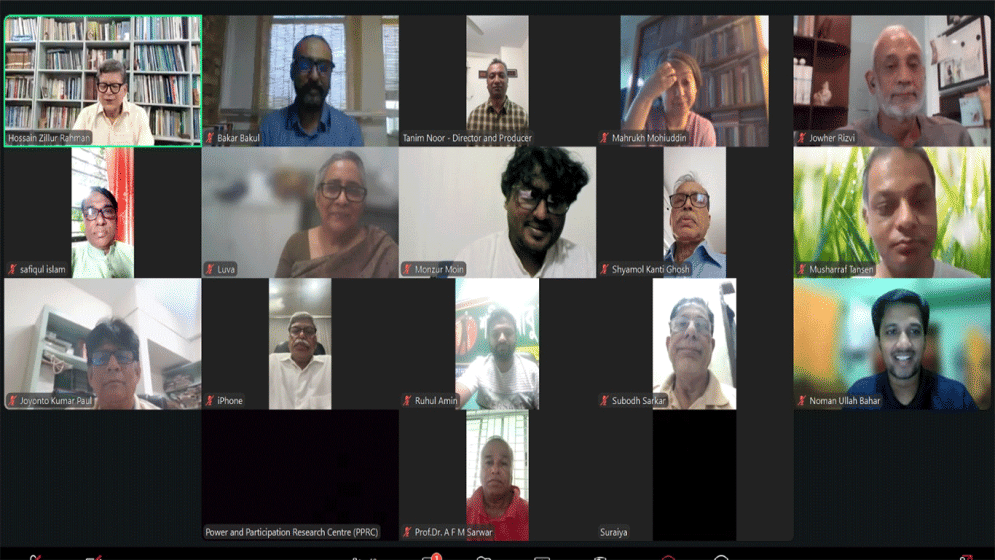
The recommendations came during a virtual panel discussion titled "Creative Economy: Slogan or Untapped Potential?" organised by the Power and Participation Research Centre (PPRC) as part of its Ajker Agenda series, said a press release.
The session was moderated by Dr Hossain Zillur Rahman, executive chairman of PPRC.
The discussion arrives at a milestone moment for the sector. For the first time, the national budget for FY2026–27 has introduced an Tk800 crore work plan for the creative economy–comprising a Tk300 crore direct allocation and Tk500 crore via Bangladesh Bank’s CSR fund.
The ambitious plan aims to boost GDP contribution, generate nearly five lakh jobs, and establish a global "Created in Bangladesh" brand spanning film, music, publishing, digital content, and design.
However, panelists highlighted that structural gaps and outdated regulations continue to hold the industry back.
Filmmaker and creative entrepreneur Tanim Noor argued that targeted tax incentives are essential to draw institutional investment. "Providing a 50% tax exemption for the film industry could significantly increase investment in Bangladeshi cinema, making the sector far more attractive to investors," he noted.
Redwan Rony, CEO of the domestic streaming platform Chorki, raised concerns over the current regulatory imbalance in the digital entertainment space. He pointed out that local Over-The-Top (OTT) platforms are heavily taxed under standard corporate structures, while global giants like Netflix and Amazon extract local revenue without facing equivalent tax obligations.
Rony urged the government to focus equally on infrastructure, licensing, and tailored digital tax policies to ensure fair competition.
The panel stressed the need to shift from cultural patronage to industrial strategy. Bakar Bakul, creative director of Tarua, criticised the long-standing tendency to view theater as a purely voluntary or political propaganda tool rather than a viable industry.
"As long as theatre depends primarily on unpaid work, it will remain difficult to build a professional, financially sustainable sector," Bakul warned.
In the literary sector, Mahrukh Mohiuddin, managing director of UPL, called for an immediate update to the National Book Policy and lamented the rampant print and digital piracy driven by weak copyright enforcement.
Meanwhile, Luva Nahid Choudhury, director general of the Bengal Foundation, emphasised that structural reforms must look beyond the spotlight to support and protect the massive, often ignored behind-the-scenes workforce.Looking at physical creative goods, Md Tauhid Bin Abdus Salam, managing director of Classical Handmade Products (CHP), shared his experience scaling Bangladeshi handicrafts globally. He stated that securing international quality certifications, strict compliance, and robust country-branding are non-negotiable for sustainable export growth.
Summing up the session, Zillur emphasised that a "one-dimensional infrastructure approach" would not suffice. He called for public-private partnerships to manage new infrastructure, alongside a total overhaul of copyright protection, royalty sharing, and sector-specific licensing.
Zillur concluded by urging industry stakeholders to form a "coalition of the willing" to independently draft a strategic roadmap, ensuring the government's Tk800 crore commitment translates into measurable, long-term economic returns.
[Bangla Press is a global platform for free thought. It provides impartial news, analysis, and commentary for independent-minded individuals. Our goal is to bring about positive change, which is more important today than ever before.]
YOU MAY ALSO LIKE




Business
Government rolls out AVS for safer savings certificate transactions
6 days ago
by Bangla Press
Sangeet Academy