
SAARC Reform Essential for Regional Economic Progress, Speakers Say

Bangla Press
Published: 06 July 2026, 09:04 AM
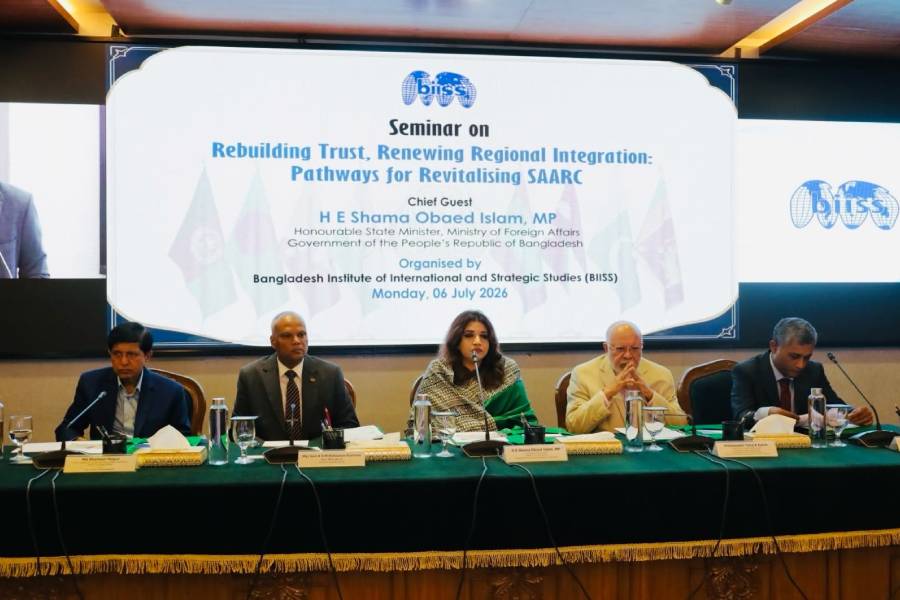
Bangla Press Desk: Speakers at a seminar on Monday called for revitalising the South Asian Association for Regional Cooperation (SAARC) through practical cooperation, institutional reforms, and renewed political commitment, saying a stronger SAARC Development Fund (SDF) could become a key driver of regional economic growth and development.
Speaking at a seminar on “Revitalising SAARC” organised by the Bangladesh Institute of International and Strategic Studies (BIISS), State Minister for Foreign Affairs Shama Obaid said South Asia remains one of the least integrated regions in the world despite its vast human, economic, cultural and strategic potential.
“The founding vision of SAARC remains as relevant today as ever. In fact, it has become more urgent,” she said, noting that while regional cooperation is gaining momentum globally, South Asia continues to lag because of political fragmentation and weak economic integration.
Acknowledging the challenges facing the regional organisation, Shama Obaid said the SAARC summit process has remained stalled for years due to political mistrust, unresolved bilateral disputes, cross-border tensions and competing security perceptions, particularly between India and Pakistan.
However, she stressed that the organisation remains institutionally relevant as its charter is still in force, the Secretariat continues to function, and its specialised bodies, legal instruments and technical networks remain operational.
She said revitalisation must begin with an honest assessment of these constraints while strengthening SAARC’s implementation capacity, financial resources and institutional mechanisms.
Placing trust at the centre of regional integration, the state minister said confidence can be rebuilt gradually through practical cooperation in areas such as public health, disaster management, climate adaptation, customs facilitation, education, research and cultural exchanges.
“Trust does not always begin with grand political declarations. It can grow through technical cooperation and regular interaction among professionals, students, researchers and entrepreneurs,” she observed.
Highlighting South Asia’s poor record in intra-regional trade, Shama Obaid said the South Asian Free Trade Area (SAFTA) has failed to create a dynamic regional market because of sensitive lists, non-tariff barriers, para-tariffs, weak logistics, customs delays and lack of standards harmonisation.
Instead of waiting for complete political consensus, she proposed revitalising SAARC “from below” through project-based cooperation, stronger regional institutions and people-centred initiatives.
As an initial step, Bangladesh wants SAARC to function at an “optimal functional level” until conditions become conducive for a full political revival.
Explaining the concept, she said it means maintaining regular technical meetings, a predictable calendar of activities, stronger specialised bodies and regional centres, continued cooperation in non-contentious sectors and visible benefits for the people of South Asia.
She also advocated flexible, project-based collaboration among willing member states, allowing countries ready to cooperate to move ahead while keeping participation open to others.
The state minister identified the SAARC Development Fund as a major instrument for accelerating regional development. She said the fund’s leadership, governance and operational capacity should be strengthened so that it can finance impactful projects in health, agriculture, climate adaptation, women-led enterprises, rural development and social development.
She reiterated that bilateral disputes must not be allowed to paralyse regional cooperation, recalling that the SAARC Charter explicitly excludes contentious bilateral issues from the organisation’s deliberations.
Commenting on Bangladesh’s diplomatic efforts, Shama Obaid revealed that over the past four months she had held separate discussions with representatives of all SAARC member states, all of whom expressed positive views about reviving the regional body.
“The intent now has to become actionable,” she said.
She also emphasised that SAARC and BIMSTEC should complement rather than compete with each other. While BIMSTEC connects South Asia with the Bay of Bengal and Southeast Asia, SAARC remains the only platform representing the broader South Asian identity, she said.
Describing SAARC as a diplomatic legacy of late President Ziaur Rahman, whose vision helped initiate regional cooperation in South Asia, she said the organisation remains closely aligned with Bangladesh’s “Bangladesh First” foreign policy by promoting connectivity, trade, food security, climate resilience and regional stability.
Looking ahead, the state minister said Bangladesh is considering a calibrated set of confidence-building initiatives, including consultations with SAARC member states, engagement with ambassadors and high commissioners in Dhaka, discussions with the SAARC Secretariat in Kathmandu on convening a Senior Officials’ Meeting, and the possibility of holding a special session of the Council of Ministers.
“SAARC is waiting for wise leadership, practical cooperation and renewed confidence. Bangladesh is ready to contribute to that confidence,” she said.
In his keynote paper m, Ambassador Tareq A Karim said though regional platform like EU, ASEAN is moving ahead, SAARC is stuck in mistrust despite having shared culture, history and ecological vulnerability.
He said a pragmatic issue-based cooperation is crucial to revitalise the SAARC.
Ecological security, river governance, connectivity and people-to-people exchanges are some of such areas for pragmatic cooperation, he noted.
He said the objectives such as welfare, economic growth, collective self-reliance, and deepening mutual trust among south asian countries, for which SAARC was launched, are still relevant.
In his welcome remarks, BIISS DG pointed out the fragile trade integration in the SAARC region and recommended a holistic approach to identifying the key constraints to strengthen the trade integration.
Diplomat Shamsul Alam and Professor Niloy Ranjan Biswas also spoke in the event.
[Bangla Press is a global platform for free thought. It provides impartial news, analysis, and commentary for independent-minded individuals. Our goal is to bring about positive change, which is more important today than ever before.]
YOU MAY ALSO LIKE

Bangladesh
Weather office reveals when winter will set in across the country.
3 hours ago
by Bangla Press
.jpg)
Bangladesh
100 flights on Dhaka-Saudi route cancelled or suspended; 15,000 passengers face hardship.
3 hours ago
by Bangla Press
.jpg)
Bangladesh
Prime Minister Seeks Citizens’ Cooperation to Tackle Dengue Risks in Video Message
4 hours ago
by Bangla Press
.jpg)
Bangladesh
Market Irregularities: 120 Establishments Fined Nearly Tk 10 Lakh Across 46 Districts
15 hours ago
by Bangla Press
Sangeet Academy