

The Unspoken Wounds Behind ‘To Whom It May Concern’

Bangla Press
Published: 24 May 2026, 10:53 AM
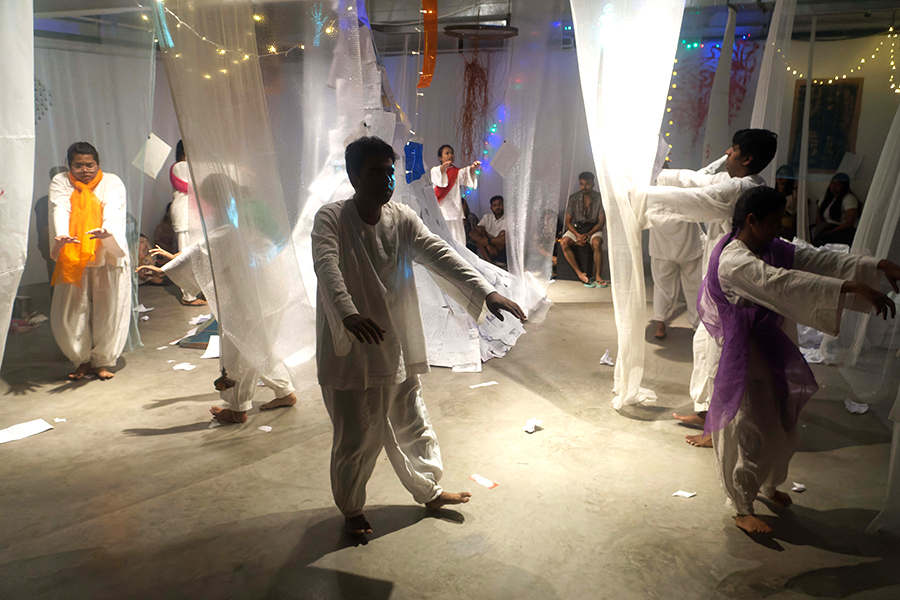
Bangla Press Desk: At SHALA_Neighbourhood Art Space, silence hangs from the ceiling in the form of letters. Some are folded. Some are suspended in layers of translucent fabric. Others appear as fragments through projection and sound. As spectators slowly enter the hall to watch the play, To Whom It May Concern, they do not sit before a conventional stage. Instead, they step into a psychological landscape – intimate, uneasy and hauntingly familiar.
Staged by Ninad, an independent artistic platform for theatrical practice, the 25-30 minute immersive theatrical production transforms anonymous testimonies of gender-based abuse and harassment into a shared artistic experience. Supported by the British Council under the WOW – Women of the World grant, the play is researched, scripted and directed by Prajna.
The work does not rely on dramatic spectacle. Its power lies in recognition.
Written based on anonymous stories of women, the play addresses the issue of how harassment subtly enters into daily life, whether in public transport, the workplace, domestic spheres, organisations, and cyberspace. Using oral monologues, broken dialogue, soundscapes, and vocal expression, the play exposes stories that society chooses to normalise and ignore.
Prajna, who studied psychology at University of Dhaka before dedicating herself fully to theatre, said the concept emerged from the painful ordinariness of such experiences.
“On the road, in public buses, in workplaces – these awkward incidents are often treated as normal,” she said during a conversation at the venue. “But the effects are not normal. The trauma remains for a lifetime.”
That understanding shapes every element of the production.

The performance space itself functions as an installation. Bubble wrap, translucent cloth, layered textures, paintings, shelves and suspended papers together create what Prajna describes as “an incident inside the mind.” The audience meanders around in this well-designed space before the performance starts. A 30-minute prelude with ambient music and text projections allows the audience to take in each element individually as if visiting someone else's memories.
“There is trauma, but there are also happy memories. Those memories, however, become layered because of the trauma,” Prajna explained.
The immersive format of the play deepens emotional proximity. Since the spectators are positioned inside a 360-degree stage with performers standing at times inches away, there is very little chance for dissociation. The actors do not simply tell stories; they enact the fear, uncertainty, anger and fatigue that come with years of unspoken suffering.
At certain points, male characters make their entrance into the scene not as villains, but as timid embodiments of societal unawareness. Their dialogues highlight the difference between women’s realities and societal understanding of them.
As opposed to creating a climactic end, To Whom It May Concern slowly shifts from isolation to acknowledgment.
Prajna insists the production does not seek to offer slogans or easy solutions.
“We don’t want to create a revolution or make a statement,” she said. “We simply want to create awareness – a kind of discomfort.”
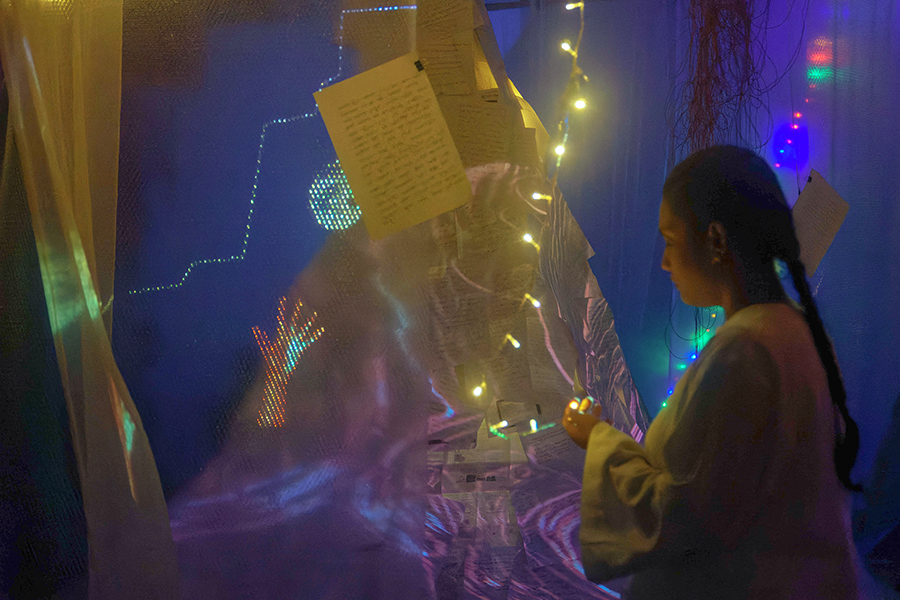
That discomfort is deliberate and, perhaps, necessary.
Audience members spend long periods inside the installation even after the performers leave. Once the formal performance ends, the space remains open for reflection.
According to Prajna, many audience members describe feeling unsettled after watching the show. Yet she sees that unease as a sign of success.
“They feel uncomfortable,” she said. “But they also feel this discomfort is important.”
The production’s emotional resonance lies precisely there – in confronting the quiet normalisation of gendered violence that often goes unquestioned in society.
For many spectators, the performance may trigger memories of incidents they once dismissed as trivial or unavoidable. A passing comment. An inappropriate joke. A touch in a crowded bus. A silence imposed within families or workplaces. This production highlights the way in which these occurrences build up in the psychological sense, leading to behaviour, fear, and self-perception even years after the events.
As one watches this play, one comes to understand just how often society is either blind or ignorant to these experiences. Very rarely do people stand by the victim who continues to live with her pain.
That recognition is the production’s greatest achievement.
Rather than accusing or preaching, To Whom It May Concern quietly unsettles the conscience. It asks difficult questions without demanding immediate answers. If these unsent letters were finally to reach someone, who would listen? And perhaps more urgently – why did no one listen before?
[Bangla Press is a global platform for free thought. It provides impartial news, analysis, and commentary for independent-minded individuals. Our goal is to bring about positive change, which is more important today than ever before.]
YOU MAY ALSO LIKE

Bangladesh
Weather office reveals when winter will set in across the country.
7 hours ago
by Bangla Press
.jpg)
Bangladesh
100 flights on Dhaka-Saudi route cancelled or suspended; 15,000 passengers face hardship.
7 hours ago
by Bangla Press
.jpg)
Bangladesh
Prime Minister Seeks Citizens’ Cooperation to Tackle Dengue Risks in Video Message
8 hours ago
by Bangla Press
.jpg)
Bangladesh
Market Irregularities: 120 Establishments Fined Nearly Tk 10 Lakh Across 46 Districts
19 hours ago
by Bangla Press
Sangeet Academy