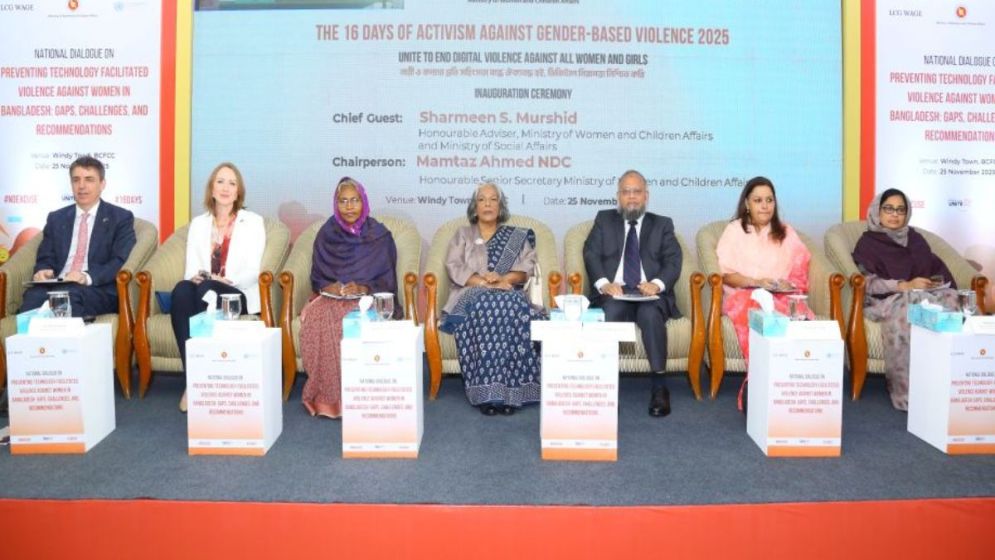
Bangla Press Desk: Bangladesh government and UN bodies on Tuesday launched the 2025 global 16 Days of Activism against Gender-Based Violence with a strong national call to “UNiTE to End Digital Violence Against All Women and Girls” at the Bangladesh China Friendship Conference Center in Dhaka.
The Ministry of Women and Children Affairs (MoWCA), the Local Consultative Group on Women’s Advancement and Gender Equality, and the United Nations jointly launched the event to address the urgent challenge of technology-facilitated violence, read a press release.
Speaking on the occasion, Women and Children Affairs Adviser Sharmeen S Murshid underscored the gravity of the issue, saying, “Before, a girl could not go out on the street without thinking of eve teasing; now you cannot enter your cyber space without being stalked. And the stalking world has become huge.
“It’s not just a boy from a neighbourhood—it’s anybody anywhere in the world who can hunt your dignity. Technology has to move its way, but it’s our own attitude that will determine its course. So the 16 Days of Activism is just a reminder and perhaps a concerted effort that we need to make every single day of our lives,” she added.
Mamtaz Ahmed, senior secretary of the ministry, emphasised the need for stronger laws, coordinated institutional responses, and public awareness, while international partners reiterated that digital violence is a global reality requiring united action.
According to World Bank data, fewer than 40% of countries have laws protecting women from cyber harassment or cyberstalking, leaving 44% of the world’s women and girls—1.8 billion—without legal protection.
From online harassment and cyberstalking to deepfakes and gendered disinformation, digital abuse is silencing voices and undermining women’s rights across borders.
Susan Ryle, high commissioner of Australia, called for united action across sectors to ensure technology becomes a tool for empowerment rather than harm. “It’s not just a women’s issue, it’s an issue for all of us. So let us stand together—governments, organizations, champions and women—to build a world where technology inspires, sport inspires, and partnerships deliver safety and equality for every woman and girl.”
Nicolas Weeks, ambassador of Sweden, stressed the importance of enforcement, “Proper implementation of existing laws is needed to enable access to justice for victims of gender-based violence. It also signals to perpetrators that these crimes will not go unpunished. The enactment of a Sexual Harassment Prevention and Protection Ordinance is crucial for ensuring the rights and freedoms of women, girls and boys.”
Gitanjali Singh, UN Women representative, highlighted the global scale of the problem, “Digital violence knows no borders. Worldwide, between 16% and 58% of women and girls face online violence or harassment. Online harassment and bullying frequently spill into offline spaces, silencing women’s voices and restricting their participation in public life.”
She said, “A different future is possible. If our ambition is for a peaceful, prosperous, and resilient Bangladesh, then there can be no higher priority for our support than women and girls. Together, we can create a future where women and girls are safe everywhere in Bangladesh. We owe it to women and girls.”
A high-level panel discussion followed the inauguration, titled “Preventing Technology-Facilitated Violence in Bangladesh: Gaps, Challenges and Recommendations.”
Moderated by Dilara Begum, joint secretary, MoWCA, the discussion featured experts from regulatory bodies, academia, government, and youth-led platforms, including Mahmud Hossain (Bangladesh Telecommunication Regulatory Commission), Nasima Akhtar Khatun (University Grants Commission), Ummey Sharaban Tahura (Law and Justice Division), and Labonno Binte Hafiz (Youth Policy Forum).
Panellists highlighted critical gaps such as insufficient evidence-based policymaking, weak enforcement mechanisms, limited digital literacy among women and girls, and the absence of a coordinated national framework for reporting and responding to online harms.
They emphasised that digital violence is deeply intertwined with social norms and power structures and requires integrated approaches across prevention, protection, and accountability.
In her closing remarks, UNFPA representative Catherine Breen Kamkong said, “Technology Facilitated GBV is real and it deserves the same serious attention as any other form of GBV. Recognizing it clearly as we have done here today is a very small step forward. We need a legal framework and guidelines to improve investigation. The prevention and response need to be survivor-centric.”
Throughout the programme, speakers reiterated that digital violence is not merely a technological issue but a human rights and development challenge that restricts women’s freedom, safety, and participation.
The event underscored the need for stronger laws, greater accountability from technology companies, survivor-centred support mechanisms, and expanded investment in digital literacy and norm change.
As Bangladesh marked the 30th anniversary of the Beijing Declaration and Platform for Action, the 2025 campaign called upon government institutions, the private sector, civil society, youth networks, and international partners to take concrete and coordinated measures to eliminate technology-facilitated violence.
BP/SP
[Bangla Press is a global platform for free thought. It provides impartial news, analysis, and commentary for independent-minded individuals. Our goal is to bring about positive change, which is more important today than ever before.]

 E-paper
.jpg)

.jpg)
.jpg)