
New BNP Government’s Foreign Policy
'Bangladesh’s Interests Will Come First,' Says Tarique Rahman

Bangla Press
Published: 14 February 2026, 11:12 AM
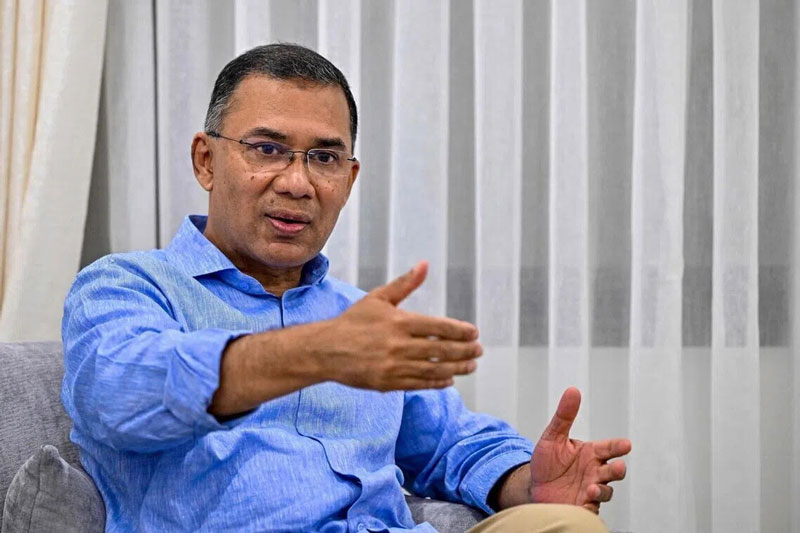
BNP Chairman Tarique Rahman
Staff Reporter: Tarique Rahman Saturday said his government’s foreign policy would be guided by national interest, asserting that Bangladesh would ‘keep the interest of Bangladesh first’ in its relations with India and other countries.
Addressing his first press conference after the landslide victory of the Bangladesh Nationalist Party (BNP) in the 13th Parliamentary Election, Rahman responded to a question on India–Bangladesh ties by stating, “Will keep the interest of Bangladesh first.” Elaborating on his position, he said, “We have cleared ourselves regarding the foreign policy, which is the interest of Bangladesh and the interest of the Bangladeshi people comes first. By protecting the interests of Bangladesh and the people of Bangladesh, we will decide our foreign policy.”
Prime Minister Narendra Modi was the first leader to call and greet Rahman Friday after it became clear that his centre-right party had secured a landslide two-thirds majority in elections to the Bangladesh parliament, one of the most-watched elections in South Asia in recent years.
Modi’s outreach assumes significance given the acrimony and strain in ties between Delhi and Dhaka after the dramatic August 2024 ouster of Prime Minister Sheikh Hasina, one of India’s closest partners in the neighbourhood. Her presence in India will frame a diplomatic challenge for two countries, apart from irritants that include water-sharing, border, connectivity and illegals.
Modi dialled Rahman even before the official results were announced by the Election Commission of Bangladesh.
Rahman hails election outcome as ‘democratic mandate’
The foreign policy remarks were part of a wider speech in which Rahman hailed the election outcome as a democratic mandate and outlined key challenges ahead, including restoring the economy, strengthening institutions and improving law and order.
“This victory belongs to Bangladesh. This victory belongs to democracy. This victory belongs to the people who aspire to and have sacrificed for democracy,” he said earlier during the press conference. With the BNP set to return to power after nearly two decades, attention will now turn to how Rahman’s stated principles translate into concrete policy, particularly in managing relations with India, Bangladesh’s largest neighbour and a key economic and strategic partner.
‘We must remain united’
“Our paths and opinions may differ, but in the interest of the country, we must remain united,” he said. “I firmly believe that national unity is a collective strength, while division is a weakness,” he added, linking unity to the responsibilities facing the country after the polls.
The appeal came after elections held on Thursday, the first national vote since the violent 2024 uprising that led to the removal of former prime minister Sheikh Hasina.
Figures released by the Election Commission showed the BNP-led alliance securing 212 seats, while the Jamaat-e-Islami-led bloc won 77. The Bangladesh Awami League, led by Sheikh Hasina, was barred from contesting.
Opening his speech by thanking supporters, Rahman said, “Freedom loving pro-democracy people of the country have once again brought victory to the Bangladesh Nationalist Party.”
“This victory belongs to Bangladesh, belongs to democracy, this victory belongs to people who aspired to and have sacrificed for democracy,” he added.
Challenges ahead
Even as he celebrated the sweeping mandate, Rahman cautioned that the incoming administration would inherit serious structural challenges.
“We have paved the way for the establishment of democracy in the country,” he said.
Highlighting the road ahead, he added, “We are about to begin our journey in a situation marked by a fragile economy left behind by an authoritarian regime, weakening constitutional and structural institutions and destroying law and order.”
Rahman’s return to power marks a significant political resurgence for the 60-year-old leader, who returned to Bangladesh in December after 17 years in exile in Britain and re-entered national politics at a critical juncture.
He is the son of former president Ziaur Rahman, who was assassinated in 1981, and former prime minister Khaleda Zia, a three-time officeholder and one of the most influential figures in the country’s political history.
*Copyright 2026 Bangla Press. All rights reserved. This material may not be published, broadcast, rewritten or redistributed.
BP/SM
[Bangla Press is a global platform for free thought. It provides impartial news, analysis, and commentary for independent-minded individuals. Our goal is to bring about positive change, which is more important today than ever before.]
YOU MAY ALSO LIKE
.jpg)
.jpg)
Bangladesh
5 arrested in connection with the leaking of Youth Development exam questions
10 hours ago
by Bangla Press
.jpg)
Bangladesh
All flights from Dammam to Riyadh suspended until October 18
10 hours ago
by Bangla Press
Sangeet Academy