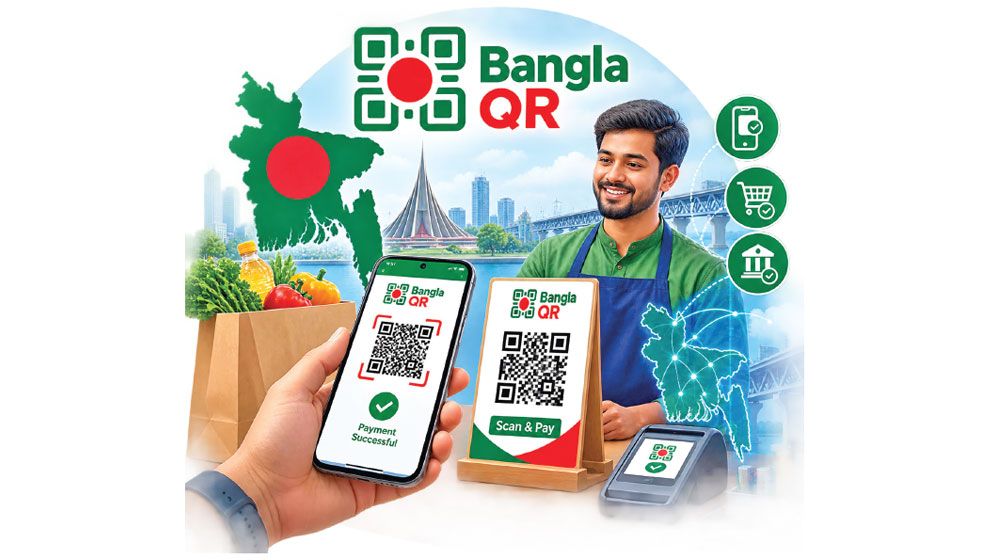
Bangla Press Desk: Bangladesh Bank (BB) has taken an initiative to introduce person-to-person (P2P) money transfers through the ‘Bangla QR’ system as part of efforts to reduce cash transactions and expand digital payments.
Banks, mobile financial service (MFS) providers, payment service providers (PSPs) and payment system operators (PSOs) have been instructed to add the necessary features to their respective apps by 31 October to facilitate the new service.
In a letter, the central bank asked the institutions to enable customers to generate a dedicated P2P QR code and scan or upload a P2P QR code received from another person.
The new service will officially come into operation on 1 November, 2026. All banks, MFS providers and PSPs will have to be ready to offer the service from that date.
Under the new system, every bank and MFS account will have its own ‘Personal Bangla QR’ code.
A person will be able to send money directly to another person’s bank or MFS account using the QR code, without having to enter a lengthy bank account number, routing number or 11-digit mobile number.
BB sources said customers will receive a personal Bangla QR through their respective banking or MFS apps.
To receive money, a beneficiary can simply display the QR code on a smartphone screen. The sender can scan it through their own app and complete the transfer.
A beneficiary who is elsewhere can also send a photograph or screenshot of the QR code. The sender will be able to upload the image from the app’s gallery and make the payment.
Once the QR is scanned or the image is uploaded, the recipient’s name and a shortened account number will automatically appear on the screen. The sender can then complete the transaction using a PIN.
Transactions will be settled through the National Payment Switch Bangladesh (NPSB), operated by Bangladesh Bank.
BB officials said the new system will reduce the risk of money being sent to the wrong account and help prevent fraud.
At present, a customer making a ‘send money’ transaction may mistakenly enter a wrong digit, resulting in money being transferred to another account.
Under the QR-based system, the recipient’s details will automatically appear after the code is scanned.
BB spokesperson Arief Hossain Khan said introducing P2P payments through Bangla QR would significantly increase online transactions.
“Customers currently face the risk of sending money to the wrong account if they make a mistake while entering a number. With a single QR code, that risk will no longer remain,” he said.
A customer will be able to transact through either a bank or an MFS provider using the same QR without complications, he added.
There will be no need to enter the recipient’s name or other information manually.
Discussions have also been held with different government agencies on whether Bangla QR can be used for payments in education, healthcare and National Board of Revenue (NBR) tax collection, the spokesperson said.
How P2P Bangla QR will work
Bangla QR has so far mainly been used for customer-to-merchant (C2M) payments.
For example, after purchasing a product from a shop, a customer scans the merchant’s Bangla QR using a banking or MFS app and pays the bill.
The new system will extend the same technology to person-to-person transfers.
The QR code can be displayed on a smartphone, printed on paper or kept on a laminated card. It can also be shared through social media.
The sender will not need to know which bank or MFS platform the recipient uses. Once the QR is scanned, the system will automatically determine where the money should be sent.
To prevent fraudsters from replacing QR codes or using fake QR codes to steal money, BB plans to incorporate public key infrastructure (PKI) technology and digital signatures into the system.
Public keys will be stored in a central trust store and verified in real time through the payment switch during every transaction.
The mechanism is expected to prevent fraudsters from altering QR codes or manipulating transaction information to divert funds.
Existing transaction charges to apply
The new P2P service will not have a separate fee structure. Existing charges for interoperable transactions through NPSB will apply.
At present, a bank-to-bank transfer costs Tk10 per transaction. Transfers from a bank to an MFS provider or another service carry a charge of 0.15%, while transfers from MFS to a bank or another service can carry a fee of up to 0.85%.
Transfers from a PSP to a bank, MFS provider or another service can carry a maximum charge of 0.20%.
The existing IBFT charge will apply to bank-to-bank transfers, while the previously prescribed rates will remain applicable to interoperable transactions involving banks, MFS providers and PSPs.
The new system could bring around 14 crore bank accounts and 24 crore MFS accounts under the Bangla QR framework.
As part of efforts to expand digital payments, Bangladesh Bank has abolished interchange reimbursement fees for Bangla QR-based transactions.
Financial institutions will not be allowed to charge fees or service charges to the card-issuing institution or the merchant’s payment-acquiring institution on this account.
The decision will come into effect on 1 October.
The central bank has also created a Tk100 crore incentive fund to encourage small merchants to adopt Bangla QR.
Bangla QR transactions jump 8.6-fold in six months
BB data show that Bangla QR transactions have grown rapidly in recent months.
In January 2026, 723,378 transactions were conducted through Bangla QR, with a total value of Tk212.05 crore.
By July, the number of transactions had risen to 62.5 lakh while their total value increased to Tk1,475.95 crore.
Thus, in six months, the number of Bangla QR transactions increased about 8.6 times, while their value rose nearly sevenfold.
The number of Bangla QR merchants has also increased sharply.
There were 13.5 lakh Bangla QR merchants in May 2026. The figure rose to 16.8 lakh in June and further to 24.2 lakh in July.
The number of merchants therefore increased by around 79% in just three months and by about 93% over the past 10 months.
[Bangla Press is a global platform for free thought. It provides impartial news, analysis, and commentary for independent-minded individuals. Our goal is to bring about positive change, which is more important today than ever before.]

 E-paper

.jpg)
.jpg)