

‘Bhashani wanted people’s freedom, not power for himself’

Bangla Press
Published: 23 December 2025, 09:38 AM
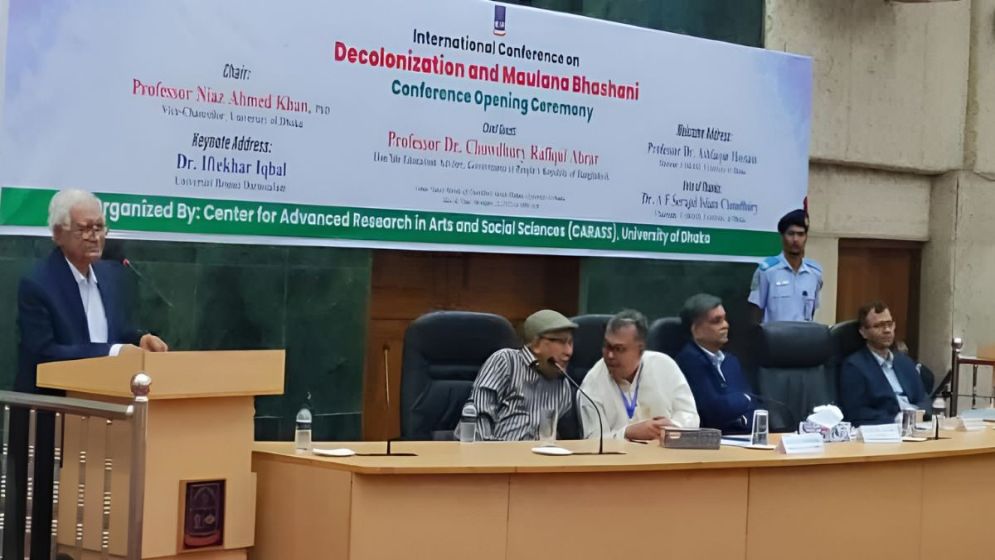
Bangla Press Desk: Dhaka University Professor Emeritus Serajul Islam Choudhury said on Tuesday that Maulana Abdul Hamid Khan Bhashani never engaged in politics to gain power, nor did he aspire to become a minister or an ambassador; instead, he stood with the hardworking people throughout his life and joined their struggle for liberation.
He made the remarks while delivering the concluding speech at the inaugural session of a two-day international conference titled “Decolonisation and Maulana Bhashani,” held at the Nabab Nawab Ali Chowdhury Senate Bhaban of Dhaka University.In his speech, Prof Serajul Islam Choudhury described Maulana Bhashani as a true anti-imperialist leader and said the idea of decolonisation had been deeply embedded in Bhashani’s political consciousness from the very beginning.
Although the subcontinent produced many renowned political leaders, Bhashani did not seek fame in the conventional sense, he said, adding that Bhashani was a unique and extraordinary political figure. There is no other example in the subcontinent of a leader who stood so firmly with the working people and practised politics in this way, he noted.
He also said Bhashani did not believe in private property as he upheld the socialist ideals.
Referring to his political journey, he said Bhashani initially joined the Congress but left the party due to the dominance of capitalist interests. He later joined the Muslim League, hoping it would represent farmers and the poor.
However, he said, Bhashani envisioned a democratic and liberating Pakistan, which was fundamentally different from the capitalist state imagined by Quaid-e-Azam. In Bhashani’s dream, equal rights and opportunities for multiple ethnicities and decentralisation of power would be ensured.
This vision was reflected in his 21-point, 14-point, and 11-point programmes, which prioritised issues directly affecting ordinary people, including rivers, water resources and flood management, he added.
Prof Chowdhury further said Bhashani regarded Pakistan as a prison for various ethnic groups and spoke for the liberation of not only Bengalis but also Punjabis, Sindhis, Baloch and Pathans. For this reason, he said, Bhashani should be evaluated as a social revolutionary.
Education Adviser Prof Chowdhury Rafiqul Abrar attended the programme as the chief guest, while Prof Ahmed Kamal spoke as a special guest. Associate Prof Dr Iftekhar Iqbal of Universiti Brunei Darussalam presented the keynote paper. Prof Dr Ashfaq Hossain, director of CARAS, delivered the welcome address.
Prof Abrar said Bhashani was not merely a political leader but a moral voice and conscience. He believed religion could serve as a source of moral strength, but civil rights, equality, justice and human dignity must remain the foundation of state governance.
This perspective distinguished Bhashani from other leaders of his time and remains highly relevant for contemporary Bangladesh, he said.
The adviser further said Bhashani understood that political freedom holds meaning only when it safeguards economic security, cultural dignity and self-respect. From this principled stance, Bhashani was able to quickly identify discrimination and injustice within the Pakistani regime.
Referring to Bhashani as a symbol of intellectual freedom, the adviser said that following his spirit, educational institutions should become spaces where debate is safe, dissent is possible and speaking the truth is encouraged, since an education system that fears questions can never build a just society.
Dr Iftekhar Iqbal said more research is needed to understand Bhashani’s political life and thoughts. A greater engagement with Bhashani’s writings and ideas would yield positive outcomes for society and politics. However, to do so, it is essential to collect the existing works on Bhashani and establish a dedicated research centre.
The conference is being organised by the Centre for Advanced Research in Arts and Social Sciences (CARASS) of Dhaka University.
Following the inaugural session, a special photography exhibition by renowned portrait photographer and writer Nasir Ali Mamun was held at noon. The conference later continued with the presentation of various research papers on Maulana Bhashani.
BP/SP
[Bangla Press is a global platform for free thought. It provides impartial news, analysis, and commentary for independent-minded individuals. Our goal is to bring about positive change, which is more important today than ever before.]
YOU MAY ALSO LIKE
.jpg)
.jpg)
Bangladesh
5 arrested in connection with the leaking of Youth Development exam questions
20 hours ago
by Bangla Press

.jpg)
Bangladesh
All flights from Dammam to Riyadh suspended until October 18
20 hours ago
by Bangla Press
Sangeet Academy