
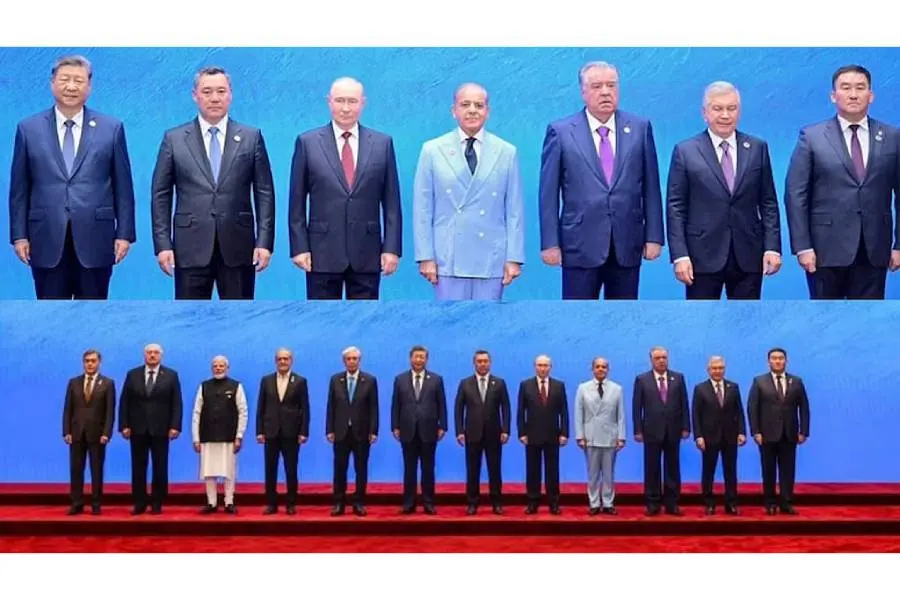
Global security concerns rise as New START Treaty nears expiry

Bangla Press
Published: 01 February 2026, 06:50 AM
-697f287c07505.jpg)
Bangla Press Desk: The United States and Russia are poised to embark on a new cycle of deploying additional long-range missiles and fitting them with nuclear warheads, barring any eleventh-hour deal before their last remaining arms control treaty expires in less than a week.
With the New START treaty set to end on 5 February, Russian President Vladimir Putin has proposed the two sides should stick to existing warhead limits for one more year to buy time to work out what comes next.
US President Donald Trump has not formally responded to Putin's offer. Some US politicians and security analysts argue he should reject it, freeing the United States to start growing its arsenal right away to counter a rapid nuclear build-up by China.
If the two sides cannot agree to maintain missile and warhead limits, they would be left for the first time in more than half a century without mutual constraints on the size of their strategic arsenals - the weapons they would use to strike each other's capitals, military bases and industrial centres in the event of a nuclear war.
Security analysts say the value of nuclear treaties goes way beyond the setting of numerical limits: they create a transparent and stable framework that prevents arms races from spiralling out of control.
In their absence, both sides are deprived of a critical channel of communication to "try to understand where the other side is coming from and what their concerns and drivers are", said Darya Dolzikova, a nuclear specialist at the RUSI think-tank in London.
“With the loss of New START now, and the absence of negotiation for some kind of replacement for New START, we continue this loss of communication between the two sides on these critical strategic issues,” she said.
The New START treaty caps the number of deployed strategic warheads at 1,550 on each side, with no more than 700 deployed ground- or submarine-launched missiles and bomber planes to deliver them.
Trump said this month that "if it expires, it expires", and that the treaty should be replaced with a better one.
But that would be a formidable and time-consuming task, as the situation now is vastly more complex than when New START was negotiated back in 2010.
Russia has developed new nuclear-capable systems - the Burevestnik cruise missile, the hypersonic Oreshnik and the Poseidon torpedo - that fall outside the framework of the old treaty. And Trump has announced plans for a space-based Golden Dome missile defence system that Moscow sees as a provocative attempt to shift the strategic balance in Washington's favour.
For the US, a key concern is China's growing arsenal. It now has an estimated 600 warheads, but the Pentagon estimates it will have more than 1,000 by 2030.
Trump says he wants to pursue "denuclearisation" with both Russia and China, but Beijing says it is unreasonable to expect it to join disarmament talks with two countries whose arsenals are far larger.
A bipartisan Congressional commission in 2023 said the United States was facing an "existential challenge" from not one but two nuclear peers and needed to be prepared for the scenario of simultaneous wars with Russia and China.
Its recommendations included preparing to upload some or all of the strategic nuclear warheads removed under the New START treaty and stored in a reserve stockpile.
“The Chinese have been very reluctant to engage in those conversations, but also the Russians are looking then at the British and French forces, nuclear forces,” said Dolzikova.
“There is no such thing as mutual nuclear deterrence between the Russian Federation and the People's Republic of China, said Prokhor Tebin, who is the Head of Center for Military-Economic Research at Higher School of Economics in Moscow.
“Of course, the Chinese nuclear potential is taken into consideration in Moscow because not intentions, but capabilities matter in international politics,” he said adding that “Russia and China are strategic partners who have no reasons to get into a state of mutual nuclear deterrence now or in the foreseeable future.”
Experts say that could involve restoring warheads that were removed from Minuteman III intercontinental ballistic missiles (ICBMs) and submarine-fired Trident D5s and returning to nuclear roles some 30 B-52 strategic bomber planes that had been converted to conventional missions.
They also agree that a new arms race is already going on. Tebin mentioned “hypersonic technologies" and "constant development of high-precision non-nuclear arms. So, in general, yes, technological and, in some areas, quantitative arms race, is ongoing," he said.
In policy circles in the United States, views are divided on whether Trump should agree to Putin's suggestion of keeping existing limits in place for a year.
Arms control advocates point out that the United States is during a nuclear force modernization program - including the construction of a new submarine, bomber and an ICBM – that is suffering serious delays and massive cost overruns.
The nonpartisan Congressional Budget Office estimates that it will cost US taxpayers nearly $1 trillion between 2025 and 2034 to modernize, sustain and operate the country’s nuclear forces.
On the other side of the debate, experts and former officials say the US shouldn't trust Putin, noting that he halted mutual inspections under New START in 2023 because of US support for Ukraine in its war with Russia.
US weapons requirements should increase, although "not radically, not monumentally," he said, in a process that would probably take several years.
Asked about Trump's intentions, a White House official said: "The president will decide the path forward on nuclear arms control, which he will clarify on his own timeline."
Dmitry Medvedev, who as Russian president signed the New START deal with Barack Obama in 2010, told the Kommersant newspaper that Trump was unpredictable.
"Russia is prepared for any development. New threats to our security will be promptly and firmly countered," he said.
BP/SP
[Bangla Press is a global platform for free thought. It provides impartial news, analysis, and commentary for independent-minded individuals. Our goal is to bring about positive change, which is more important today than ever before.]
YOU MAY ALSO LIKE
International
Meloni’s Government Sets Record as Italy’s Longest-Lasting
9 hours ago
by Bangla Press
.jpg)

Sangeet Academy