Bangla Press Desk: A recent incident of IELTS “question leak scam” has exposed shortcomings in the country’s laws related to the international or private exams as they are controlled and supervised by international entities that apparently go beyond the purview of the local laws.
On 6 September, acting on a tip off, the Banani police arrested two people – Md Mamun Khan, 37, and Poonam Halder Keya, 26, and detained one student – Nadit Hasan Rocky, 20, with Tk8.38 lakh from a hotel in the capital when they were collecting money from IELTS examinees for leaking question papers ahead of the exam.
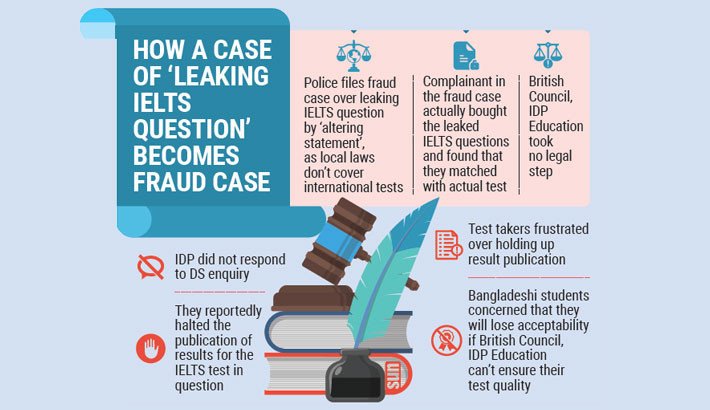
Over the incident of question paper leak, the law enforcers were supposed to file a case under the Public Examinations (Offences) Act-1980. However, when the police found that the law doesn’t cover international exams like IELTS, PTE, TOEFL, SAT, O Level, and A Level, they resorted to filing a fraud case under sections 406 and 420 of the penal code against Mamun and Keya. Nadit was made the complainant in the case.
In the case statement, Nadit said he along with some others paid Tk1.80 lakh to Tk3 lakh each for buying questions of IELTS test, but the leaked questions did not completely match with the questions that actually appeared on the test.
However, before filing the case he told the police that the leaked questions matched hundred percent with the actual test. The Daily Sun has a recording of his confession.
When asked about the case, Banani Police Station Officer-in-Charge Rasel Sarwar told the Daily Sun on 22 September that they had to change the narration of the case as the existing laws didn’t cover the criminal offence.
He said the police cannot file a case against anyone involved in leaking IELTS questions. They can do it only when it is a public examination. In case of IELTS, only IDP Education or British Council can file a case over leaking the question paper.
Where is the legal gap?
In Bangladesh, only leaking questions of public examinations like SSC, HSC, BCS and exams of different universities are considered as crimes under the existing laws.
In 2014, the Ministry of Education took an initiative to revise the Public Examination (Offences) Act-1980, but it was never done.
The Public Examinations (Offences) Act-1980 defined “public examinations” as any test that is conducted, organised, supervised or controlled by a university or an examining board or any other authority established under any Bangladeshi law.
According to section 4 of the act, if anyone leaks a question paper before the examination, the offender will be punished with up to four-year-imprisonment along with a fine.
But as per the law experts, this act is designed to regulate the conduct of public examinations in Bangladesh and outlines offenses related to malpractices in local exams.
Under this law, the term “board” typically refers to national educational boards that regulate and oversee public exams in Bangladesh. These boards established by the Ministry of Education should oversee the public exams.
However, the IELTS, PTE, SAT, TOEFL, O Level and A Level exams don’t fall under the public examination as the law defines it. This apparently barred the police from filing the case mentioning what really happened, and led them to file a case of fraud.
Regarding the matter, popular public interest petitioner Manzill Murshid said, “The Banani police had to file a case of breaching public trust as the existing law does not cover it. But the tragedy is that a student who gave bribes for acquiring leaked questions is also an offender along with the person who received the bribe for supplying the question.”
The case statement, which changed what really happened, weakened the litigation, he said.
Barrister Kazi Tamrin Rashed, a member of the Law Faculty at North South University, told the Daily Sun, “British Council and IDP are international institutions. We can’t take direct action regarding IELTS question leaks with our current laws. It’s their responsibility to bring the key actors to book. If they remain nonchalant about it, it will become a serious legal and credibility issue for Bangladesh.”
Students, too, are voicing frustration over the lack of accountability of such institutions.
Monnujan Khan, a law student at North South University, said, “If this continues, we will lose credibility globally. It is the responsibility of the IDP Education and the British Council to take proper action. Otherwise, very soon Bangladeshi students will start losing acceptability at foreign universities.”
When the Daily Sun asked what could be done regarding the legal barriers surrounding international examinations, a renowned senior advocate of the Supreme Court of Bangladesh, Zahirul Islam Khan Panna, said, “If any offence occurs, its remedy must be addressed under our existing laws and I believe it is still possible to take legal action in this case if we properly interpret the Public Examination (Offence) Act, 1980.”
Terming the IELTS question leak a “disgraceful and reprehensible act,” he said, “This is a grave injustice to thousands of students. Someone should file a Public Interest Litigation (PIL) to ensure accountability and justice.”
The British Council and IDP Education have not filed any case against anyone over the incident so far. Besides, it could not be known if they took any departmental actions after the question leak scam.
However, they reportedly halted the publication of the result for the IELTS test in question.
The Daily Sun on 23 September emailed IDP Education to know their reaction in this regard, but they shared nothing other than an automated email response which said that they would respond within two working days, which they didn’t till filing this report.
BP/SP
[Bangla Press is a global platform for free thought. It provides impartial news, analysis, and commentary for independent-minded individuals. Our goal is to bring about positive change, which is more important today than ever before.]

 E-paper

.jpg)
.jpg)
.jpg)
.jpg)