
Lynching of Hindu man in Bangladesh fans fears of rising intolerance

Bangla Press
Published: 22 December 2025, 11:45 PM
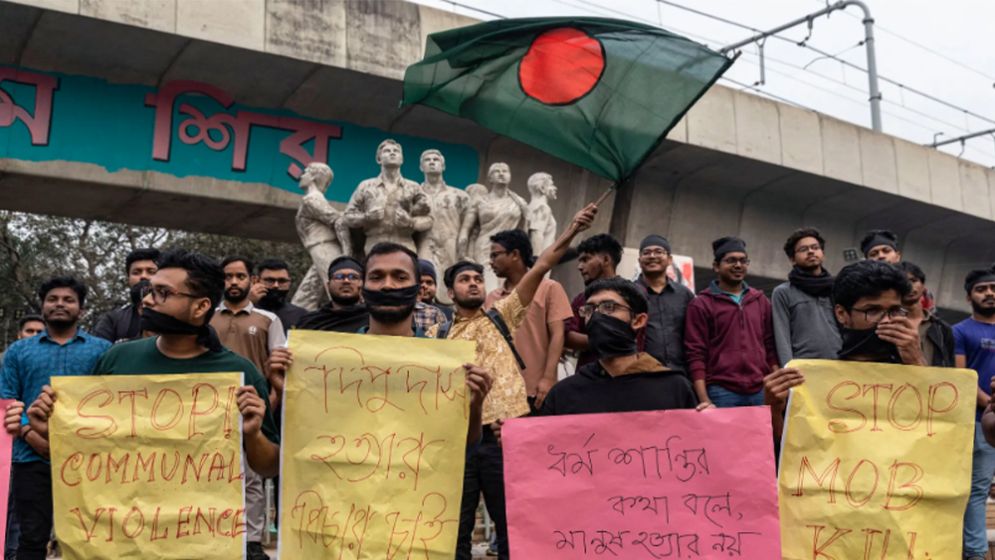
Bangla Press Desk: Dipu Chandra Das, 27, worked at a garment factory outside the capital city of Dhaka. His 12-hour shifts, for a monthly salary of $150, entailed checking pants and shirts sewn by thousands of workers in the huge factory for global high street brands.
But after Dipu, a Hindu, made a comment in a debate around the inspection table last Thursday, his co-workers accused him of blasphemy and dragged him out into the street. As rumors spread that Dipu had said something disparaging of Islam’s prophet Mohammed, an angry mob grew. They lynched him, tied his body to a tree and set it on fire.
By Monday, authorities in Bangladesh had arrested 12 people, including two of Dipu’s co-workers. The police said they have not been able to verify what Dipu had said to stir the mob.
But the brutal nature of the killing, amid a wave of riots and mob violence, has raised alarms about the tense leadership vacuum that has persisted in Bangladesh since its authoritarian prime minister was toppled in student-led protests last year.
Security forces have struggled to contain sporadic breakdowns of law and order. Human rights groups have expressed concern about the safety of religious minorities in the face of extremist forces that have long lurked in the country and are now openly exploiting the moment for political gain ahead of a general election scheduled for February.
The threats to Hindus in Bangladesh have drawn widespread concern in India, where Prime Minister Narendra Modi’s government has repeatedly voiced alarm. But they are the latest in a wider pattern of religious intolerance in the South Asia region.
In Pakistan, in the grip of a rising Islamist militancy, charges of blasphemy have frequently led to lynchings. In Afghanistan, what remained of a small Sikh and Hindu minority largely left the country after deadly attacks before the Taliban established their fundamentalist rule.
In India, Hindu vigilantes have targeted Muslims and other minorities, particularly over accusations of possessing beef (a large portion of Hindus revere cows as sacred). In the latest episode, a migrant laborer in India’s south was lynched last week by a mob that police said had mistaken him for being a Bangladeshi — a label India’s ruling Hindu nationalist politicians loosely use to describe Muslim migrants. The man, Ram Narayan Baghel, 31, was from the bottom ranks of India’s rigid caste hierarchy.
In the anarchy shortly after the fall of Sheikh Hasina, who fled to India last August, a series of killings and arson attacks were reported against religious minorities.
Bangladesh’s interim government, led by the 85-year-old Nobel laureate Muhammad Yunus, has condemned the violence as part of a larger security struggle and not as something targeted against any section of the population. But the religiously motivated murder of Dipuwas openly celebrated by many.
“You have brought joy to the hearts of the people,” Jubayer Ahmad Tasrif, who is planning to run in parliamentary elections, said in a video he posted on Facebook.
Naimul Hassan, a senior police official, said the factory manager and a floor supervisor were among those arrested. “Why didn’t they hand him over to the police, or why didn’t they take any measure to save him?” he said.
Selim Mia, a colleague of Dipu’s, told The New York Times that the deadly incident unfolded after a religious discussion in the closing hours of the Thursday shift escalated.
Mia said some of Dipu’s colleagues had commented that, ahead of the Muslim day of Friday prayer, it was the best opportunity to repent for the week’s mistakes. Dipuhad said the fixation on the day made it sound like a superstition. When his colleagues had confronted him about superstitions in his faith as well, he had said all faiths contain superstitions.
But Mia said a quarrel broke out where those around him accused Dipu of disrespecting Prophet Muhammad.
Opu Chandra Das, the victim’s brother, said his family received a call from a colleague at around 7 p.m. saying Dipuwas in trouble, and that the family should arrive quickly.
“But around 8 or 8:30 p.m. they called again to say my brother was no more,” he said.
He said Dipuwas a college graduate who had married three years ago and has a toddler daughter. He would visit his home in the village, about 40 miles away, once a month.
When Opu reached the crime scene late on Thursday night, his brother’s body was laid out in the street, bloodied and burned. Security forces tried to hold back the mob from desecrating it as they moved the body for a post-mortem the next day.
On Friday evening, Opu accompanied his brother’s corpse in the vehicle on a lonely journey back to their village, with a police escort following behind. They went straight to the village crematory for final rites, where just a handful of family members showed up out of fear they, too, could be targeted by violent attackers.
BP/SP
[Bangla Press is a global platform for free thought. It provides impartial news, analysis, and commentary for independent-minded individuals. Our goal is to bring about positive change, which is more important today than ever before.]
YOU MAY ALSO LIKE
.jpg)
.jpg)
Bangladesh
5 arrested in connection with the leaking of Youth Development exam questions
20 hours ago
by Bangla Press
.jpg)
Bangladesh
All flights from Dammam to Riyadh suspended until October 18
20 hours ago
by Bangla Press
Sangeet Academy