Bangla Press Desk: Pakistan’s cotton story has moved from decline to dependence.
What was once a crop that anchored rural incomes, fed the textile chain and supported export earnings is now increasingly being replaced by imported lint, with the latest buying rush underscoring how deep the collapse has become.
A crop now bought from abroad
The most striking sign of distress is the scale and timing of imports. Pakistan has ordered 206,000 bales from the United States, almost the entire quantity sold there in that week, while imports from Brazil are also rising sharply ahead of the domestic harvest.
That is not a normal seasonal adjustment; it is evidence that the country’s cotton supply chain is now structurally tied to foreign markets.
This shift carries a hard economic cost. Cotton imports could run into billions of dollars, adding pressure to a foreign exchange position already weakened by chronic dollar shortages and recurring balance-of-payments stress.
In a country that once produced enough cotton to meet the needs of its textile industry, the dependence now speaks to a long-running policy failure rather than a short-term crop shortfall.
Output falls, imports rise
Pakistan’s cotton decline has been visible for years, but the latest season has made the pattern more severe.
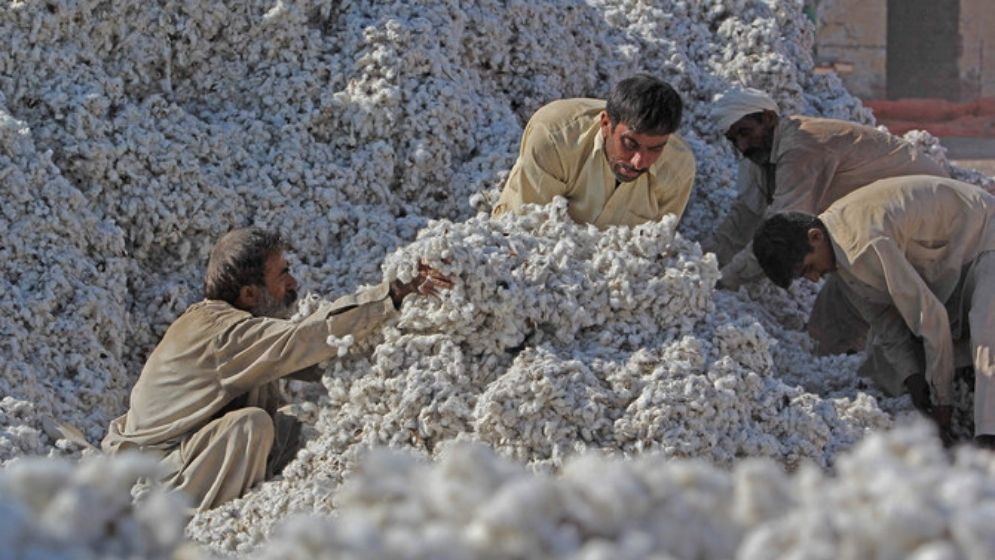
Production has fallen sharply from earlier levels, with recent reports placing output at around 5 million bales, far below the volumes that once made Pakistan a major cotton producer.
The decline has not only reduced domestic availability; it has also pushed mills into the import market earlier and more aggressively.
The problem is not limited to acreage alone. Reports on the sector point to shrinking cultivation area, weak seed quality, climate stress, pest pressure and a drift towards other crops such as sugarcane, maize and rice.
As the cotton area contracts, mills lose domestic supply, imports increase, and the foreign exchange burden rises — a cycle that now defines the sector.
Policy contradiction in plain sight
The crisis has sharpened the contradiction between official rhetoric and market reality. Governments continue to speak of agricultural revival and export-led growth, yet cotton policy has not delivered the conditions needed to sustain production.
The result is a sector that is expected to underpin textile exports while being allowed to weaken at every stage of the chain.
Industry reporting has repeatedly pointed to structural failures: poor seed regulation, uneven institutional support, weak extension services and inconsistent pricing signals.
Farmers face rising input costs, while textile manufacturers complain of shortages and import dependence. The policy architecture appears to have encouraged short-term fixes rather than a serious rebuild of the crop base.
Mills under pressure
The strain extends well beyond farms. Pakistan’s textile industry, the country’s largest export earner, depends heavily on cotton, and the shortage of local lint feeds directly into higher import bills and tighter margins.
When domestic supply weakens, the industry must either pay more for foreign cotton or cut back production, both of which feed into wider external stress.
This pressure has already shaped demands from across the value chain.
Producers have pressed for tax relief, lower energy tariffs and reduced levies, arguing that the sector cannot absorb the cost of import dependence and weak domestic output at the same time.
But these calls, while urgent, sit within a larger crisis: the system is no longer generating enough cotton to support the industry on its own.
A familiar set of causes
The reasons behind the collapse are now well documented. Recent analyses point to climate change, erratic rainfall, heat stress, pest outbreaks, obsolete agronomic practices and the spread of low-quality or uncertified seed.
Farmers have also shifted away from cotton because other crops often offer lower risk and, in some cases, better returns.
The structural weaknesses do not stop there. Weak pest management, poor advisory support and fragmented coordination between institutions have made recovery difficult.
Even where cotton output shows signs of partial rebound, the gains remain fragile and far below levels needed to restore self-sufficiency. The overall picture is of a crop under repeated attack from weather, economics and governance failures at once.
Foreign exchange and external shock
The economic implications are immediate. Cotton imports drain dollars at a time when Pakistan is already under pressure to stabilise reserves and manage external account vulnerability.
Every additional purchase abroad makes the country more exposed to exchange-rate swings, import costs and supply shocks in global markets.
That dependence also weakens the logic of export-led growth.
A textile sector that relies on imported raw cotton becomes more vulnerable to global price changes and shipping disruptions, while the benefits that should have remained inside Pakistan’s rural economy are instead transferred abroad.
In practical terms, the country is paying more to buy what it once produced competitively at home.
The wider industrial drift
Recent reporting shows that the cotton crisis is now part of a broader industrial and agricultural drift.
A Dawn analysis in late May warned that structural barriers were hindering revival plans, even as the state set ambitious targets for the next season.
Other recent accounts describe Pakistan’s cotton sector as moving toward a historic low, with acreage and output both under pressure and import reliance growing in parallel.
The consequence is a narrowed industrial base. If cotton remains weak, textile production becomes more exposed, export stability becomes harder to sustain, and the balance-of-payments strain intensifies.
The country’s “white gold” has not vanished overnight, but it has become a crop whose decline now shapes multiple parts of the economy at once.
A crisis without pause
What makes the present moment especially severe is the timing. Pakistan is buying large quantities of cotton before the local harvest has even arrived, which signals not recovery but structural dependency.
That dependence is already affecting reserves, industry planning and rural confidence, while the domestic crop continues to face weak policy support and unstable growing conditions.
The latest developments show a sector caught between legacy importance and present decay.
Cotton still matters to Pakistan’s export system, yet the country is increasingly importing what it used to grow itself. That reversal now stands as one of the clearest signs of policy rot in the agricultural economy.
[Bangla Press is a global platform for free thought. It provides impartial news, analysis, and commentary for independent-minded individuals. Our goal is to bring about positive change, which is more important today than ever before.]

 E-paper

.jpg)

.jpg)