
Exclusive Interview
Making FOBANA Vision 2040 a Reality Is Now My Day-and-Night Dream

Bangla Press
Published: 12 August 2026, 11:34 PM
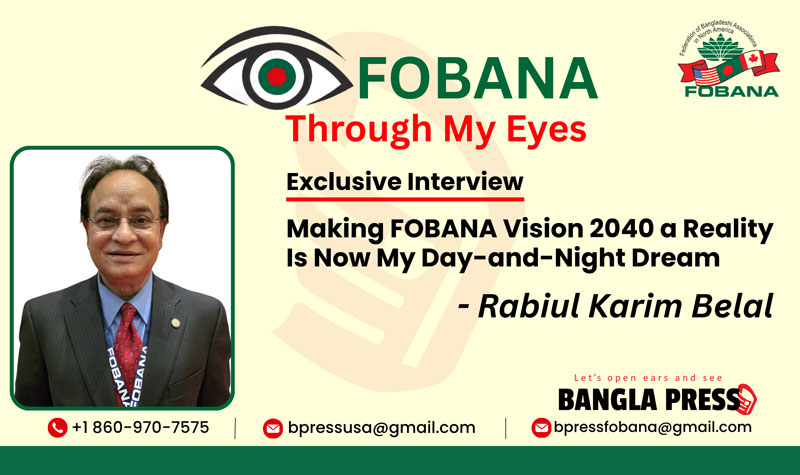
FOBANA Executive Committee Chairperson Rabiul Karim Belal
FOBANA Executive Committee Chairperson Rabiul Karim Belal speaks with Bangla Press in an exclusive interview conducted by Bangla Press Editor Chhabed Sathee.
Bangla Press: You introduced 'Vision 2020' in 2010. What was its primary objective?
Rabiul Karim Belal: It was essentially a roadmap for FOBANA’s long-term development. During my first tenure as Chairperson in 2009–2010, I introduced Vision 2020. Although it was not fully implemented, the vision and many of its ideas have remained part of FOBANA’s aspirations to this day.
My vision was that a day would come when the FOBANA Foundation would have millions of dollars in resources dedicated to philanthropic and humanitarian initiatives, earning recognition and respect around the world. I also envisioned five regional FOBANA conventions being held across the United States, with participation and representation from governments of different countries.
The process is somewhat like conducting a blood test or medical diagnosis. If we can accurately identify FOBANA’s problems and challenges, many possible paths toward solutions will become clearer. I have already outlined some potential solutions in a video message, and I hope future leaders will build upon these ideas and make even greater progress.
Vision 2020 was primarily conceived as a blueprint for transforming FOBANA into a stronger, more modern, accountable, and future-oriented organization. It included plans for organizational reform, a permanent institutional structure, the development of young leadership, technology-driven management, and broader participation by Bangladeshis across North America.
Perhaps, at the time, we were thinking a little ahead of our time.
Bangla Press: Why, then, was that plan not implemented?
Rabiul Karim Belal: To be candid, the biggest obstacle was a lack of coordination. No matter how strong a strategic plan may be, it is difficult to succeed in a large organization unless everyone works toward the same objective.
I do not regard Vision 2020 as a failure. Rather, I consider it an important learning experience. The lessons we gained from that period are helping me develop a more practical and realistic strategy today.
That is why I am now committed to making the implementation of Vision 2040 a priority as we continue ‘Paving the Pathway of Excellence.’
Bangla Press: You are now Chairperson of the FOBANA Executive Committee. Why introduce ‘Vision 2040’ at this stage?
Rabiul Karim Belal: Because I believe every organization needs a long-term vision. Vision 2040 is not the plan of any one individual; it is a roadmap for future generations.
Our goal is for FOBANA to become, by 2040, the most widely accepted, representative, and unified platform for Bangladeshis throughout North America.
Recently, I prepared an approximately eight-minute video presentation on Vision 2040 to explain why we need to measure FOBANA’s progress. Again, I compare the process to a medical diagnosis or a patient undergoing a blood test. Before determining what treatment is needed, you first have to understand the patient’s condition. In the same way, FOBANA must assess where it currently stands before deciding how to move forward.
There is a fundamental principle: if you cannot measure where you are, you cannot properly understand your current position. If you do not know your current position, you cannot determine what needs to change. And without meaningful change, improvement—and ultimately achieving your goals—becomes impossible.
We therefore need to make adjustments and improvements whenever necessary. To do that effectively, we must have appropriate tools and systems in place to measure progress at every milestone.
Vision 2040 should provide a clearly defined roadmap identifying what can and should be accomplished during 2027–2030, what needs to be achieved during 2030–2035, and what additional objectives should be pursued during 2035–2040.
Leaders will change, but the strategy should not change simply because leadership changes. The strategy should continue while adapting, when necessary, to the needs and realities of the time.
Under Vision 2020, I proposed three fundamental areas of focus: strengthening the Constitution, establishing effective Operating Procedures, and creating expert-led subcommittees to carry out specialized responsibilities.
Vision 2040 takes that concept much further. It is a long-term strategic approach that begins with organizational diagnosis and evaluation. Based on those findings, we must provide appropriate training, tools, resources, and support, while maintaining a goal-oriented approach designed to achieve clearly defined objectives.
Ultimately, the goal is to help transform FOBANA from simply a nonprofit organization into a strong and sustainable institution. We want to strengthen every pillar of FOBANA and establish a comprehensive institutional structure capable of serving the Bangladeshi community for generations to come.
Bangla Press: What are the key priorities of Vision 2040?
Rabiul Karim Belal: First, organizational unity. Second, developing the next generation of leaders. Third, building a transparent, technology-driven administrative system. In addition, we want to give a stronger institutional framework to cultural activities, education, business networking, professional engagement, and community service. We envision a FOBANA where everyone feels represented and has a sense of belonging.
Bangla Press: How are you moving forward with the implementation of Vision 2040?
Rabiul Karim Belal: I have already begun a series of discussions with FOBANA’s current and former leaders, Standing Committees, various member organizations, and prominent members of the community. I believe the best decisions emerge through meaningful dialogue. Therefore, Vision 2040 is not an individual initiative; it will be a collective plan shaped by everyone’s participation.
In this regard, I would like to emphasize three guiding principles: gain knowledge and experience from the past; celebrate the present through our achievements; and approach the future with innovation, visionary leadership, and a clearly defined roadmap.
Bangla Press: As FOBANA marks 40 years, what do you consider its greatest challenge?
Rabiul Karim Belal: The greatest challenge is maintaining unity while engaging the next generation. The world has changed, and so have people’s perspectives and expectations. FOBANA must therefore evolve with the times. The organization will remain strong and relevant only when the younger generation sees it as an organization of their own.
Bangla Press: How do you view the 40th FOBANA Convention?
Rabiul Karim Belal: This is more than just a convention; it is a celebration of FOBANA’s four decades of achievements. The leaders of the Bangladesh Association of California (BAC), the organizing committee, and more than a hundred volunteers have been working tirelessly for the past year. Their dedication is truly commendable. I believe the Los Angeles convention will become a memorable chapter in FOBANA’s history.
Bangla Press: How important is the role of the Bangladeshi diaspora in implementing Vision 2040?
Rabiul Karim Belal: It is extremely important. An organization cannot function through its Executive Committee alone. Its strength comes from the collective participation of member organizations, volunteers, the younger generation, cultural activists, professionals, and the broader community. I want everyone to become a partner in this vision and share ownership of this dream.
Bangla Press: On a personal level, what is your greatest dream?
Rabiul Karim Belal: My greatest dream is that one day FOBANA will truly become an organization that every Bangladeshi in North America can call their own. I envision an institution where differences of opinion exist, but division does not; where leaders may change, but the mission remains unchanged. To be candid, making Vision 2040 a reality is now my day-and-night dream.
Bangla Press: What message would you like to share with Bangladeshis across North America?
Rabiul Karim Belal: We may live in different cities, work in different professions, and hold different opinions, but we share one identity—we are Bangladeshis. Let us break down the walls of division and build bridges of unity.
Let us work together to transform FOBANA into a stronger, more modern, inclusive, and future-ready institution for generations to come. I firmly believe that if we remain united, Vision 2040 will not remain merely a dream—it will become a reality.
Bangla Press: I would like to ask a personal question. Where is your hometown in Bangladesh, and could you tell us a little about your family?
Rabiul Karim Belal: My hometown is Bogura. I have one son and two granddaughters. I currently live in Philadelphia, Pennsylvania, with my wife, Shirin Akter. Our son, Mobashwir Karim Akash, lives in New Jersey with his wife, Nadia Karim, and their two daughters.
Bangla Press: Thank you very much for taking the time to speak with Bangla Press despite your extremely busy schedule surrounding the celebration of FOBANA’s four decades of achievements in Los Angeles.
Rabiul Karim Belal: Thank you very much as well.
*Copyright 2026 Bangla Press. All rights reserved. This material may not be published, broadcast, rewritten or redistributed.
BP/SM
[Bangla Press is a global platform for free thought. It provides impartial news, analysis, and commentary for independent-minded individuals. Our goal is to bring about positive change, which is more important today than ever before.]
YOU MAY ALSO LIKE

Migration
Maryland BNP Seeks Restoration of ‘Ziaur Rahman Way’ in Baltimore
3 weeks ago
by Bangla Press
Migration
Expatriates’ Welfare Minister Attended Los Angeles Convention at FOBANA’s Official Invitation
3 weeks ago
by Bangla Press

Migration
New York Reception for PM Tarique Canceled: ‘Extortion or Cost-Cutting’ Behind the Decision?
3 weeks ago
by Bangla Press
Migration
Chhabed Sathee Receives Fifth Consecutive ‘Courageous Journalism’ Award
4 weeks ago
by Bangla Press
Migration
40th FOBANA Convention Wraps Up Three-Day Celebration in Los Angeles
1 month ago
by Bangla Press
Sangeet Academy