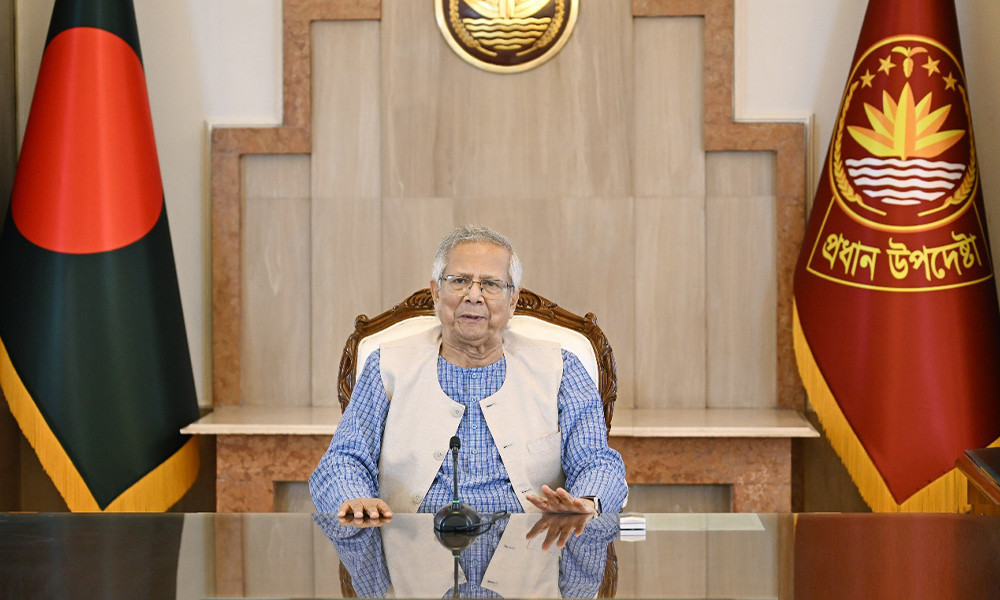
Bangla Press Desk: Chief Adviser Prof Muhammad Yunus on Thursday announced that the referendum on the July National Charter will coincide with the national election scheduled for early February 2026 – paving the way for a landmark twin vote to choose Bangladesh’s next government and define its future constitutional framework.
In a televised address to the nation, the chief adviser said that the interim government had approved the July National Charter (Constitutional Reform) Implementation Order, 2025 during Thursday’s meeting of the Advisory Council, thereby clearing the way for its publication in the official gazette.
“We have decided that the referendum will be held on the same day as the national election – that is, in the first half of February. This will not hinder the reform goals and will make the process more festive and cost-effective. Necessary legislation will be enacted in due course for holding the referendum,” he said in his speech.
The chief adviser added that, in accordance with the July Charter, the wording of the referendum question had also been finalised.

Later in the day, President Mohammed Shahabuddin issued the “July National Charter (Constitution Reform) Implementation Order, 2025”, removing the provision that automatically incorporated reform measures into the constitution if the Constitutional Reform Council failed to act within a specified timeframe.
A gazette in this regard, detailing the order’s implementation, was issued in the afternoon.
Under the new order, if the referendum is approved, the next parliament will serve a dual mandate – acting both as the legislature and as the Constitutional Reform Council – with 180 days from its first sitting to complete the constitutional amendments. The Consensus Commission had earlier recommended a 270-day timeframe and suggested automatic incorporation of reforms if the council failed to act, a proposal opposed by the BNP and its allies.
The order comes amid calls from Jamaat-e-Islami and the National Citizen Party (NCP) for formal legal recognition of the Charter, with the NCP specifically urging that it be issued by the chief adviser rather than the President.
The question and four key points of the referendum
Prof Yunus then read out the question during his address: “Do you approve of the ‘July National Charter (Constitution Amendment) Implementation Order, 2025’, and the following proposals for constitutional reform as recorded in the July National Charter?”
He also outlined the four key points to be attached to the question. The referendum will ask voters to approve four core reform points outlined in the July National Charter. These include the formation of a caretaker government, Election Commission, and other constitutional bodies under the Charter’s guidelines during election periods, and the introduction of a bicameral parliament with an upper house of 100 proportionally elected members whose consent will be required for constitutional amendments.
The Charter also binds all future governing parties to uphold key reforms – such as women’s representation, term limits for the Prime Minister, greater presidential authority, judicial independence, stronger local government, and protection of fundamental rights – while ensuring that other agreed reforms are implemented according to each party’s stated commitments.

Four issues, one vote
Prof Yunus said voters would express their opinion by casting a single “Yes” or “No” vote on all four points on referendum day.
If the majority votes “Yes”, a “Constitutional Reform Council” will be formed, comprising members of the newly elected parliament.
“These members will simultaneously serve as Members of Parliament. The Council will complete the constitutional reforms within 180 working days of its first session, and within 30 working days thereafter, an upper house will be established proportionally based on the election results. Its tenure will last until the end of the lower house’s term,” he explained.
According to him, the July Charter will also be formally incorporated into the Constitution, as stated in the newly approved order.
CA thanks NCC and politicians
The chief adviser said the National Consensus Commission (NCC), formed to draft proposals for state restructuring, had worked tirelessly for nearly nine months and held discussions with representatives of the political parties that participated in the July uprising.
“In a cordial atmosphere, with patience and mutual respect, these political parties have debated and presented their arguments on various reform proposals. Where differences existed, they tried to narrow them. In many cases, consensus was reached. The people of the country were able to witness the entire process live. This was an unprecedented event – not only in Bangladesh’s political history but also by global standards,” he said.
Describing it as a hopeful sign for the future of national politics, Prof Yunus extended his gratitude to the NCC members and political leaders.
“I extend my sincere thanks to the members of the Consensus Commission and to the leaders of the political parties for making this extraordinary democratic exercise a success,” he said.
Difference in public statements, agreement in the charter
Prof Yunus noted that political parties often express opposing views in public, though their actual positions on many issues are strikingly similar.
“While public statements by parties may seem contradictory, a careful analysis of the July Charter shows far less difference in substance. This is our unique achievement and a source of national courage,” he said.
He added that through the July Charter, consensus had been achieved among political parties on 30 significant constitutional reform proposals – a historic milestone for the country.
“Some proposals have minor differences, while a few appear to have larger gaps – but even those are not deeply divisive upon closer examination. The disagreements are mainly over whether certain reforms should be enshrined in the Constitution or enacted through legislation – not over their necessity or guiding principles,” he explained.
CA hopes political parties will accept the order
Outlining the interim government’s main responsibilities – to bring to justice those responsible for the July massacre, undertake reforms for a transparent and effective democratic system, and transfer power to an elected government through a free and fair election – the chief adviser said that people, long deprived of their voting rights, are now eager to exercise them in the upcoming polls.
“It is absolutely essential that the political parties supporting the uprising remain united in ensuring a fair election in February. Otherwise, the nation will face grave peril – a concern I have expressed repeatedly,” he warned.
“The unity of our people against fascism in July 2024 was forged by those who stood tall in the face of death. Let us not dishonour their sacrifice by engaging in petty disputes,” he added.
Prof Yunus said the people simply asked that all political leaders honour the memory of the fallen through tolerance, unity, and commitment to the nation’s collective aspirations above all else.
“Therefore, I sincerely hope that the political parties will accept our decisions in the broader national interest and move forward toward a festive national election,” he said, adding that through this, “we will enter a new Bangladesh.”
BP/SP
[Bangla Press is a global platform for free thought. It provides impartial news, analysis, and commentary for independent-minded individuals. Our goal is to bring about positive change, which is more important today than ever before.]
 E-paper
.jpg)
.jpg)
.jpg)
.jpg)