
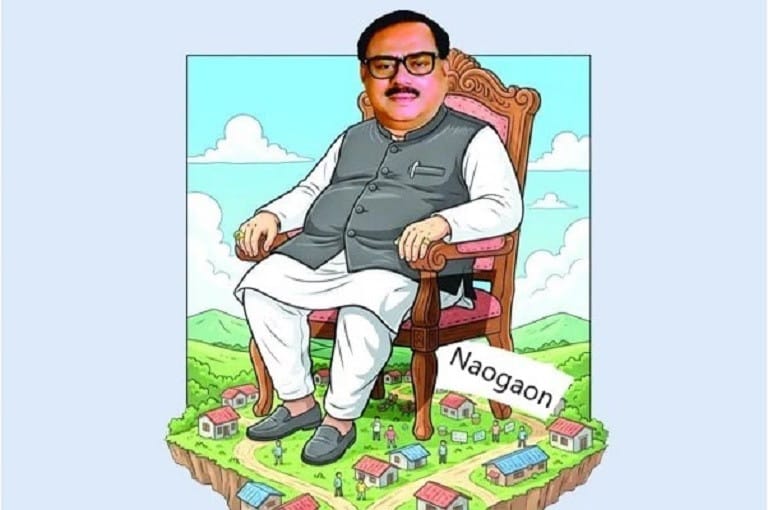
 Bangla Press Desk: Sadhan Chandra Majumder was born into a lower-middle-class family in Shibpur Baldahghat village of Niamatpur upazila in Naogaon. For someone from such a family background, becoming a minister was itself a surprise. His political journey began as chairman of Hajinagar Union Parishad. Later, Sadhan Chandra Majumder was elected Member of Parliament four consecutive times from Naogaon-01 (Niamatpur–Porsha–Sapahar) constituency. Of these, he became an MP without contest three times. He had no real popularity in the area. Rather, by wielding power, Sadhan established a reign of terror. Besides being a minister, he also served as general secretary of the Naogaon district Awami League. Through this position, he controlled the local Roads and Highways Department, LGED, and Agriculture Department. His family members used his influence to establish the Majumder empire in Naogaon. Irregularities, corruption, and land-grabbing business went on unchecked. By suppressing and torturing opposition parties, Sadhan enforced his dictatorship in his constituency.
During Sadhan’s rule, his younger brother Monoranjan Majumder and his elder daughter’s husband, Nasim Ahmed—general secretary of Naogaon municipal Awami League—held Naogaon firmly in their grip. Naogaon is one of the country’s largest rice-trading hubs, where even a slight fluctuation in price affects the entire nation’s rice market. Yet, in this very district, illegal stockpiling of rice and paddy in warehouses was rampant. One rice trader, requesting anonymity, said that in collusion with syndicate members, large mill owners stockpiled thousands of tons of old rice and paddy. Because of this syndicate, the rice market never stabilized. Through such practices, they looted hundreds of crores of taka. According to sources, the former food minister’s brother, Monoranjan Majumder, owns Monar Rice Mill in Niamatpur. Major rice traders had no choice but to obey him.
Grabbing ponds and large water bodies for fish farming was another obsession of the syndicate. In Sadhan’s constituency, there are at least five to six thousand water bodies across three upazilas, of which about 4,500 were under his control. Their “pond grabbing” still causes pain for many. One such victim, Hakim, a fish trader from Niamatpur, said that after the fall of the Awami League government in the student-people’s uprising on August 5, his burden finally lifted. “For years I couldn’t even go near my own water body! The minister’s men harvested and sold all the fish, and I couldn’t protest out of fear.”
In road development, paving, and repair projects, contractors had to pay a 20 percent commission to the Sadhan syndicate. If the commission was short, contractors faced reprisals. Most recently, road projects worth Tk1,120 crore were undertaken in six routes from Naogaon Sadar to Atrai, Badalgachhi, Mohadevpur, and from Manda to Niamatpur. The syndicate collected 20 percent of the money in advance from this regional highway development project. Besides this, all markets in Naogaon were auctioned off at nominal rates to Sadhan’s chosen people. Information has also surfaced about massive corruption in the thousand-crore CSD construction project in Naogaon and in plans to establish an economic zone in Sapahar. In both cases, syndicate members grabbed land in advance. They plotted to buy land at low prices and sell it to the government at high prices. But with the regime change, that plan collapsed.
Bangla Press Desk: Sadhan Chandra Majumder was born into a lower-middle-class family in Shibpur Baldahghat village of Niamatpur upazila in Naogaon. For someone from such a family background, becoming a minister was itself a surprise. His political journey began as chairman of Hajinagar Union Parishad. Later, Sadhan Chandra Majumder was elected Member of Parliament four consecutive times from Naogaon-01 (Niamatpur–Porsha–Sapahar) constituency. Of these, he became an MP without contest three times. He had no real popularity in the area. Rather, by wielding power, Sadhan established a reign of terror. Besides being a minister, he also served as general secretary of the Naogaon district Awami League. Through this position, he controlled the local Roads and Highways Department, LGED, and Agriculture Department. His family members used his influence to establish the Majumder empire in Naogaon. Irregularities, corruption, and land-grabbing business went on unchecked. By suppressing and torturing opposition parties, Sadhan enforced his dictatorship in his constituency.
During Sadhan’s rule, his younger brother Monoranjan Majumder and his elder daughter’s husband, Nasim Ahmed—general secretary of Naogaon municipal Awami League—held Naogaon firmly in their grip. Naogaon is one of the country’s largest rice-trading hubs, where even a slight fluctuation in price affects the entire nation’s rice market. Yet, in this very district, illegal stockpiling of rice and paddy in warehouses was rampant. One rice trader, requesting anonymity, said that in collusion with syndicate members, large mill owners stockpiled thousands of tons of old rice and paddy. Because of this syndicate, the rice market never stabilized. Through such practices, they looted hundreds of crores of taka. According to sources, the former food minister’s brother, Monoranjan Majumder, owns Monar Rice Mill in Niamatpur. Major rice traders had no choice but to obey him.
Grabbing ponds and large water bodies for fish farming was another obsession of the syndicate. In Sadhan’s constituency, there are at least five to six thousand water bodies across three upazilas, of which about 4,500 were under his control. Their “pond grabbing” still causes pain for many. One such victim, Hakim, a fish trader from Niamatpur, said that after the fall of the Awami League government in the student-people’s uprising on August 5, his burden finally lifted. “For years I couldn’t even go near my own water body! The minister’s men harvested and sold all the fish, and I couldn’t protest out of fear.”
In road development, paving, and repair projects, contractors had to pay a 20 percent commission to the Sadhan syndicate. If the commission was short, contractors faced reprisals. Most recently, road projects worth Tk1,120 crore were undertaken in six routes from Naogaon Sadar to Atrai, Badalgachhi, Mohadevpur, and from Manda to Niamatpur. The syndicate collected 20 percent of the money in advance from this regional highway development project. Besides this, all markets in Naogaon were auctioned off at nominal rates to Sadhan’s chosen people. Information has also surfaced about massive corruption in the thousand-crore CSD construction project in Naogaon and in plans to establish an economic zone in Sapahar. In both cases, syndicate members grabbed land in advance. They plotted to buy land at low prices and sell it to the government at high prices. But with the regime change, that plan collapsed.
Sadhan’s fascist rule over Naogaon

Banglapress
Published: 23 September 2025, 10:26 AM
 Bangla Press Desk: Sadhan Chandra Majumder was born into a lower-middle-class family in Shibpur Baldahghat village of Niamatpur upazila in Naogaon. For someone from such a family background, becoming a minister was itself a surprise. His political journey began as chairman of Hajinagar Union Parishad. Later, Sadhan Chandra Majumder was elected Member of Parliament four consecutive times from Naogaon-01 (Niamatpur–Porsha–Sapahar) constituency. Of these, he became an MP without contest three times. He had no real popularity in the area. Rather, by wielding power, Sadhan established a reign of terror. Besides being a minister, he also served as general secretary of the Naogaon district Awami League. Through this position, he controlled the local Roads and Highways Department, LGED, and Agriculture Department. His family members used his influence to establish the Majumder empire in Naogaon. Irregularities, corruption, and land-grabbing business went on unchecked. By suppressing and torturing opposition parties, Sadhan enforced his dictatorship in his constituency.
During Sadhan’s rule, his younger brother Monoranjan Majumder and his elder daughter’s husband, Nasim Ahmed—general secretary of Naogaon municipal Awami League—held Naogaon firmly in their grip. Naogaon is one of the country’s largest rice-trading hubs, where even a slight fluctuation in price affects the entire nation’s rice market. Yet, in this very district, illegal stockpiling of rice and paddy in warehouses was rampant. One rice trader, requesting anonymity, said that in collusion with syndicate members, large mill owners stockpiled thousands of tons of old rice and paddy. Because of this syndicate, the rice market never stabilized. Through such practices, they looted hundreds of crores of taka. According to sources, the former food minister’s brother, Monoranjan Majumder, owns Monar Rice Mill in Niamatpur. Major rice traders had no choice but to obey him.
Grabbing ponds and large water bodies for fish farming was another obsession of the syndicate. In Sadhan’s constituency, there are at least five to six thousand water bodies across three upazilas, of which about 4,500 were under his control. Their “pond grabbing” still causes pain for many. One such victim, Hakim, a fish trader from Niamatpur, said that after the fall of the Awami League government in the student-people’s uprising on August 5, his burden finally lifted. “For years I couldn’t even go near my own water body! The minister’s men harvested and sold all the fish, and I couldn’t protest out of fear.”
In road development, paving, and repair projects, contractors had to pay a 20 percent commission to the Sadhan syndicate. If the commission was short, contractors faced reprisals. Most recently, road projects worth Tk1,120 crore were undertaken in six routes from Naogaon Sadar to Atrai, Badalgachhi, Mohadevpur, and from Manda to Niamatpur. The syndicate collected 20 percent of the money in advance from this regional highway development project. Besides this, all markets in Naogaon were auctioned off at nominal rates to Sadhan’s chosen people. Information has also surfaced about massive corruption in the thousand-crore CSD construction project in Naogaon and in plans to establish an economic zone in Sapahar. In both cases, syndicate members grabbed land in advance. They plotted to buy land at low prices and sell it to the government at high prices. But with the regime change, that plan collapsed.
Bangla Press Desk: Sadhan Chandra Majumder was born into a lower-middle-class family in Shibpur Baldahghat village of Niamatpur upazila in Naogaon. For someone from such a family background, becoming a minister was itself a surprise. His political journey began as chairman of Hajinagar Union Parishad. Later, Sadhan Chandra Majumder was elected Member of Parliament four consecutive times from Naogaon-01 (Niamatpur–Porsha–Sapahar) constituency. Of these, he became an MP without contest three times. He had no real popularity in the area. Rather, by wielding power, Sadhan established a reign of terror. Besides being a minister, he also served as general secretary of the Naogaon district Awami League. Through this position, he controlled the local Roads and Highways Department, LGED, and Agriculture Department. His family members used his influence to establish the Majumder empire in Naogaon. Irregularities, corruption, and land-grabbing business went on unchecked. By suppressing and torturing opposition parties, Sadhan enforced his dictatorship in his constituency.
During Sadhan’s rule, his younger brother Monoranjan Majumder and his elder daughter’s husband, Nasim Ahmed—general secretary of Naogaon municipal Awami League—held Naogaon firmly in their grip. Naogaon is one of the country’s largest rice-trading hubs, where even a slight fluctuation in price affects the entire nation’s rice market. Yet, in this very district, illegal stockpiling of rice and paddy in warehouses was rampant. One rice trader, requesting anonymity, said that in collusion with syndicate members, large mill owners stockpiled thousands of tons of old rice and paddy. Because of this syndicate, the rice market never stabilized. Through such practices, they looted hundreds of crores of taka. According to sources, the former food minister’s brother, Monoranjan Majumder, owns Monar Rice Mill in Niamatpur. Major rice traders had no choice but to obey him.
Grabbing ponds and large water bodies for fish farming was another obsession of the syndicate. In Sadhan’s constituency, there are at least five to six thousand water bodies across three upazilas, of which about 4,500 were under his control. Their “pond grabbing” still causes pain for many. One such victim, Hakim, a fish trader from Niamatpur, said that after the fall of the Awami League government in the student-people’s uprising on August 5, his burden finally lifted. “For years I couldn’t even go near my own water body! The minister’s men harvested and sold all the fish, and I couldn’t protest out of fear.”
In road development, paving, and repair projects, contractors had to pay a 20 percent commission to the Sadhan syndicate. If the commission was short, contractors faced reprisals. Most recently, road projects worth Tk1,120 crore were undertaken in six routes from Naogaon Sadar to Atrai, Badalgachhi, Mohadevpur, and from Manda to Niamatpur. The syndicate collected 20 percent of the money in advance from this regional highway development project. Besides this, all markets in Naogaon were auctioned off at nominal rates to Sadhan’s chosen people. Information has also surfaced about massive corruption in the thousand-crore CSD construction project in Naogaon and in plans to establish an economic zone in Sapahar. In both cases, syndicate members grabbed land in advance. They plotted to buy land at low prices and sell it to the government at high prices. But with the regime change, that plan collapsed.
[Bangla Press is a global platform for free thought. It provides impartial news, analysis, and commentary for independent-minded individuals. Our goal is to bring about positive change, which is more important today than ever before.]
YOU MAY ALSO LIKE
Bangladesh
The Constitution is obligated to ensure the security of followers of all religions: Home Minister
10 hours ago
by Bangla Press
.jpg)
Bangladesh
Bangladesh to seek the return of Sheikh Hasina during talks with India
10 hours ago
by Bangla Press
.jpg)
.jpg)
Bangladesh
Celebrate the festival with peace of mind and in safety: Prime Minister
11 hours ago
by Bangla Press
.jpg)
Bangladesh
107 flights canceled on Dhaka-Saudi route, more than 16 thousand passengers suffer
11 hours ago
by Bangla Press

Bangladesh
Saleh Shibli claims 410 pieces of misinformation were spread against the Prime Minister over 9 months.
11 hours ago
by Bangla Press
Sangeet Academy