

Textbook printing syndicate accused of Tk659 crore embezzlement

Bangla Press
Published: 13 March 2026, 11:57 PM
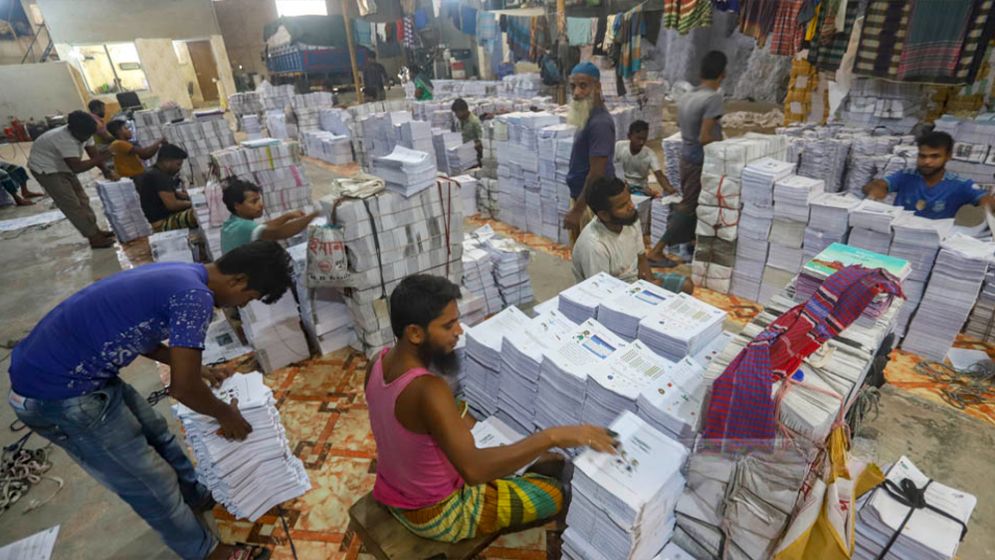
Bangla Press Desk: A powerful syndicate allegedly embezzled nearly Tk659 crore from the government in 2025 through manipulation in the printing of free textbooks distributed to students nationwide. The funds were reportedly siphoned off through irregularities in the printing tender process and manipulation of paper supply and pricing.
The allegations were revealed in a special report by a key government agency investigating the printing and distribution of textbooks for the 2025 academic year under the National Curriculum and Textbook Board (NCTB).According to the report, local printing companies formed a syndicate after the government decided not to print textbooks in Indian institutions following the July mass uprising. The group allegedly leaked confidential tender estimates and divided printing lots among themselves before the bidding process began.
The printing companies reportedly submitted bids 20–25 percent higher than normal, resulting in an additional Tk 6.58 billion in costs beyond the government’s allocated budget. In previous years, companies had typically offered bids about 10 percent lower than the estimated price for primary school textbook printing contracts.
In 2025, the government printed approximately 401.57 million textbooks for students from pre-primary to class ten at a total cost of about Tk27.62 billion.
The report states that the syndicate’s influence in the NCTB textbook printing tender process has become severe. Several printing companies were identified as key players in the alleged cartel, including Karnafuli Art Press, Letter N Color, Apex Printing and Color, Sarkar Printing and Publishing, Agrani Printing Press, Ananda Printers Ltd., Kochua Press and Publications, Simanta Printing Press and Publication, Proma Press and Publications, and Bright Printing Press.
Sources cited in the report claim that some NCTB officials leaked tender price estimates to press owners in exchange for illegal financial benefits. Owners of major printing presses allegedly held secret meetings to divide preferred printing lots among themselves and coordinate bidding strategies.
The investigation also uncovered manipulation in the paper supply chain. Although Bangladesh has 119 registered paper mills, only a small number—including Bashundhara, Meghna, Amber Super, and Partex—are capable of supplying paper that meets NCTB specifications. Many other mills reportedly lack the machinery, capacity, and financial resources required to meet the standards, often supplying lower-quality paper instead.
Some printing presses that receive textbook printing contracts reportedly engage in other commercial printing, such as guidebooks and notes, toward the end of the year. This practice contributes to delays in textbook production and can create temporary shortages of paper.
In addition, certain printing presses are reportedly involved in paper trading. By purchasing large quantities of paper in advance and storing them in warehouses, they allegedly create artificial shortages that push market prices higher, forcing smaller printing presses to buy paper at inflated rates.
The report also named several individuals suspected of involvement in the paper supply syndicate, including Mintu Molla, Sheikh Siraj, Dulal Sarkar, Omar Faruk, Mohsin, Rubel-Robin, Rabbani Jabbar, and Dewan Kabir.
Data in the report indicates that about 23 paper mills supplied paper directly or through dealers for textbook printing in the 2025 academic year. These mills collectively have a daily production capacity of roughly 1,000 tons. However, investigators found that some mills increase prices as demand grows and sometimes supply lower-quality paper while charging higher-grade prices.
The report also highlighted irregularities in the supply of 230 GSM art card paper used in textbook printing. Because this paper is fully imported and subject to taxes and VAT, legal imports typically carry high costs. The syndicate allegedly imported the material through illegal channels, stockpiled it, and created artificial shortages to raise prices.
Several companies and individuals were reportedly linked to this activity, including Master Cimex Paper Ltd., Union Associates, Rahmat Enterprise, Yusuf Enterprise in Nayabazar, Omar Faruk of Sarkar Press, press owner Tofayel, Amin Hilali of Dosh Disha Printers, and Rafin Enterprise.
Responding to the allegations, Rashed Hossain, an executive at Letter N Color Ltd., said he personally handles textbook printing tenders and denied the existence of any syndicate or negotiation in the process, claiming that all procedures are conducted according to regulations.
Mamun Hossain, owner of Proma Press and Publications, declined to comment when contacted regarding the allegations.Source: daily Sun
BP/SP
[Bangla Press is a global platform for free thought. It provides impartial news, analysis, and commentary for independent-minded individuals. Our goal is to bring about positive change, which is more important today than ever before.]
YOU MAY ALSO LIKE
.jpg)
.jpg)
Bangladesh
5 arrested in connection with the leaking of Youth Development exam questions
2 hours ago
by Bangla Press
.jpg)
Sangeet Academy