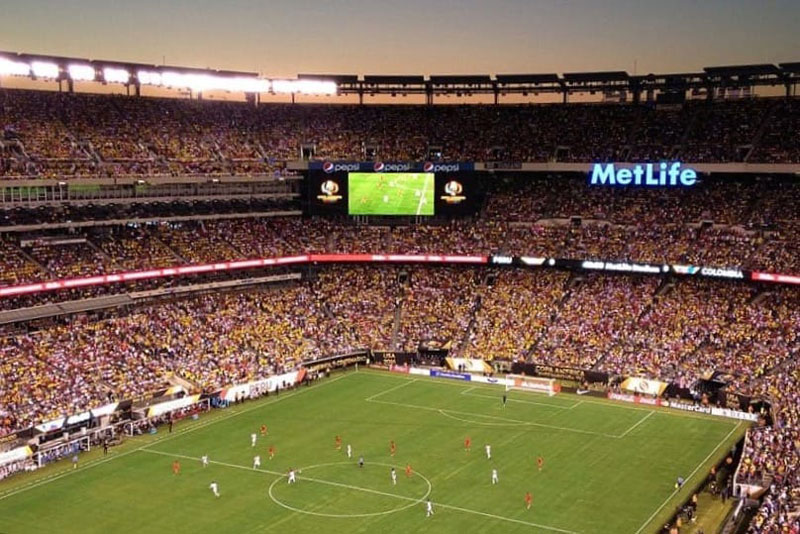
Noman Sabit: New Jersey asked to host this year’s World Cup. Now it risks offending its guests with plans to squeeze soccer fans a move that is either proof that all politics are local or an own goal for the state’s new Democratic governor on the global stage.
The state’s public transit agency said Friday it plans to charge 40,000 World Cup goers $150 to get to MetLife Stadium for each of the eight matches in the state, including the final. Gov. Mikie Sherrill, who was elected last fall talking about affordability, appears to be calculating that it won’t cost her politically to charge extra to fans attending matches that already cost hundreds or thousands of dollars to get into. She’s also proposed a special sales and hotel tax for fans visiting the part of New Jersey nearest MetLife.
But her pitch is causing political drama and fingerpointing pitting the governor of the state where billions of eyes will be turned for the World Cup final against FIFA, soccer’s global governing body, and some fellow Democrats in New York, which is co-hosting the global event.
Sherrill and FIFA have been in a dayslong back-and-forth after she blamed the sporting body for not paying to move soccer fans to and from the World Cup matches.
“In the agreement that my administration inherited, FIFA put zero dollars towards transporting World Cup fans,” she said in a statement Friday. The Garden State agreed to host part of the tournament when soccer-fan Phil Murphy was in office. Tammy Murphy, his wife, remains chair of the host committee. Sherrill’s line of attack garnered some support from some other affordability-minded Democrats including New York City Mayor Zohran Mamdani and Senate Minority Leader Chuck Schumer (D-N.Y.) who agree FIFA is raking in cash from fans while burdening local governments with security and transportation costs.
FIFA pushed back and said host cities had originally promised to get fans to matches for free. All 16 cities have a standard agreement. Heimo Schirgi, the COO for the World Cup, said New Jersey’s plan “will have a chilling effect” and “creates broader ripple effects that ultimately diminish the economic benefit and lasting legacy the entire region stands to gain from hosting the World Cup.”
“Furthermore, to arbitrarily set elevated prices and demand FIFA absorb these costs is unprecedented. No other global event, concert or major sporting promoter has faced such a demand,” Schirgi said. “While FIFA is projected to generate approximately $11 billion in revenue, not profit, as the governor incorrectly claims, FIFA has always been a not-for-profit organization as per our statutes.” There is also bipartisan backlash against Sherrill and New Jersey Transit, which runs the state’s bus and train system. Most World Cup ticketholders are expected to stay in New York City and then schlep across the river on New Jersey Transit trains.
New York Gov. Kathy Hochul said she worried New Jersey’s high fares could throw “cold water” on the whole event.
The Republican head of the White House’s World Cup task force, Andrew Giuliani, called the high fares a “bailout” for local agencies, like New Jersey Transit, that have long struggled with budget gaps.
New York Assemblymember Robert Carroll, a Brooklyn Democrat, said “the next time New York City hosts the world, partnering with New Jersey won’t even be on the table.”
New York City Council Majority Leader Shaun Abreu, a Democrat, said New Jersey is “price gouging.”
“They are seeing the World Cup as a cash grab, but we’re not playing those games on this side of the Hudson,” Abreu said, referring to the river that separates New York from New Jersey.
Abreu is pushing Mamdani’s administration to launch a new ferry service so that fans traveling out of New York City to New Jersey have another way to get to MetLife. Right now, that’s not part of the official mobility plans for the games, which were unveiled during a lengthy Friday press conference led by officials from the New Jersey Transit and New York New Jersey Host Committee.
Without the $150 fare, state officials said New Jersey commuters and residents would be on the hook for $48 million in World Cup-related transit expenses. New Jersey Transit already has a $200 million-a-year structural budget deficit, a chunk of it driven by providing service to dozens of NFL games and concerts at MetLife each year. “The world is excited for these eight days, but New Jerseyans are excited for the next eight years of this governor’s administration,” said Kris Kolluri, the head of New Jersey Transit and key architect of the plan to move people to and from the World Cup.
Officials expect 78,000 fans to come and go from MetLife Stadium for each match.
Kolluri said New Jersey Transit has planned to move 40,000 fans on its trains and buses and not a single fan more. The $150 round trip ticket is only available to match ticket holders and only 40,000 will be sold for each match.
Of those, it’s expected 28,000 people will ride New Jersey Transit’s trains toward the stadium from New York Penn Station, which is already America’s busiest transit hub. The rest will be starting their journey in New Jersey.
Of the fans who don’t rely on New Jersey Transit, 10,000 fans can take $80 shuttle buses organized by the host committee. Twenty-two thousand are expected to rely on FIFA-provided vehicles. And 6,000 fans are expected to use rideshare services, though at who knows what cost, given the potential for surge pricing.
Some of the details of the plan had already leaked in recent days, including the $150 fare and plans to close off part of Penn Station to anyone without a World Cup ticket.
The details of the Penn Station changes are nuanced: City subways, Amtrak trains and the Long Island Rail Road are expected to operate normally in and out of Penn Station. But for seven hours on match days, a chunk of New Jersey Transit trains will be devoted to moving fans to the stadium: For four hours before a match, no regular New Jersey Train trains will leave New York for New Jersey, just World Cup trains. For three hours after a match, no regular trains from New Jersey will enter New York Penn Station, just trains for fans.
Other ways in and out of the city, like ferry service and a bi-state train operated by the Port Authority of New York and New Jersey, will be forced to pick up some of the slack.
The plan is built by officials who have what Kolluri called “PTSD” from a disastrous 2014 Super Bowl, when fans departing MetLife were stranded for hours.
*Copyright 2026 Bangla Press. All rights reserved. This material may not be published, broadcast, rewritten or redistributed.
BP/SM
[Bangla Press is a global platform for free thought. It provides impartial news, analysis, and commentary for independent-minded individuals. Our goal is to bring about positive change, which is more important today than ever before.]

 E-paper
-6a96667b6b0bc.jpg)

.jpg)