BanglaPress Desk: The Ministry of Health has taken responsibility for the healthcare of the country’s nearly 60 million urban residents. For the next six months, urban health centers will continue to provide services under their existing operational frameworks. During this period, a sustainable, cost-effective, and multi-faceted urban health model will be finalized, taking into account the specific needs of the urban population.
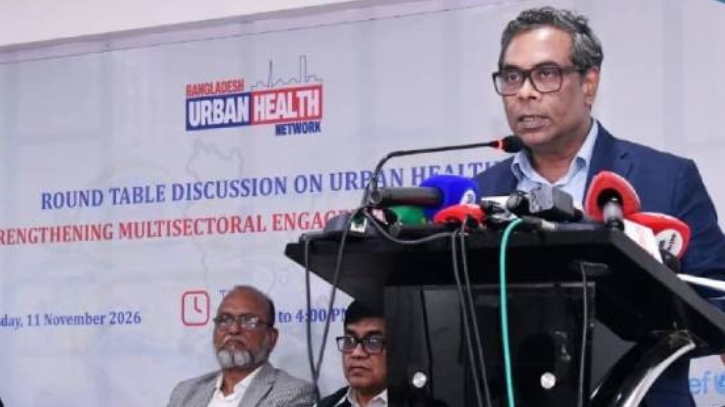
State Minister for Health, Dr. M. A. Muhit, shared this information during a discussion meeting held yesterday, Wednesday, at the Pan Pacific Sonargaon Hotel in the capital. The event, titled "Urban Health: Enhancing Multi-Sectoral Engagement," was jointly organized by the Bangladesh Urban Health Network (BUHN) and Eminence, with support from the Embassy of Sweden and UNICEF.
Speaking as the chief guest, State Minister M. A. Muhit noted that while there is a well-defined network of Upazila Health Complexes to serve the rural population, the Ministry of Health previously lacked a direct, formal mandate for the healthcare of the vast urban population. To address this gap, the current government has made a definitive decision to assume responsibility for urban health.
Emphasizing the need to ensure that service delivery remains uninterrupted, Dr. M. A. Muhit stated that existing urban health centers will continue to operate under their current partnership-based frameworks for the next six months—pending their full transition to government management. Necessary policy and financial approvals have already been granted for this process. A comprehensive and sustainable urban health model will be developed within this timeframe.
Regarding the health budget, the State Minister highlighted that the current allocation for the health sector is the highest in the country's history. However, the government does not intend to limit itself to this current level; there is a clear political commitment to allocate 5 percent of the national budget to the health sector over the next five years.
Urging that urban healthcare not be confined merely to hospitals and medication, the State Minister pointed out that factors such as housing, access to safe water, sanitation, employment, mental health, and the prevention of non-communicable diseases are all integral to the well-being of urban residents. Consequently, the urban health system must be built by considering these elements in an integrated manner. He further added that the healthcare model used at the Upazila level cannot be blindly replicated in urban areas; instead, planning must be based on an assessment of the actual health needs of the urban population. In this regard, he emphasized the introduction of electronic health cards and the establishment of an effective referral network among public and private healthcare institutions.
Noting that the urban health project has been preliminarily incorporated into the Planning Commission, the State Minister stated that public health experts, researchers, and development partners must now come forward. Through their concerted efforts, it is essential to promptly formulate a realistic, cost-effective, and multi-sectoral action plan.
Others who spoke at the discussion meeting included Professor Dr. Harun Al Rashid, President of the Doctors Association of Bangladesh (DAB); Dr. Md. Enamul Haque, Director General of the Health Economics Unit; Professor Dr. Nasrin Sultana, Director of the National Institute of Preventive and Social Medicine (NIPSOM); Imadul Haque, Health Manager at UNICEF Bangladesh; Dewan Emdadul Haque, a representative from the World Health Organization (WHO); Wameq Raza, a representative from the World Bank; and Kazi Saifuddin Bennoor, Director of the Bangladesh Medical Research Council (BMRC).
BP/TI
[Bangla Press is a global platform for free thought. It provides impartial news, analysis, and commentary for independent-minded individuals. Our goal is to bring about positive change, which is more important today than ever before.]

 E-paper