

Workshop on ‘Research and Innovation Scaling Demand in Bangladesh’ held in Dhaka

Bangla Press
Published: 12 December 2025, 12:19 AM
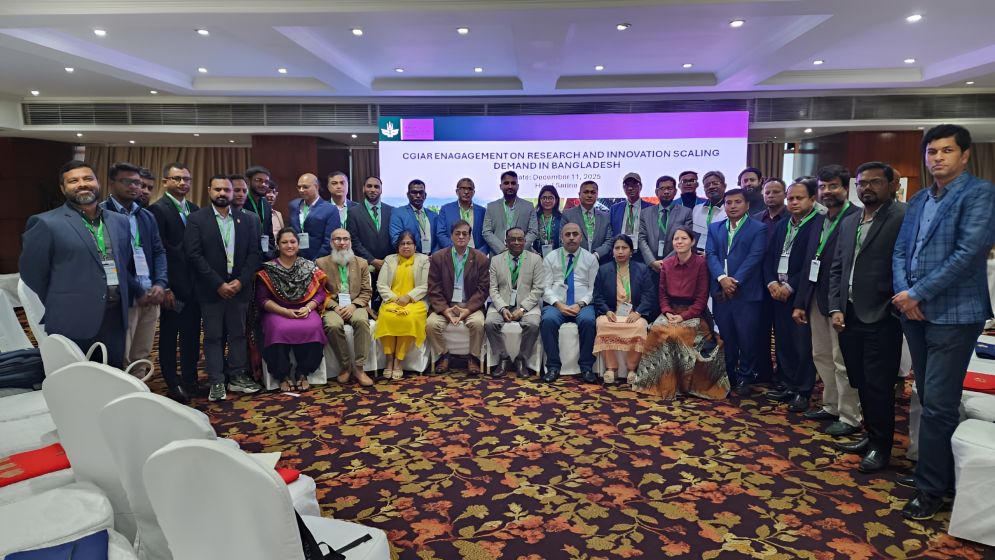
Bangla Press Desk: The International Maize and Wheat Improvement Center (CIMMYT) and the International Water Management Institute (IWMI) jointly hosted a stakeholder engagement workshop titled “Research and Innovation Scaling Demand in Bangladesh” on Thursday in Dhaka, marking a significant step toward strengthening demand-driven agrifood innovation in the country.
The event brought together representatives from government institutions, research organisations, development partners, the private sector, farmer groups, and civil society, read a press release.
The workshop was attended by more than 50 participants, including Dr Md Mahfuz Bazzaz, director general of BWMRI, alongside scientists from key NARES institutions such as BARI, BRRI, BSRI, BLRI, and BIRTAN.
The vice-chancellor of HSTU, Professor M Enamullah, attended with academicians from universities including SAU and KAU.
Senior officials from the Department of Agricultural Extension (DAE) joined representatives from seed and biopesticide, agri-machinery companies, national bodies such as SRDI, BRDB, BFA, and BADC, UN agencies, several CGIAR centres, and a wide range of other national and international organisations, reflecting the diversity of stakeholders engaged in Bangladesh’s agrifood systems.
Led by Dr Sreejith Aravindakshan (CIMMYT) and Dr Shreya Chakraborty (IWMI), and facilitated by Manon Dohmen, Consultant at IWMI, the workshop served as a platform for diverse actors to contribute ideas and experience about Bangladesh’s innovation ecosystem and how it can better align scientific capabilities with the practical needs of farmers, agribusinesses, and public institutions.
Participants outlined the most pressing challenges and opportunities facing their institutions. These insights will directly inform CGIAR’s future research directions, ensuring that innovations reflect real-world constraints and opportunities across Bangladesh’s agrifood systems.
During the workshop, participants also completed a digital ODK (Open Data Kit) survey developed by CGIAR’s Scaling for Impact programme. The survey was designed to capture their priority scaling demands, as well as the key barriers and challenges hindering the adoption and scaling of innovations across Bangladesh’s agrifood systems.
A central component of the discussions was the co-design of an upcoming digital Scaling Demand Signaling Dashboard—a tool envisioned to capture and visualise market-driven signals for innovations. By enabling researchers, donors, and implementing partners to better understand actual demand, the dashboard aims to improve the targeting and scaling of solutions.
Stakeholders also contributed to shaping a roadmap for channeling donor and investor interest toward innovations that are ready for scaling and capable of delivering measurable benefits. This pathway will support more strategic and impactful investments in Bangladesh’s agrifood sector.
The workshop underscored the importance of co-creation, transparency, and responsiveness in guiding the next phase of research and innovation. By convening a broad spectrum of voices, CIMMYT, IWMI, and the CGIAR Scaling for Impact programme have taken an important step toward ensuring that future research investments, tools, and digital solutions are genuinely aligned with stakeholder priorities.
HSTU VC Enamullah emphasised that "strengthening Bangladesh’s food security and agricultural productivity will require wider adoption of modern, evidence-based innovations, noting that a persistent policy–practice gap continues to hinder the effective implementation of these solutions".
Former BINA director general and current FAO National Consultant, Dr Mirza Mofazzal Islam, emphasised that "public–private partnerships are essential for accelerating innovation development and scaling, ensuring that farmers are better protected against a rapidly changing climate and are able to adapt to increasingly commercialised production systems.
“We face significant challenges ahead in sustaining national food security,” he noted, underscoring the urgency of coordinated action across institutions.
Dr Md Latiful Islam, Chief Scientific Officer at the Bangladesh Fisheries Research Institute (BFRI), highlighted the importance of advancing digital aquaculture and mechanisation to strengthen the country’s fish farming sector.
He emphasised that integrating smart monitoring systems, data analytics, and automation in the aquaculture sector to support more sustainable practices.
BP/TD
[Bangla Press is a global platform for free thought. It provides impartial news, analysis, and commentary for independent-minded individuals. Our goal is to bring about positive change, which is more important today than ever before.]
YOU MAY ALSO LIKE
.jpg)
.jpg)

Bangladesh
5 arrested in connection with the leaking of Youth Development exam questions
22 hours ago
by Bangla Press

.jpg)
Bangladesh
All flights from Dammam to Riyadh suspended until October 18
22 hours ago
by Bangla Press
Sangeet Academy