

Foreign students in U.S: Success stories and future prospects

Bangla Press
Published: 28 December 2025, 02:58 PM
Chhabed Sathee
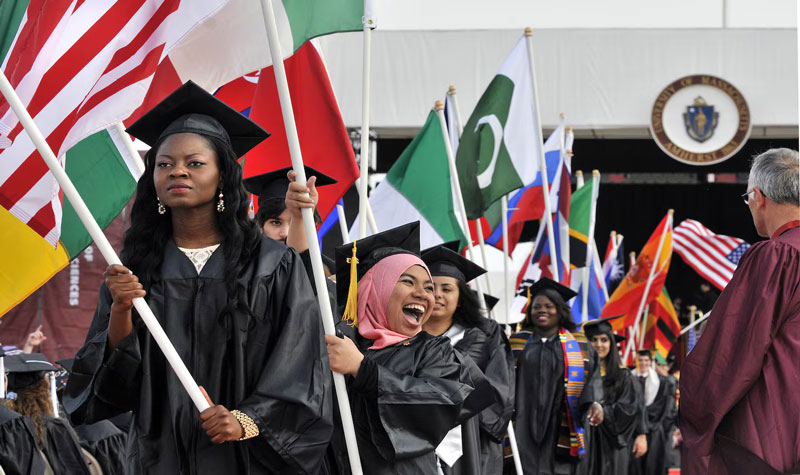
In the United States, foreign students are no longer confined to classrooms and campuses alone. Their success stories are now visible across education, research, technology, healthcare, entrepreneurship, and even public service. As America navigates a rapidly changing global landscape, international students have become an integral part of the country’s present strength and future potential.
For decades, U.S. universities have been the top destination for talented students from around the world. These students bring not only academic excellence but also diverse perspectives, innovative thinking, and a strong work ethic. In classrooms and laboratories, they contribute significantly to research output, particularly in science, technology, engineering, and mathematics (STEM) fields—areas where the United States continues to face a critical talent shortage.
Beyond academia, foreign students have played a transformative role in the American economy. Many international graduates go on to work in cutting-edge industries, launching startups, developing new technologies, and strengthening key sectors such as artificial intelligence, biotechnology, and clean energy. A striking indicator of their impact is that nearly half of Fortune 500 companies were founded by immigrants or the children of immigrants—many of whom first came to the U.S. as students.
International students are also a major economic asset. They typically pay full tuition and living expenses, contributing tens of billions of dollars annually to the U.S. economy. This revenue supports universities, sustains local communities, and helps subsidize education costs for domestic students. In many regions, especially smaller college towns, international students are a vital driver of economic activity.
Equally important is their role in strengthening America’s global influence. Students who study in the United States often develop lasting professional and cultural ties with the country. When they return home—or remain in the U.S. as skilled professionals—they act as informal ambassadors, fostering cooperation in business, science, and diplomacy. This “soft power” advantage has long been one of America’s most valuable, yet understated, strategic assets.
However, the future of foreign students in the United States is not without challenges. Visa uncertainties, shifting immigration policies, travel restrictions, and a perception of unpredictability have led some prospective students to consider alternative destinations such as Canada, the United Kingdom, and Australia. If these trends continue, the U.S. risks losing not only tuition revenue but also global talent and long-term competitive advantage.
.jpg)
Looking ahead, America’s future prosperity will depend heavily on its ability to attract, retain, and empower international talent. At a time when the domestic college-age population is declining and global competition for skilled workers is intensifying, welcoming foreign students is not just an educational policy—it is an economic and strategic necessity.
Ensuring a transparent, fair, and welcoming environment for international students will help sustain America’s leadership in innovation, research, and higher education. Their success is not separate from America’s success; it is deeply intertwined with it.
Last month, President Trump reiterated his plan to allow up to 600,000 Chinese students to study at U.S. universities. “I actually think it’s good to have outside countries,” he said in a Fox News interview. “I want to be able to get along with the world.” He also noted that having foreign students, who often pay full freight, is economically beneficial for the country. “It’s not that I want them, but I view it as a business,” he said.
But it turns out business is suffering. A recent report shows that new international student enrollment has declined 17 percent between the last school year and the current one.
What if such a loss were to continue in subsequent years? How would a 17-percent decrease in total international enrollment impact the financial bottom line?
A rough calculation using publicly available data helps put the financial stakes in perspective. To estimate, we assume international students pay the full cost of tuition, fees, room, and board themselves or with the help of their governments. We use federal data on the types of degree programs in which international students are enrolled, and assume they attend public and private institutions in the same proportions as U.S. students. Among private institutions, we assume they only attend nonprofits. We use data from the College Board to calculate tuition for four-year undergraduate students, and apply non-district tuition prices for associate degrees.
Unfortunately, there does not appear to be comprehensive national data on in-state versus out-of-state graduate-school prices. In an effort to better reflect what international students would pay, we adjust the average graduate in-state tuition price, as reported in the most recent federal data, to 2025 dollars, and to reflect the percentage difference between in-state and out-of-state undergrad prices.
We find based on these assumptions that a 17 percent decline in total international students would cost the U.S. economy about $18 billion. Such a loss would hurt the financial stability of universities and lead to higher costs for domestic students. Concerning the latter, some research suggests the international students’ tuition helps subsidize in-state students.
A reduced international presence would also widen the existing gap in STEM talent, as foreign students make up a large share of degree seekers in these fields. Indeed, some research shows that universities increase overall enrollment when they attract more international students, meaning their presence tends to expand opportunities for American students rather than limit them.
Using the same financial assumptions as above, an additional 600,000 Chinese students would contribute about $43 billion to the U.S. economy. And this estimate does not account for the many talented students who would remain in the United States after graduation, where they would join the workforce, pay taxes and bolster our global competitiveness. Indeed, according to the American Immigration Council, nearly half of Fortune 500 companies in 2025 were founded by immigrants or their children.
Another way of looking at the economic benefits of welcoming foreign students is that it aligns with Trump’s stated goal of reducing trade deficits: the United States maintains a surplus in international education, bringing in more than 1 million foreign students while sending only about 406,000 Americans abroad. And as higher education faces long-term decline in college-aged Americans, increasing foreign students can fill empty seats.
Alas, travel bans, restrictions based on social media posts, and other unpredictable policies threaten all of this. They create uncertainty and push prospective students toward countries with more stable and transparent admissions processes.
International students make significant contributions to the U.S. economy, its universities and its global competitiveness. Continued declines in total enrollment would mean billions in lost revenue, reduced opportunities for domestic students, and knowledge gaps in critical fields. Conversely, welcoming large numbers of Chinese and other foreign students would generate immediate economic benefits and strengthen American research, innovation and its global standing.
The evidence is clear: foreign students are not only thriving in the United States—they are helping shape its future. Investing in their potential means investing in the continued growth, competitiveness, and global leadership of the nation itself.
Chhabed Sathee: U.S based writer, journalist and American political analyst. Editor Bangla Press.
[Bangla Press is a global platform for free thought. It provides impartial news, analysis, and commentary for independent-minded individuals. Our goal is to bring about positive change, which is more important today than ever before.]
BP/SM
[Bangla Press is a global platform for free thought. It provides impartial news, analysis, and commentary for independent-minded individuals. Our goal is to bring about positive change, which is more important today than ever before.]
YOU MAY ALSO LIKE



Column
Twenty-Six Years Alongside FOBANA Through Its Joys and Challenges
2 months ago
by Bangla Press

Column
FOBANA's Historic Legacy Faces Uncertain Future Amid Growing Divisions
2 months ago
by Bangla Press

Column
Government is buying your widely scattered data without a warrant
6 months ago
by Bangla Press
Sangeet Academy