
What Did He Say to Him?

Bangla Press
Published: 29 December 2025, 08:26 PM
Chhabed Sathee
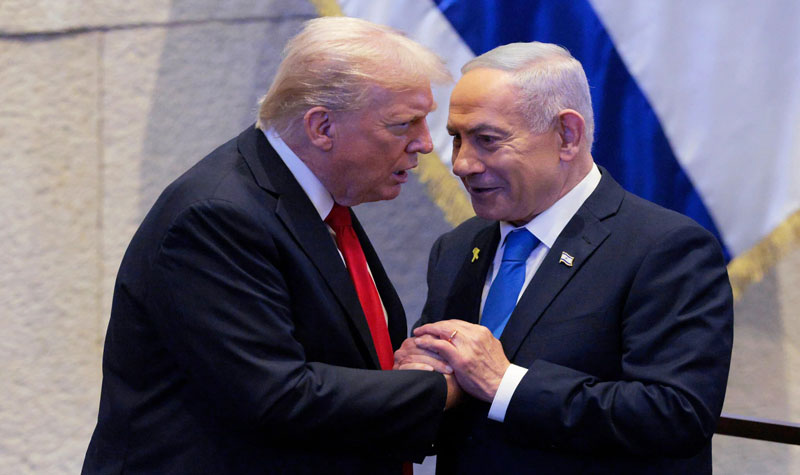
Mar-a-Lago, located in Palm Beach, Florida, is a luxury resort, but at the same time it has become a quiet yet significant stage of American political power. It was at this historic estate that the much-discussed meeting between Donald Trump and Israeli Prime Minister Benjamin Netanyahu took place on Monday (December 29, 2025). The question now being asked is: what was discussed in this meeting, and why has it drawn such close attention from global politics?
Although Donald Trump is currently out of office, he remains a powerful figure in U.S. politics. The relationship between this central leader of Republican politics and Netanyahu is not new. During Trump’s first term, recognizing Jerusalem as Israel’s capital, moving the U.S. embassy there, and acknowledging the Golan Heights as part of Israel were major diplomatic achievements for Netanyahu’s government. This Mar-a-Lago meeting appears to signal a revival of that old political chemistry.
In the current global context, the situation in Israel and the Middle East is extremely sensitive. The war in Gaza, tensions between Iran and Israel, and the issues involving Hezbollah and Hamas have placed Netanyahu under intense international pressure. At the same time, Trump, in the context of upcoming elections, is eager to present himself once again as an alternative force of global leadership. Against this backdrop, the Mar-a-Lago meeting was not merely a courtesy call; rather, it was a significant moment for the exchange of strategic messages.
According to analysts, five key issues were at the center of the discussion. These included: Trump’s hard deadline for disarming Hamas, renewed threats of action against Iran, President Herzog’s refusal of Trump’s demand to pardon Netanyahu, claims of an “understanding” regarding Syria along with a tone favorable to Russia, and the downplaying of China’s military drills.
First, Middle East security and the Iran issue were central topics. Trump has consistently taken a hardline stance against Iran, and Netanyahu has been one of the strongest supporters of that position. Second, there was the question of potential political backing to counter international criticism and diplomatic pressure following the Gaza war. Third, the role of pro-Israel voters and lobbying groups in U.S. domestic politics was also significant.
.jpg)
The Mar-a-Lago meeting sends another clear message: Trump is still viewed by global allies as a “potential future president.” Even while out of power, such meetings allow him to signal that a return to office could bring major changes to U.S. foreign policy. Netanyahu’s presence made that signal even more explicit.
President Trump and Israeli Prime Minister Benjamin Netanyahu were in lockstep on Monday during a press conference following their lunch meeting at Mar-a-Lago, ramping up pressure on Hamas to disarm and threatening to renew attacks on Iran if it seeks to build up its ballistic missile program.
Trump said Israel had lived up to its commitments in the Gaza ceasefire plan “100 percent,” despite the U.S. reportedly scolding Netanyahu for killing a top Hamas military leader in Gaza earlier this month.
And the president sought to ramp up pressure on Israel’s adversaries, telling Hamas to disarm quickly or be “wiped out,” and even suggesting that Arab countries might intervene militarily if Hamas refuses to abide by the contours of a peace deal signed in September.
Trump said it was unclear if Iran was seeking to “build up again,” apparently referring to reports of ballistic missile testing, but he warned the U.S. could deploy its B-2 bombers if necessary, as it did to launch strikes on Iranian nuclear facilities in June.
Trump also discussed the latest developments in his push for peace in Ukraine, ongoing efforts to bring stability to Syria and China’s military drills around Taiwan.
Here are five key takeaways from the meeting:
Trump ramps up pressure on Hamas to disarm
Trump said Hamas would be given a “very short period of time” to disarm, warning the militant group would be “wiped out” if it refused to abide by its commitments in the second phase of the U.S.-brokered peace plan. Phase 1 of the plan is nearly complete, with all but one hostage — believed to be deceased — having been returned to Israel.
However, neither Hamas leaders nor Netanyahu’s government have shared Trump’s urgency about moving onto the second phase, which requires Hamas to disarm and Israel to withdraw from most of the Gaza Strip.
Trump said “other countries” that signed the Gaza peace pact might be willing to intervene militarily to disarm Hamas if it refused to do so voluntarily.
Morton Klein, president of the Zionist Organization of America, said he was encouraged to hear Trump give a short deadline for complete disarmament, after hearing other officials and lawmakers suggest partial disarmament over a two-year time frame.
“I’ve heard that from important people. So I was thrilled to hear soon, soon is less than two years,” he said. “So yes, of course, I would prefer for him to have said they must disarm by the end of January … you know, to give it a real date, that has a lot more power, but using the word ‘soon’ is good enough for me.”
Anwar Mhajne, an assistant political science professor at Stonehill College in Massachusetts with a focus on Middle Eastern politics, said Hamas was clearly reestablishing itself during the ceasefire with “no clear path” for how the group will be disarmed.
At the same time, Israel is expanding settlements in the West Bank and seeking to weaken the Palestinian Authority, which has been floated as a potential governing power in post-Hamas Gaza.
“There’s a huge base that wants Israel to maintain control over Gaza,” she said, adding that Netanyahu remains wary of any process that may lead to an independent Gaza or a unified Palestinian state.
Trump is renewing threats to strike Iran
Trump renewed his threat to authorize U.S. strikes against Iran over Tehran’s purported expansion of its ballistic missile program and expressed support for Israel’s potential military action against the country.
“I hope they’re not trying to build up again, because if they are, we’re going to have no choice but very quickly, to eradicate that build up,” the president said at the press conference.
Israeli officials have expressed concerns that Iran was ratcheting up its production of ballistic missiles and potentially conducted tests in recent weeks.
Over the weekend, Iranian President Masoud Pezeshkian said Iran is at war with Israel, the U.S. and Europe writ large.
After the U.S. failed to reach an agreement over Iran’s expanding nuclear program, following five rounds of talks earlier this year, Israel struck Iran in mid-June, killing military officials and nuclear scientists, while damaging arms factories and launchers.
Days later, the U.S. sent B-2 bombers into Iran, dropping heavy payloads of bunker-busting bombs onto Iran’s top nuclear facilities — Isfahan, Natanz and Fordow. The Pentagon said in early July that Iran’s nuclear program was set back by “one to two years.”
“We didn’t really see any conclusive evidence that their capabilities were derailed for like, a significant amount of time,” Mhajne said, but she noted that Iran’s effort to rebuild itself is “very possible.”
Despite Trump’s threat — saying the U.S. does not want to “waste the fuel on a B-2, it’s a 37-hour trip both ways” — he reiterated the U.S. is open to holding discussions with Tehran regarding its nuclear program.
“I don’t think he is interested in restarting battle with Iran, that’s for sure,” Mhajne said of Trump.
Herzog denies Trump’s claim on Netanyahu pardon
Israeli President Isaac Herzog denied Trump’s claim that he told the commander in chief that he would pardon Netanyahu.
Netanyahu is facing multiple corruption charges including fraud and bribery in separate cases as part of a long-running trial, which kicked off in 2020. He has denied wrongdoing.
Trump has derided the charges against the Israeli prime minister and asked Herzog in October, during a visit to Israel, to pardon Netanyahu.
“I spoke to the president, he tells me it’s on its way,” Trump said of the pardon ahead of his Monday meeting with Netanyahu. “You can’t do better than that, right?”
Herzog’s office said the Israeli president has not spoken with Trump, but that he had a conversation with the president’s aide.
“Several weeks ago, a conversation took place between President Herzog and a representative on behalf of Trump, who inquired about the American president’s letter,” Herzog’s office told multiple news outlets on Monday.
“He was given an explanation of the stage the request is currently at, and that a decision on the matter would be made in accordance with the established procedures,” Herzog’s office added.
Klein said he believes Herzog’s office has indicated that a pardon is on the way.
“I do not believe Trump would have made that statement unless it was true to him. It would be incredibly humiliating to Herzog and Israel for him to make a statement like that, if things were still up in the air,” Klein said.
“I believe he understands that it is best for Israel to give Netanyahu a pardon,” Klein said of Herzog. “No matter what the actual issues are, how real they are or unreal they are.”
Trump, Netanyahu have ‘understanding’ on Syria
Trump claimed that he and Netanyahu had reached an “understanding regarding Syria,” adding he was “sure” that Israel and Syria’s new leader, Ahmed al-Sharaa, would get along.
The new government in Syria has been a rare area of tension between Trump and Netanyahu, who deeply distrusts al-Sharaa, a former Islamic militant with ties to al Qaeda.
“He’s a very strong guy, and that’s what you need in Syria,” Trump said of al-Sharaa.
“So I hope Israel, I’m sure that Israel and him will get along. I will try and make it so that they do get along. I think they will,” Trump added, before asking Netanyahu to weigh in.
“Our interest is to have a peaceful border with Syria,” Netanyahu said, adding that Israel wanted its Druze allies and other religious minority groups in Syria to be safe.
Al-Sharaa’s ability to maintain security in the fractured country was tested earlier this month by an Islamic State group attack that killed two American soldiers. The U.S. responded with airstrikes on ISIS sites before Christmas.
Mhajne said Trump may be able to negotiate a “buffer zone” on the Syria-Israel border that would be acceptable to both countries.
Israel’s regular incursions into Syria, she added, were undermining al-Sharaa’s popularity in Syria and efforts to stabilize the relationship between the three countries more broadly.
Trump sides with Russia, plays down Chinese military drills
Trump also spoke briefly about global events outside the Middle East during his two appearances with Netanyahu — the press conference and impromptu remarks to reporters upon welcoming the Israeli leader to Mar-a-Lago.
Trump said he was “very angry” about Russian claims that Ukraine had targeted one of Russian President Vladimir Putin’s residences with an attempted drone attack, an accusation that Kyiv denied, accusing Moscow of creating a pretext for rejecting a peace proposal.
Trump said he had learned about the claims on a call with Putin earlier in the day.
“I don’t like it, it’s not good,” he said.
Trump also said there remained “a few very thorny issues” between Ukraine and Russia in his ongoing push to end the war.
The president was also asked about reports that China is conducting military drills around Taiwan, which has heightened concern over a potential Chinese invasion of the island nation.
“They’ve been doing naval exercises for 20 years in that area. Now, people take it a little bit differently, but in fact, larger than they’re doing right now. So we’ll see,” he said. “But they’ve been, they’ve been doing that for 20 to 25 years.”
However, critics are not few. According to them, this meeting bypasses the diplomatic stance of the current U.S. administration and reflects a kind of shadow foreign policy. This raises an important question: how ethical and democratic is it for a foreign leader to hold such close discussions with a politician who is not currently in state power?
All things considered, there is no simple answer to the question, “What was said to him?” What was discussed behind the walls of Mar-a-Lago has not been made public, but the meeting has made one thing clear: on the chessboard of global politics, both Trump and Netanyahu are preparing their next moves. And the impact of those moves may not be limited to the United States or Israel alone—it could spread across the Middle East and the broader arena of global politics.
In summary: At the Mar-a-Lago meeting, Trump and Netanyahu took tough positions on Hamas and Iran, yet they did not completely shut the door on diplomacy. At the same time, Trump’s remarks on Syria, the Russia–Ukraine war, and China–Taiwan clearly signaled his global priorities.
Chhabed Sathee: U.S based writer, journalist and American political analyst. Editor Bangla Press.
[Bangla Press is a global platform for free thought. It provides impartial news, analysis, and commentary for independent-minded individuals. Our goal is to bring about positive change, which is more important today than ever before.]
BP/SM
[Bangla Press is a global platform for free thought. It provides impartial news, analysis, and commentary for independent-minded individuals. Our goal is to bring about positive change, which is more important today than ever before.]
YOU MAY ALSO LIKE



Column
Twenty-Six Years Alongside FOBANA Through Its Joys and Challenges
2 months ago
by Bangla Press

Column
FOBANA's Historic Legacy Faces Uncertain Future Amid Growing Divisions
2 months ago
by Bangla Press

Column
Government is buying your widely scattered data without a warrant
6 months ago
by Bangla Press
Sangeet Academy