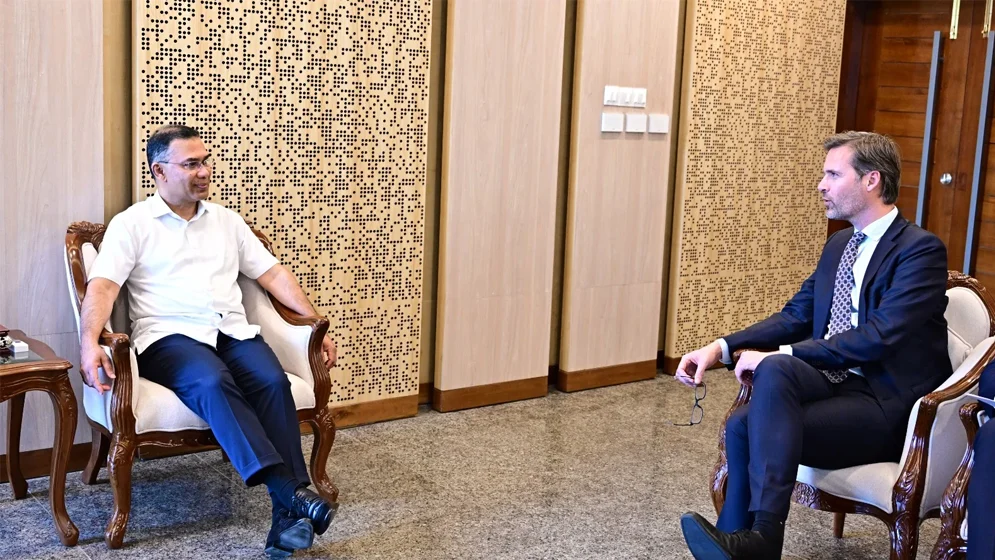
Bangla Press Desk: The government plans to establish three additional floating storage and regasification units (FSRUs) at Payra, Mongla, and Hiron Point by 2029 to expand Bangladesh's Liquefied Natural Gas (LNG) import capacity, says Power, Energy and Mineral Resources Minister Iqbal Hassan Mahmood.
The government had already ordered one new FSRU and was conducting feasibility studies for the three proposed terminals while seeking investors, he said on Thursday while speaking as the chief guest at a discussion.
Titled "Navigating Bangladesh's Energy Crisis: Immediate Priorities and the Path to a Sustainable Energy Future", the event was organised by the Centre for Policy Dialogue (CPD) in the capital.
"We are studying these locations -- Payra, then Mongla and Hiron Point -- and we are inviting investors," Mahmood said.
The minister said the recent fire at one of Bangladesh's two existing FSRUs had exposed the risks of depending on limited LNG infrastructure.
Another LNG carrier was anchored beside the terminal when the fire broke out but was quickly moved away, preventing a potentially larger accident.
The damaged FSRU is being repaired by specialised engineers from Britain and Singapore.
Once the second phase of repairs was completed, the terminal would have to be shut down for about 72 hours to synchronise its two boiler systems, Mahmood said, warning that gas supply could deteriorate further during the shutdown.
"We are in a shortage situation right now."
The government had procured four LNG cargoes, which would be unloaded immediately once the FSRU became operational, he said.
"If there had been four FSRUs instead of two, we might not have faced this problem today."
However, he acknowledged that additional terminals alone would not solve the gas shortage because transmission capacity was also constrained.
The government therefore plans to construct an undersea gas pipeline from Chattogram to Bakhrabad to improve transmission to major demand centres.
The government is also stepping up domestic gas exploration through Bangladesh Petroleum Exploration and Production Company (BAPEX), with new wells being drilled and two additional drilling rigs ordered.
"If there is no exploration, where will we get gas from?" Mahmood said.
The government is also exploring the transportation of gas from Bhola to industrial consumers in containers.
A private company has been permitted to use 30 container trucks, while Bangladesh is discussing the required technology and equipment with Malaysia.
The minister said the initiative could provide some relief to industries without waiting for new pipelines.
Syed Nasim Manzur, member of the CPD Board of Trustees and president of the Footwear Leathergoods and Accessories Exporters Association, said the energy crisis was directly undermining industrial competitiveness.
"We need reliable power, affordable power, quality power," he said.
He said factories could not operate efficiently when gas and electricity supply remained uncertain.
Even if uninterrupted supply could not immediately be guaranteed, he stressed, industries needed predictable schedules so they could plan production, arrange labour, and meet shipment commitments.
For exporters, he said, uncertainty was particularly damaging because interruptions in production could result in missed shipment deadlines and affect relationships with international buyers.
The industrial sector, he added, was already under pressure from rising production costs and bank loans, while shortages of gas and electricity were creating an additional burden.
Manzur stressed that the problem was therefore not simply how much energy was supplied, but whether it was reliable, affordable, and of an acceptable quality.
His comments came as industrial representatives warned that production disruptions were making it increasingly difficult for businesses to retain customers and manage costs.
Anwar-Ul-Alam Chowdhury Parvez, president at the Bangladesh Chamber of Industries (BCI), said the crisis had pushed the industrial sector into deep distress, while growing publicity around the energy shortages was increasing the risk of losing foreign orders for the readymade garment sector.
He said businesses were at risk of becoming loan defaulters as they had to pay high energy bills despite not receiving fuel supply on time.
The BCI president called for the highest priority to be given to gas supply for industries and urged the government to provide an emergency "rescue package" to protect businesses and employment.
CPD Executive Director Dr Fahmida Khatun said the crisis had accumulated over many years and required both immediate measures and long-term reforms.
Dr Sakib Bin Amin, an economics professor at North South University, called for reducing gas losses, improving energy efficiency, and removing barriers to rooftop solar, while energy expert Rubiya Binte Mustafiz highlighted illegal connections, leakage, and weaknesses in distribution management.
Institute for Energy Economics and Financial Analysis (IEEFA) Lead Energy Analyst Shafiqul Alam cautioned against relying excessively on LNG imports because of their fiscal cost and exposure to international price volatility.
Bangladesh Independent Power Producers' Association (BIPPA) President David Hasanat described the situation as an emergency.
Bangladesh Sustainable and Renewable Energy Association (BSREA) President Mostafa Al Mahmud called for faster renewable-energy development, while energy expert Professor Ijaz Hossain said efficiency, demand management, pricing reforms, and additional supply would all be necessary.
The scale of the gas crisis was highlighted in a CPD presentation by Senior Research Associate Foqoruddin Al Kabir.
The Petrobangla data for August 11 showed that power plants received only 29 per cent of their total gas demand, while fertiliser companies got 38 per cent.
The five gas-producing companies were operating at only 57 per cent of their operational capacity.
The presentation identified four major causes - failure to discover commercially viable new gas fields, transmission and distribution bottlenecks, a widening demand-supply gap, and growing dependence on imported LNG.
It projected that cumulative gas utilisation could reach around 30 trillion cubic feet by 2031, with remaining reserves approaching depletion without new discoveries or intervention.
Domestic gas production has been declining, while LNG imports have increased since 2018, leaving Bangladesh increasingly dependent on imported fossil fuels.
Imported LNG accounted for 28.82 per cent of national gas consumption in FY25, according to the presentation.
Petrobangla's LNG subsidy bill rose to Tk 166 billion, compared with a Tk 60 billion allocation for FY26, while spot LNG prices climbed to $15.88-16.98 per million British thermal units from around $10 earlier this year.
The CPD presentation showed that Bangladesh's energy system remained overwhelmingly dependent on fossil fuels.
Natural gas, coal, and furnace oil together dominate the power generation capacity mix, accounting for 42.15 per cent, 23.41 per cent, and 19.06 per cent, respectively.
Renewable energy and hydropower have only marginal shares.
The CPD presentation recommended a three-stage response.
In the short term, it called for better LNG procurement, pricing and regulatory reforms, stronger social protection, and a review of policies governing private investment.
Medium-term priorities include expanding LNG terminals and storage, strengthening transmission and distribution networks, and adopting time-bound policies to diversify the energy mix and expand renewable energy.
[Bangla Press is a global platform for free thought. It provides impartial news, analysis, and commentary for independent-minded individuals. Our goal is to bring about positive change, which is more important today than ever before.]

 E-paper
.jpg)
.jpg)