Bangla Press Desk: Dhaka has built drains, dredged canals and launched project after project to tackle waterlogging. Billions have been spent. Yet when it rains heavily, much of the capital can still disappear under water for hours.
Residents and urban planners point to a familiar list of failures: poor coordination between agencies, plans left unfinished, irregularities in construction, piecemeal infrastructure, poorly controlled housing developments and the growing pressure of climate change.
The latest reminder came in July.
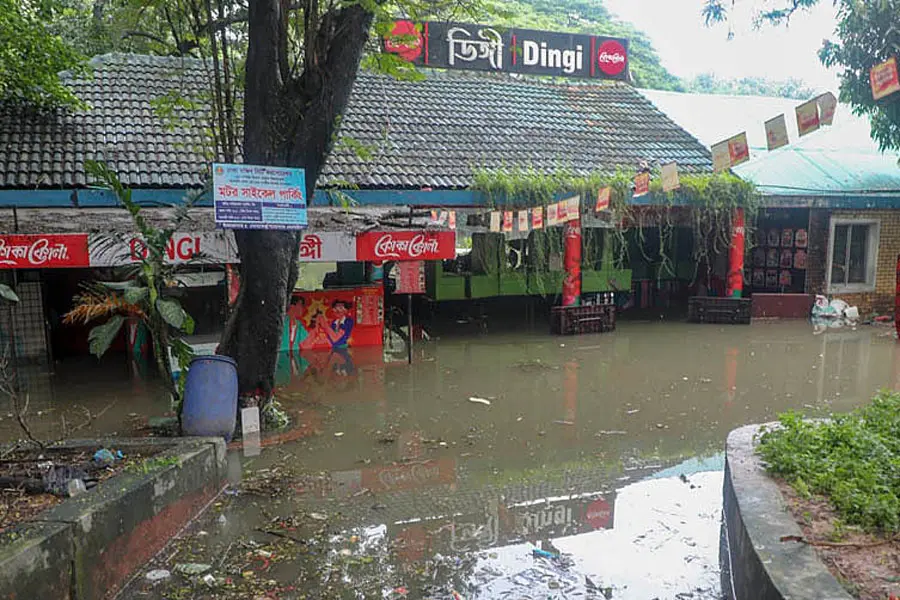
On Jul 12, roads and alleys in Motijheel, Fakirapul, Arambagh, Shantinagar, Rajarbagh, Dhanmondi, Mirpur and other parts of Dhaka were inundated after hours of rain.
The Bangladesh Meteorological Department recorded 82mm of rain between 6am and noon that day and 175mm over 24 hours.
For 9-year-old Samad, who goes by a single name and sleeps rough around Malibagh, flooding means finding somewhere else to spend the night.
“When the water reaches where we sleep, we go and sit on the flyover,” he said. “When the water goes down, we come back.”
Others pay in lost time and income.
Sanjida Sultana left home an hour early during the July rain but still failed to reach work on time. At one point, she took off her shoes and waded through the water.
Rickshaw-puller Abdul Kader said rain would normally bring more passengers and higher earnings. But severe waterlogging can make roads impossible to use, forcing him to stop working.
Hawker Ruhul Amin faces a similar problem. When flooded streets empty, his sales all but disappear.
Money Keeps Flowing
The spending has been substantial.
Figures from Dhaka WASA and the two city corporations show at least Tk 21.46 billion was spent in the decade to 2024 on building and repairing drains, cleaning canals and tackling waterlogging.
Between the 2015-16 and 2019-20 financial years, Dhaka South City Corporation spent about Tk 6.06 billion on drains, while Dhaka North spent Tk 7.11 billion.
Dhaka WASA spent roughly another Tk 1 billion on waterlogging during a similar period. Together, the three agencies spent around Tk 14.16 billion.
Responsibility for canals and stormwater drainage was transferred from WASA to the two city corporations on Dec 31, 2020. Over the next four years, the corporations spent at least another Tk 7.3 billion, taking the total past Tk 21.46 billion by 2024.
That works out at an average of about Tk 5.9 million a day.
And the spending has continued.
The two city corporations had another Tk 1.65 billion allocated for waterlogging-related work in the 2025-26 financial year — Tk 1.15 billion for Dhaka South and Tk 500 million for Dhaka North.
But expenditure has not always translated into drainage.
Between 2016 and 2018, Dhaka South spent around Tk 1 billion on easing waterlogging in Shantinagar and nearby areas, including a roughly 12km stormwater line stretching from Malibagh rail crossing to Bijoynagar.
City corporation officials say the new drains can carry rainwater towards their intended destination. But the water then struggles to move further because downstream WASA pumping stations lack sufficient capacity.
Dhanmondi residents tell a similar story.
In 2021, Dhaka South built a one-kilometre drain under Road 27 at a cost of Tk 204.9 million.
The original plan called for an RCC drain, but the design was changed, and concrete pipes were installed instead.
Residents say the main drain is not cleaned regularly, allowing silt and rubbish to obstruct the flow.
Questions have also been raised over drainage and pavement work on Bailey Road, where a contractor was served a show-cause notice over allegations that specified materials were not used and concrete was poured at night without the responsible engineer present.
Dhaka South Administrator Abdus Salam ordered the work stopped after visiting the site on Aug 2.
Urban planners say much of the money spent over the past decade has addressed immediate problems rather than creating a drainage system capable of meeting the city’s future needs.
Dr Akter Mahmud, an urban planner, said too much of the investment had gone into cleaning drains and canals.
“The investment needed for a sustainable drainage system, taking the future into account, has not been made adequately,” he told bdnews24.com.
Key proposals in Dhaka’s drainage master plan, including retention ponds and lakes to hold rainwater, have largely remained on paper, he said.
141 Waterlogging Hotspots
The scale of the problem is reflected in official figures.
Information presented to parliament on Jun 30 identified 141 waterlogging hotspots across Dhaka’s two city corporations -- 108 in the north and 33 in the south.
Dhaka North has formed 21 quick-response teams across its 10 zones.
For the 2025-26 financial year, it set targets to build 115km of roads and 120km of drains. Work has also been carried out to recover and demarcate 29 canals.
Dhaka South drains water through outlets at Kamalapur-TT Para, Dholaikhal and Hatirjheel.
With those outlets lacking sufficient capacity, the corporation plans to build two more.
Another outlet from Gulistan to Sadarghat is being planned under the World Bank-supported Metro Dhaka Water Security and Resilience Programme.
Meanwhile, a Tk 8.99 billion project has been approved to restore the Kalunagar, Jirani, Manda, and Shyampur canals.
The Cabinet Committee on Economic Affairs approved the scheme on Jun 24, with Dockyard and Engineering Works Ltd, an organisation under the Bangladesh Navy, tasked with implementation.
Too Many Agencies, Too Little Coordination
Dhaka’s drainage system has passed through several sets of hands.
Until 1990 it was managed by the Department of Public Health Engineering. After the 1988 floods, responsibility moved to Dhaka WASA.
At the end of 2020, it was formally transferred again, this time to the two city corporations.
But that handover remains a source of disagreement.
Dhaka North Chief Engineer Brig Gen Syed Rakibul Hasan said WASA transferred 29 of 43 canals without providing documentary records of their precise boundaries and areas.
Dhaka WASA Supervising Engineer Abdul Majid rejected that claim, saying everything from pump houses to manhole covers had been formally handed over.
Abdus Salam, the Dhaka South administrator, blames years of poor management under the former Awami League government.
“The entire metropolis was in a state of mismanagement,” he said. “Now everything has to be brought under accountability.”
The government is also considering a broader overhaul of how the capital is run.
State Minister for Local Government Mir Shahe Alam has advocated a “city government” system, arguing that the agencies responsible for crucial urban services should come under a single authority.
Speaking at a seminar at Dhaka North’s Nagar Bhaban on Jul 15, he said bringing the various departments under the city corporation would not solve every problem, but could resolve “70 to 80 percent” of them.
Asked when such a system might be introduced, he said the government was examining how it could be implemented.
Concrete, Sewage and Changing Climate
Coordination is only part of the problem.
Rakibul points to structural weaknesses beneath the city itself.
Dhaka has about 1,600km of underground drainage pipelines, he said, but the lack of proper sewerage means household waste and sewage frequently enter and block the drains.
He said WASA had failed to provide sewerage lines even in areas such as Gulshan, Banani, and Baridhara.
Major infrastructure projects, including the metro rail and elevated expressway, have also disrupted natural drainage paths during construction, while wetlands have disappeared as Dhaka has expanded.
Climate change is adding another layer of pressure.
Dhaka South Chief Engineer Nur Azizur Rahman said drainage systems were once designed using maximum rainfall of about 140mm as a benchmark.
“Because of climate change, the intensity of rainfall has increased,” he said. “Now we have to consider 300mm.”
The problem is compounded by concrete.
Rahman estimates that because most of Dhaka is now covered by hard surfaces, between 90 and 95 percent of rainwater runs directly into the drainage network instead of soaking into the ground.
Housing developments have also consumed areas that once absorbed or carried floodwater.
A 2014 study published in Sustainable Cities and Society found that around 10,000 hectares of flood-flow zones within the Dhaka Metropolitan Development Plan area had been converted into housing developments.
Rakibul said that even after the transfer of drainage responsibilities, the city corporations still do not have full control over all the relevant infrastructure, including some facilities inside private housing projects.
Urban planner Adil Muhammed Khan said that lack of state control was unacceptable.
A city corporation must be able to enter and work effectively inside housing developments, he argued, while government agencies need much stronger oversight at the planning, approval and construction stages.
Plans Made, Not Delivered
Urban planners do not believe Dhaka’s waterlogging is impossible to solve.
The deeper problem, they say, is that plans already drawn up have not been fully implemented.
Akter Mahmud said earlier studies carried out when WASA managed drainage had identified catchment-based water routes and outlets needed to move stormwater out of the city.
But major elements of the drainage master plan were never delivered.
“For years, we have mostly cleaned canals or recovered and protected parts of them,” he said.
“But the main proposals in the drainage master plan have not been implemented.”
Among them were five retention ponds, links between those reservoirs and their surrounding catchment areas, and measures to keep natural water routes free of obstructions.
“Those things were not done,” Mahmud said. “That is why the problem now seems almost impossible.”
Almost — but not quite.
He argues that the city can still bring waterlogging under control if it returns to the 2015-16 drainage master plan and delivers its central proposals.
Around 80 percent of Dhaka is now built up, he said, making it impossible to restore the city to its earlier condition.
With more concrete and other impermeable surfaces, rainwater reaches the streets far faster, while many existing drainage channels cannot handle the volume.
That means completely eliminating waterlogging everywhere may no longer be realistic.
But keeping drainage routes clear, recovering and protecting canals, and creating places where rainwater can be held are still achievable.
“The drainage channels have to be kept free of obstructions, the canals must be recovered and protected, and water-retention areas must be created,” Mahmud said.
“These things can be done. They have to be done.”
His warning goes beyond flooded streets.
“Dhaka could eventually become a city people abandon for many reasons,” he said. “Waterlogging could be one of them.”
His prescription, however, is less dramatic: stop producing new fixes for an old problem and implement the major proposals already sitting in the drainage master plan.
[Bangla Press is a global platform for free thought. It provides impartial news, analysis, and commentary for independent-minded individuals. Our goal is to bring about positive change, which is more important today than ever before.]

 E-paper
.jpg)
.jpg)