Bangla Press Desk: A high-level expert panel under the Power Division has uncovered extensive irregularities and corruption in numerous power sector contracts, including deals with India’s Adani Group. The committee found that during the tenure of the ousted Awami League government, widespread graft took place through collusion among private power producers, senior officials, and political figures — a nexus that ultimately drove electricity prices sharply upward.
The committee’s data show that electricity in Bangladesh now costs 25% more than in competing countries — and 40% more if subsidies are excluded. Over the past 14 years, power generation has increased fourfold, but costs have soared elevenfold. In 2011, Bangladesh spent $638 million on power purchases; by 2024, that figure had ballooned to $7.8 billion.
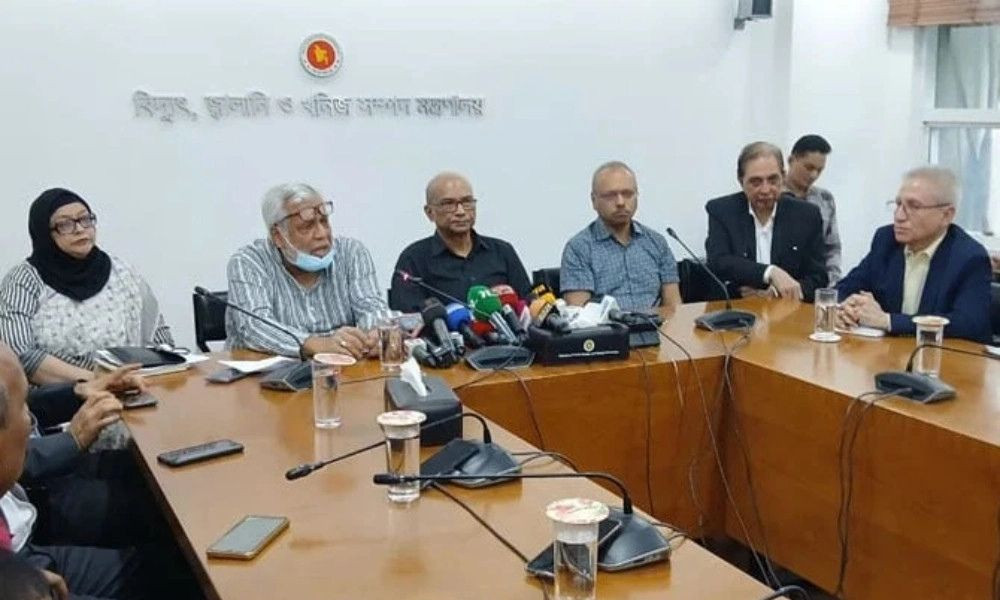
The National Committee, formed to review power sector contracts made under special provisions, submitted its interim report yesterday to Muhammad Fouzul Kabir Khan, adviser to the Ministry of Power, Energy and Mineral Resources.
The committee, chaired by retired Justice Moinul Islam Chowdhury, includes BUET Pro-Vice Chancellor Abdul Hasib Chowdhury, former KPMG Bangladesh COO Ali Ashraf, former World Bank lead economist Dr. Zahid Hossain, University of London professor of law and social science Dr. Mushtaq Hossain Khan, and Supreme Court lawyer Dr. Shahdeen Malik. The committee was formed in September last year and is expected to submit its final report by January next year.
During a press briefing, Adviser Fouzul Kabir said that if irregularities are proven in Adani’s contract, it will be canceled without hesitation. “Every contract contains a declaration that no corruption was involved. If that clause is violated, the agreement can be annulled. However, the court will require concrete evidence, not just verbal claims,” he said.
Asked what action would be taken against officials implicated in corruption, he said, “If we get cooperation from everyone, the Anti-Corruption Commission (ACC) will take action. We will share all the information with the ACC. There isn’t much scope for departmental action since many of the officials have already retired.”
Committee convener Justice Moinul Islam stated that “massive irregularities and corruption” took place under the Quick Rental Power Act, causing serious environmental damage in the name of various projects. “These contracts were made with companies from several countries, including India’s Adani Group. All involved will be brought under the law,” he said.
Professor Mushtaq Hossain Khan explained that these are sovereign contracts—agreements between a state and a company recognized under international law. “You cannot arbitrarily cancel such contracts; doing so could invite huge penalties from international arbitration courts,” he cautioned. “We took time to carefully examine where the procedures were breached. Some findings are ongoing, so not everything has been disclosed in the interim report.”
He added, “There has been widespread corruption, which must be stopped. Due to this corruption, the price of electricity in Bangladesh is already 25% higher than in competitor countries — and will reach 40% higher if subsidies are removed. At such costs, our industries cannot survive. These contracts must be corrected.”
He further said, “Our report identifies where and how interference occurred and who issued unlawful orders. The administration was not always innocent — we found proof of that. The burden has fallen on ordinary taxpayers and consumers. Those who profited and left must be held accountable. We are gathering evidence and will take action, but it’s a complex process. Rushing it could lead to mistakes.”
He also mentioned that two writ petitions have been filed regarding the special law-based contracts. “The first was by Dr. Shahdeen Malik. In the second, the court ordered the ACC and other relevant agencies to submit a report within 60 days. We are assisting in that process. Within a month, you will see strong evidence of this corruption,” he said. “Once that happens, Adani and several other large companies involved in these irregularities will face legal proceedings both domestically and internationally.”
Dr. Zahid Hossain, former lead economist of the World Bank, said, “We reviewed all power purchase agreements and related correspondence from 2008–09 to 2024. The Power Division shared financial data from the Economic Council with us. Our analysis found major discrepancies between the money paid and the electricity actually received.”
He noted, “Between 2011 and 2024, electricity generation increased fourfold, but payments grew 11.1 times — from $638 million to $7.8 billion. When we compare who received the payments and how much power was delivered in return, the numbers don’t add up.”
Lawyer Dr. Shahdeen Malik said, “There is sufficient evidence to justify the cancellation of several contracts. However, if we cancel unilaterally, the companies may take the matter to international arbitration and claim up to $5 billion in damages. Therefore, any decision to terminate must be carefully considered.”
BP/SP
[Bangla Press is a global platform for free thought. It provides impartial news, analysis, and commentary for independent-minded individuals. Our goal is to bring about positive change, which is more important today than ever before.]

 E-paper
.jpg)
.jpg)
.jpg)
.jpg)