
From Streets to Screens: Bangladesh’s New Battle Against Extremism

Bangla Press
Published: 19 July 2026, 01:14 AM
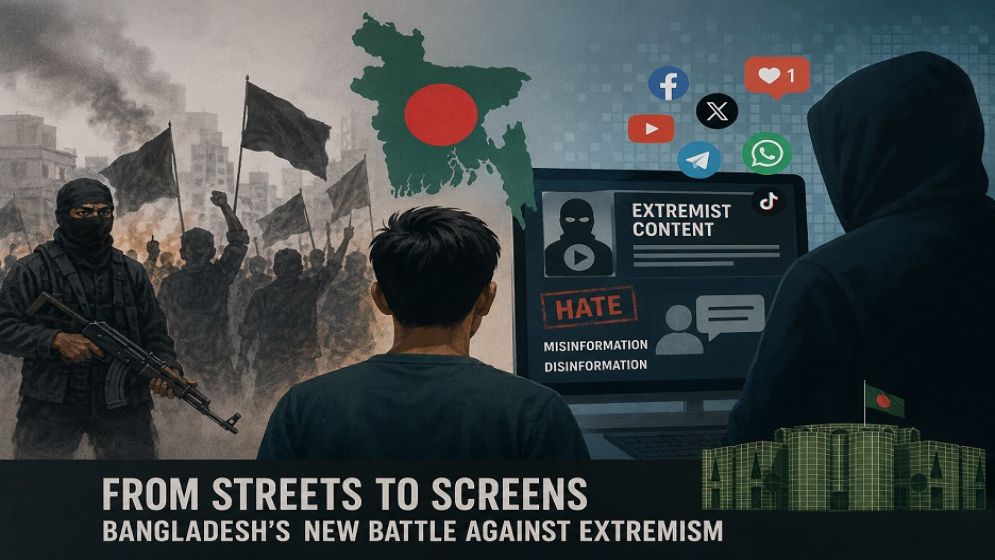
Bangla Press Desk: The issue of violent extremism has returned to the centre of Bangladesh’s national conversation following Prime Minister Tarique Rahman’s statement in Jatiya Sangsad on July 15 that his government would maintain “zero tolerance” towards extremism and militancy. Yet the challenge extends far beyond any single government or political period. How Bangladesh responds to violent extremism will have long-term consequences for its security, economy and social harmony.
For a country seeking sustained economic growth, foreign investment and deeper integration with the global economy, stability is not simply a political objective — it is an economic necessity. Investors look beyond infrastructure and market opportunities; they also consider institutional strength, public security and confidence in the rule of law.
Bangladesh’s own experience demonstrates that extremist violence carries a heavy human, economic and reputational cost.
On August 17, 2005, Jama'atul Mujahideen Bangladesh (JMB) carried out coordinated bomb attacks across 63 districts, detonating more than 450 improvised explosive devices in a short period. The attacks targeted state institutions and marked a major escalation of organised militancy.
More than a decade later, the July 1, 2016 Holey Artisan Bakery attack in Dhaka’s Gulshan diplomatic area became Bangladesh’s most internationally damaging terrorist incident. Twenty hostages, mostly foreign nationals, and two police officers were killed during the 12-hour siege. The attack damaged Bangladesh’s global reputation at a time when the country was expanding trade, investment and international engagement.
The economic consequences of extremism are often less visible than the immediate human tragedy. Terrorist attacks and extremist intimidation create uncertainty, increase security costs and weaken investor confidence. The greatest burden ultimately falls on ordinary citizens, particularly young people whose opportunities depend on a stable economy.
International experience also offers important lessons. Pakistan’s prolonged struggle with militant groups demonstrates how extremist organisations, once they gain organisational capacity and ideological influence, can become serious internal security threats. Containing such movements becomes increasingly difficult after they establish social networks.
Bangladesh continues to face concerns over the spread of extremist narratives in public discourse. The challenge has now expanded into the digital world. Extremist messaging no longer depends only on underground organisations or physical networks. Social media platforms allow individuals and groups to rapidly spread misinformation, inflammatory messages and conspiracy theories, sometimes transforming online anger into real-world mobilisation.
The influence of online platforms became particularly visible during unrest following the killing of Inquilab Mancha spokesperson Osman Hadi in December 2025. Public anger surrounding the incident was amplified through online mobilisation. The resulting unrest contributed to attacks and vandalism targeting a diplomatic mission, cultural institutions and media organisations.
Violent demonstrations outside the Indian Assistant High Commission in Chattogram resulted in damage to diplomatic property and injuries among law enforcement personnel.
Cultural institutions have also faced pressure from extremist elements. Organisations such as Udichi and Chhayanaut, which represent Bangladesh’s cultural heritage and pluralistic traditions, have repeatedly faced hostility from groups seeking to narrow the space for cultural expression and public debate.
Addressing this challenge requires a careful balance. A democratic society must protect freedom of expression and legitimate political criticism. At the same time, no individual or platform — whether operating inside or outside Bangladesh — should be allowed to encourage violence, intimidation or attacks on institutions.
The period following the 2024 political transition also generated debate over Bangladesh’s counter-extremism efforts. The interim administration led by Dr Muhammad Yunus stated that there was no scope for the return of Islamic extremism and that maintaining security and social stability remained a priority. However, critics, security observers and rights organisations raised concerns that institutional disruption, political uncertainty and weaknesses in coordination created opportunities for radical groups to become more visible.
Reports highlighted increased online mobilisation and public activities by individuals associated with hard-line ideologies. Supporters of the interim administration disputed some interpretations, arguing that many incidents reflected wider law-and-order challenges rather than a resurgence of organised terrorism.
The escape of prisoners, including individuals linked to banned militant organisations, during the Narsingdi District Jail incident in July 2024 also raised concerns about institutional vulnerabilities. Although many escapees were later recaptured, the incident reinforced the importance of strong security institutions and effective intelligence coordination.
The activities and public visibility of figures who were released from prison during the interim administration and identified by security agencies as an ideological figure associated with the banned Ansarullah Bangla Team. They also have faced allegations related to extremist rhetoric, and have renewed debate over how Bangladesh should address radicalisation. These cases demonstrate the difficult balance between preventing incitement to violence and ensuring due process.
Bangladesh must also remain cautious about the political use of extremist forces. Experiences from other countries show that short-term alliances with hard-line groups can produce long-term consequences. Once intolerance becomes normalised, it can threaten institutions and communities across political boundaries.
For Bangladesh’s youth, the fight against extremism is ultimately about the future they will inherit. A country competing for investment, technology, education and global opportunities requires stability, openness and trust in its institutions. Extremism offers the opposite: isolation, fear and economic uncertainty.
The response must therefore go beyond security measures alone. Bangladesh needs stronger institutions, quality education, employment opportunities, responsible public discourse and greater digital awareness. Political disagreements are a normal part of democracy, but protecting citizens from violence and extremist threats must remain a shared national responsibility.
Bangladesh’s future will not be shaped only by political promises. It will depend on whether its institutions consistently uphold the principles of law, accountability and tolerance. The country’s development achievements have created historic opportunities for the next generation. Protecting those gains requires ensuring that extremism and violence do not determine the nation’s path forward.
[Bangla Press is a global platform for free thought. It provides impartial news, analysis, and commentary for independent-minded individuals. Our goal is to bring about positive change, which is more important today than ever before.]
YOU MAY ALSO LIKE

Bangladesh
Weather office reveals when winter will set in across the country.
2 hours ago
by Bangla Press
.jpg)
Bangladesh
100 flights on Dhaka-Saudi route cancelled or suspended; 15,000 passengers face hardship.
2 hours ago
by Bangla Press
.jpg)
Bangladesh
Prime Minister Seeks Citizens’ Cooperation to Tackle Dengue Risks in Video Message
3 hours ago
by Bangla Press
.jpg)
Bangladesh
Market Irregularities: 120 Establishments Fined Nearly Tk 10 Lakh Across 46 Districts
14 hours ago
by Bangla Press
Sangeet Academy