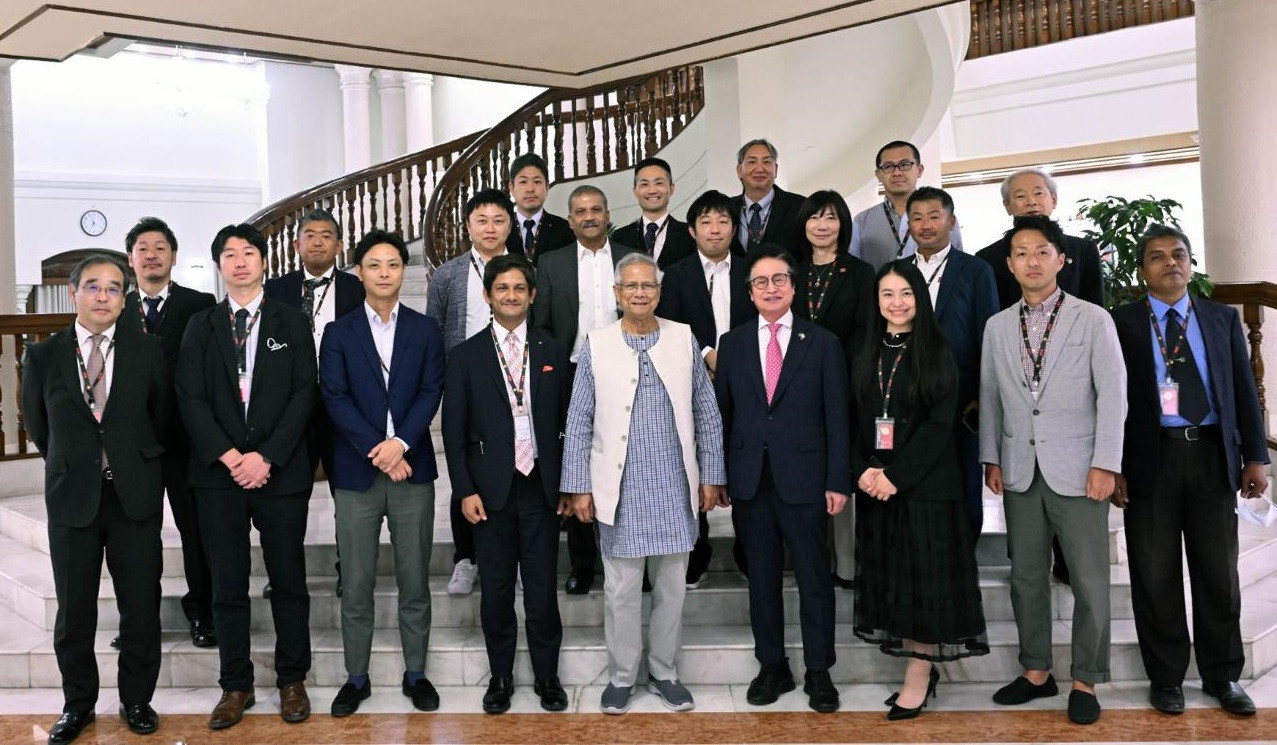
Bangla Press Desk: A 23-member delegation from Japan’s National Business Support Combined Cooperatives (NBCC) met with Chief Adviser Professor Muhammad Yunus on Sunday afternoon at the state guesthouse Jamuna to discuss progress in recruiting 100,000 skilled Bangladeshi workers for Japan.
During the meeting, Expatriates’ Welfare and Employment Adviser Dr Asif Nazrul and the Chief Adviser’s SDG Affairs Coordinator Lamia Morshed were also present.
NBCC, a federation of more than 65 Japanese companies, recently signed a Memorandum of Intent (MoI) with Bangladesh to establish a framework for training, certification, and employment of Bangladeshi workers in Japan. Under this agreement, over 100,000 workers are expected to be recruited over the next five years through the Technical Intern Training Programme (TITP) and the Specified Skilled Workers (SSW) scheme.
According to delegation members, the first phase of recruitment—comprising 2,000 skilled workers—is already underway and expected to be completed next year. In subsequent phases, 6,000 workers will be hired in 2027 and 18,000 in 2028.
The highest demand is expected in the construction, service, aviation, garment, and agriculture sectors, while the need for skilled workers in driving, automobile maintenance, and recycling is also projected to rise in the coming years.
To prepare the workforce, two training centres have been established in Khulna and Kapasia (Gazipur), where potential recruits are receiving specialised instruction. The NBCC delegation has already inspected these facilities.
Chief Adviser Yunus inquired whether there were any deficiencies in the training system. In response, NBCC Chairman Mikio Kesagayama said he had visited the centres in March and was impressed by the progress made within seven months. “We are very satisfied with the training standards and optimistic about recruiting 2,000 skilled workers next year,” he said.
However, Kesagayama noted that improving instructors’ language proficiency would further enhance training quality.
Highlighting language skills as the key challenge, Professor Yunus suggested introducing virtual Japanese language classes. “Teachers from Japan could conduct online sessions, and we may also consider bringing Japanese instructors to Bangladesh for hands-on training,” he said.
The Chief Adviser praised the skill and dedication of Bangladeshi women, especially in the caregiving sector. “Bangladeshi women are exceptionally caring. With language and professional training, they could make a remarkable contribution to Japan’s caregiving industry,” he said, adding that once trained, they could also teach others and create a sustainable cycle of empowerment.
The NBCC delegates informed that Japan will require over 400,000 skilled nurses in the coming years and expressed interest in recruiting more women from Bangladesh for caregiving roles.
Adviser Dr Asif Nazrul stated that the government is closely monitoring the progress of the Japan recruitment initiative and will soon develop a specific roadmap to ensure smooth implementation. He also mentioned that a dedicated cell has been formed within the ministry to address any issues related to worker deployment to Japan.
BP/TD
[Bangla Press is a global platform for free thought. It provides impartial news, analysis, and commentary for independent-minded individuals. Our goal is to bring about positive change, which is more important today than ever before.]

 E-paper

.jpg)
.jpg)
.jpg)
.jpg)