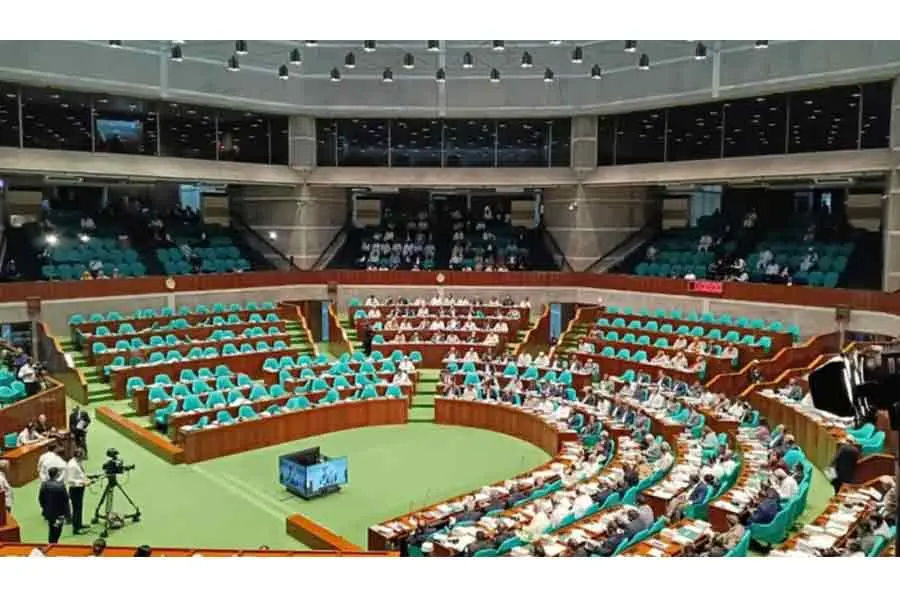
Bangla Press Desk: Parliament on Wednesday passed the Bank Resolution (Amendment) Bill, 2026, scrapping a controversial provision that had created an avenue for former shareholders of banks brought under resolution to regain shares, assets and liabilities.
The passage of the bill came amid an uproar in the House after independent MP Rumeen Farhana launched a scathing criticism of the BNP while taking part in the debate, prompting loud protests from ruling party lawmakers.
Finance Minister Amir Khosru Mahmud Chowdhury moved the bill, which was passed by voice vote after disposal of proposals for public opinion, sending the bill to a scrutiny committee and amendments.
The bill repeals Section 18(a) of the Bank Resolution Act, 2026.
The provision allowed shareholders who had held shares in a bank before it was brought under a resolution process to apply to Bangladesh Bank to reacquire shares, assets and liabilities of the bank.
Bangladesh Bank could also offer the same opportunity to another suitable person under the provision.
Section 18(a) had drawn widespread criticism, particularly in connection with the merger of five troubled Islamic banks into Sammilito Islami Bank PLC, amid concerns that former and disputed directors and shareholders could eventually return to ownership.
The provision was not included in the Bank Resolution Ordinance issued by the interim government.
It was subsequently incorporated when the ordinance was amended and approved after the BNP-led government assumed office.
Explaining the decision to repeal the provision, Finance Minister Khosru said no individual, shareholder or institution had come forward to meet all the conditions prescribed under Section 18(a) since the law came into effect.
He said the provision had originally been introduced to create a market-based mechanism for restructuring distressed scheduled banks.
According to the minister, the objective was to address capital shortages and liquidity problems, protect depositors and investors, and reduce pressure on public funds without liquidating affected financial institutions.
He said the provision contained stringent conditions intended to ensure that only eligible and capable entities could participate in the restructuring of a bank.
“As the underlying objective of the section could not be realised in practice, we have decided to scrap it,” Khosru said.
The repeal, however, triggered a separate political confrontation in the House during the bill’s debate.
Rumeen Farhana criticised the BNP, saying the party’s return to power would inevitably bring back problems such as gas and electricity shortages, fertiliser crisis, corruption and loan defaults.
She also alleged that Bangladesh would again rank among the worst performers in corruption under a BNP government.
Her remarks triggered loud protests from BNP lawmakers.
Amid the uproar, Rumeen Farhana said the House had become “intolerant” and compared the behaviour of BNP lawmakers with that of Awami League lawmakers during the previous government.
She alleged that some ruling party members had also used offensive language against her.
Her allotted speaking time ended during the commotion and her microphone was switched off, but she continued speaking without a microphone.
Deputy Speaker Barrister Kayser Kamal repeatedly asked lawmakers to maintain order, stressing that every MP had the right to express his or her views.
“An honourable member is speaking. She has the freedom to speak. But obstructing her from delivering her speech is outside democratic parliamentary practice,” he said.
The Deputy Speaker also told the chief whip that lawmakers could respond to Rumeen Farhana’s remarks when their turn came, but should not obstruct her speech.
National Citizen Party MP Abdul Hannan Masud stood in protest after Rumeen Farhana alleged that she had been subjected to abusive remarks. He said no MP should be insulted in such a manner.
Leader of the Opposition Dr Shafiqur Rahman later questioned whether Rumeen Farhana had been able to exercise her parliamentary right to speak because of the disruption. “If a member’s remarks are unparliamentary, the Speaker can rule on them, and the minister concerned can respond,” he said.
Chief Whip Nurul Islam Moni called for healthy debate in Parliament, saying lawmakers should not create problems while trying to resolve the country’s problems.
He also said the government had inherited a fragile economy and political situation and suggested that Rumeen Farhana should also be mindful of her remarks.
The Deputy Speaker responded that the chief whip also had a responsibility to maintain order and allow lawmakers to speak.
Finance Minister Khosru expressed frustration over the disruption, saying the debate had become largely irrelevant to the bill.
“I could not understand what the issue was. What did I say and what was the discussion? I may have failed to understand the matter,” he said, describing the discussion as “completely irrelevant”.
Shafiqur Rahman said Rumeen Farhana’s remarks might not all have been appropriate, but the disruption meant lawmakers could not hear what she had actually said.
The bill was eventually passed by voice vote, with ruling party lawmakers voting in favour while opposition lawmakers did not participate in the vote. Rumeen left the chamber during the passage of the bill.
Prime Minister Tarique Rahman was not present in the chamber during the uproar and passage of the bill.
[Bangla Press is a global platform for free thought. It provides impartial news, analysis, and commentary for independent-minded individuals. Our goal is to bring about positive change, which is more important today than ever before.]

 E-paper
.jpg)

.jpg)