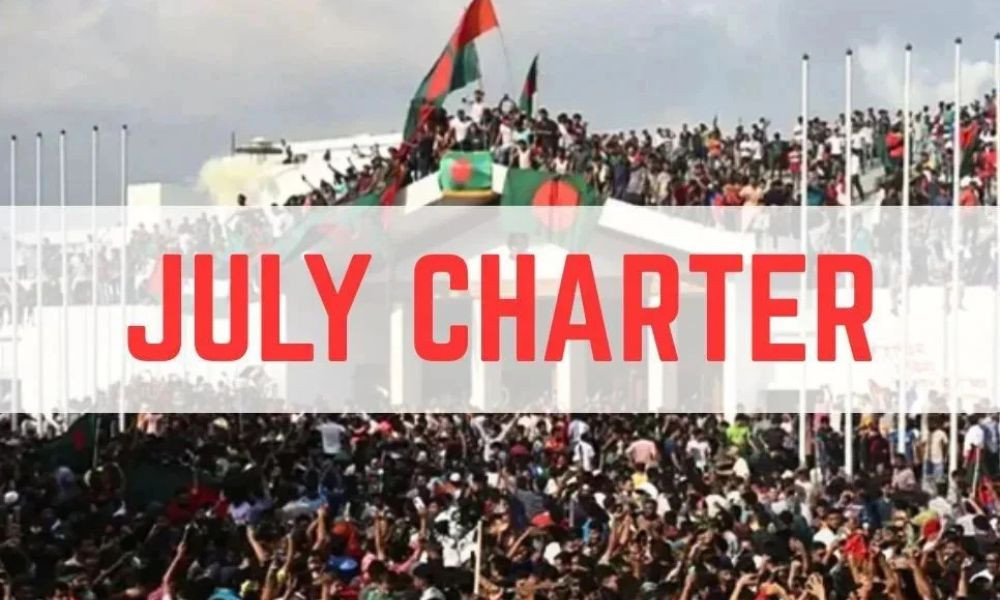
Bangla Press Desk: If all goes according to plan, political parties are scheduled to sign the July Charter on 17 October. Yet uncertainty remains over whether every party will actually sign it.
Earlier this week, the National Consensus Commission distributed copies of the charter to the parties. Upon examining the document, it appears that the Commission’s approach leans more toward highlighting divisions among political groups than promoting unity. Originally, it was agreed that only the issues enjoying unanimous support would be included in the charter. However, the version circulated now also incorporates disputed matters, even specifying which parties opposed particular proposals.
According to leaders from several parties, this was not the original understanding. They said that the charter was supposed to be finalized only with the issues on which there was full agreement among the parties. By identifying and highlighting disagreements, the Commission appears to have encouraged division instead of unity. Analysts note that most of these points of disagreement are irrelevant before the upcoming national election. Such matters should be resolved in Parliament, not by the Commission.
For instance, Clause 4 of the July Charter concerns constitutional amendments. It states that amendments would require approval from two-thirds of the lower house and a majority of the upper house. However, no country in the world gives such authority to its upper house. Several parties, including the BNP, did not support this proposal. The upper house does not even exist yet, and its structure and functions should be determined by elected representatives, not imposed prematurely.
Clause 11 deals with the powers of the president. It proposes granting the president sole authority to appoint the heads of six commissions, such as the National Human Rights Commission, the Information Commission, and the Law Commission. It also suggests giving the president unilateral power to appoint the Bangladesh Bank governor and the chairperson and members of the Energy Regulatory Commission. This contradicts the spirit of parliamentary democracy. The BNP and several other parties have objected to this clause for that reason.
Clause 15 proposes that the prime minister cannot simultaneously serve as the head of a political party. This idea is not only unsuitable for Bangladesh but also contrary to democratic practices worldwide. It would undermine party leadership structures, create internal conflicts, and weaken democracy. Clause 16 makes the caretaker government formation process unnecessarily complicated. Bangladesh had a caretaker government system in the constitution until 2011, and simply restoring that system could solve the problem. Instead, the Commission has suggested a new and complex model that even requires a separate commission to form a caretaker government—something BNP and others have opposed. Whose interests does this serve?
Currently, a debate is ongoing about the proportional representation (PR) system. Jamaat-e-Islami has brought it up as part of its political strategy. Should such a divisive topic have been included in the July Charter? The Commission has proposed forming the upper house based on the proportion of votes received in lower house elections. Naturally, the BNP and several other parties have opposed this idea. Another proposal allows the upper house to take up to two months to approve a bill, which could slow down governance. Several parties suggested reducing that period to one month.
The Commission’s recommendations on international treaties reflect its inexperience in statecraft. Clause 26 proposes that all international treaties require parliamentary approval. However, many treaties are confidential, and their secrecy is part of the agreement itself—as seen recently with the U.S. trade agreement.
There are several other proposals that could hinder governance. For example, the idea of forming three separate public service commissions instead of one is unnecessary. Similarly, Clause 42 suggests making the Anti-Corruption Commission a constitutional body—an unrealistic and even absurd proposal. Clause 60, which deals with bar association and bar council elections, is seen as an interference in citizens’ political rights.
The core spirit of the July Charter was to build a united Bangladesh and move forward in harmony. But the current draft emphasizes division instead. Even if all parties eventually sign it, how will it be implemented? If the BNP disagrees with certain clauses, why would it accept them if it comes to power? Likewise, if Jamaat wins, will it adopt BNP’s proposals? Therefore, the central goal of this charter should be the advancement of democracy. It should be up to the people’s elected representatives to determine how the future Bangladesh will be governed.
BP/SP
[Bangla Press is a global platform for free thought. It provides impartial news, analysis, and commentary for independent-minded individuals. Our goal is to bring about positive change, which is more important today than ever before.]

 E-paper
.jpg)
.jpg)
.jpg)
.jpg)