Drug Dealers Operate Freely Along Karwan Bazar Rail Corridor

Bangla Press
Published: 22 June 2026, 02:09 AM
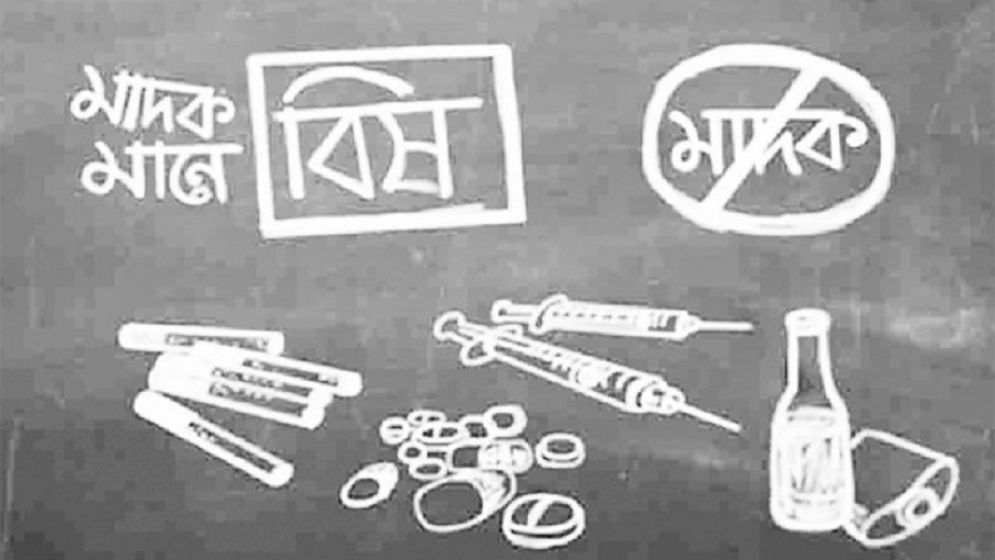
Bangla Press Desk: The Karwan Bazar level crossing in the capital sits at the junction of three police station jurisdictions—Hatirjheel, Tejgaon and Tejgaon Industrial Area. Yet despite its strategic location, drug trafficking continues openly and unabated.
At around 11:00pm one night, Kamrul Islam was crossing the railway tracks near the junction when a young man standing nearby called out: “How many?”
Kamrul noticed yaba tablets in the man's hand but initially ignored him. The dealer repeated the question. When Kamrul asked about the price, the man replied that each yaba pill cost Tk300.
Although Kamrul showed no interest in buying, the dealer persisted.
“Take some. It's good quality. Once you try it, you'll come back tomorrow. We have cannabis too,” he said.
The incident occurred last Tuesday night. Accompanying Kamrul at the time was this correspondent.
Just 30 steps further along the railway line towards Tejgaon level crossing, three young men were seen standing with yaba and cannabis in their hands.
Again came the familiar call: “How many do you need?”
As Kamrul continued walking without responding, one of the men followed him.
“Take some. You won't be disappointed. Two pills for Tk550,” he said, while carrying a sharp knife.
A short distance ahead, several men and women were sitting beside the tracks smoking cannabis. Seeing Kamrul, one woman asked: “How many packets do you want?”
She was openly selling cannabis.
Near the narrow pathway leading to the railway tracks beside the dried-fish and rice market areas of Karwan Bazar, an elderly man was observed selling both cannabis and yaba.
One customer purchased cannabis from him after inspecting the packet.
Posing as a drug user, this correspondent asked whether there was a place nearby to consume yaba. The man pointed towards a room near the railway line and replied: “You can use it there. Buy me a cup of tea and I'll provide the fuel.”
He identified himself as Mamun.
Following the initial visit on Tuesday night, this correspondent returned to the area on Wednesday afternoon and Thursday morning.At around 2:00pm on Wednesday, while walking from Tejgaon level crossing to Karwan Bazar level crossing, at least 30 men and women were seen selling packets of cannabis along both sides of the railway line.
All carried black packets containing narcotics.
The same scene was observed again on Thursday morning.
Throughout the three days of observation, no police presence was seen in the area.
The dealers have developed a discreet method of attracting customers. As pedestrians pass by, they softly utter the word "koda"—a coded reference understood by drug users. If necessary, they raise their voices and ask directly whether the passer-by wants drugs.
If a potential buyer responds, transactions are completed quickly.
According to locals, this is not a recent phenomenon. Drugs have been sold openly in the area around the clock for years.
Various locations across Karwan Bazar have become regular trading points for narcotics.
Network of dealers
Local sources say several major drug traffickers operate in the Karwan Bazar area.
Among those frequently named are Ratan of Tongi, Iqbal of Uttara, Pranti of Nakhalpara, Jahangir of Malibagh and Montu Mia.
Police are reportedly aware of these individuals.
The traffickers employ numerous street-level sellers. If one dealer is arrested, another immediately takes their place.
A seller earns around Tk10 commission for each yaba pill sold, with higher commissions availablein some cases. Commissions are also paid on cannabis sales.According to local sources, Selina Akter of Mollah Bari slum and several of her sisters are involved in drug dealing.
Many others, both large- and small-scale operators, are allegedly conducting business openly under the nose of law enforcement.
Residents and traders allege that drug sales continue through arrangements involving corrupt officials and local political figures.
Drug dens along railway corridor
The western side of the railway market falls under Tejgaon Police Station, while the eastern section falls under Tejgaon Industrial Area Police Station.
Although structures on the Tejgaon side have largely been demolished, numerous small houses remain on the Industrial Area side.
Local residents and police sources confirmed that many of these structures belong to drug traffickers or their associates.
The traffickers themselves generally live elsewhere in Dhaka and use the buildings primarily for storing and distributing drugs.
Adjacent to the railway line is Mollah Bari slum.
One resident, speaking on condition of anonymity, claimed: “Many people in the slum are involved in drugs. Almost all the sellers along the railway line live here. Drugs are stored in the slum and in the houses beside the tracks. Anyone who speaks out is forced to leave. Police take money. Sometimes officers are even attacked when they try to make arrests.”
Traders accuse authorities of turning a blind eye
Several businessmen and local residents told this correspondent that law enforcement tends to arrest buyers rather than sellers.
“The dealers pay money, so they remain untouched,” one rice trader alleged.
“Karwan Bazar is home to numerous media organisations, two police stations and the Department of Narcotics Control. Everyone knows what is happening. You can understand for yourself why nobody speaks up.”
Rejecting allegations that police receive money from drug traffickers, Tejgaon Police Station Inspector (Operations) Abdul Hannan said drug dealing occurs along railway corridors across the country.
“We arrest drug dealers every day. But within 15 minutes of arresting one person, another takes their place,” he said.
“If we conduct operations along the railway line or inside the slums, we never go with fewer than ten officers because the traffickers often attack in groups.”
Tejgaon Police Station Sub-Inspector Joydeb described a recent incident in which officers arrested a suspect carrying yaba.
“As soon as we made the arrest, nearby dealers disappeared. Then two men approached us carrying local weapons. There were only two officers present, so we had to withdraw temporarily. Otherwise, they might have attacked us,” he said.
“Karwan Bazar is a dangerous area.”He added that one female dealer told police she earns between Tk80,000 and Tk100,000 a month from selling cannabis and yaba.
“She never struggles to arrange bail money, which is why she has continued the same activities for years,” he said.
‘The Trade Will Continue Until the Slums Are Removed’
Tejgaon Industrial Area Police Station Officer-in-Charge Muhammad Mahbubur Rahman acknowledged the longstanding nature of the problem.
“Drug trafficking existed here before and it continues today,” he said.
“Many families living in the slums beside the railway tracks are involved in selling drugs. Until the city corporation removes those settlements, it will be difficult to stop the trade.”
He added that even when suspects are arrested, they often secure bail within days and return to their previous activities.
“Whenever we try to arrest them, they frequently resist and attack law enforcement personnel,” he said.
Source: Kaler Kantho
[Bangla Press is a global platform for free thought. It provides impartial news, analysis, and commentary for independent-minded individuals. Our goal is to bring about positive change, which is more important today than ever before.]
YOU MAY ALSO LIKE

Bangladesh
Weather office reveals when winter will set in across the country.
6 hours ago
by Bangla Press
.jpg)
Bangladesh
100 flights on Dhaka-Saudi route cancelled or suspended; 15,000 passengers face hardship.
6 hours ago
by Bangla Press
.jpg)
Bangladesh
Prime Minister Seeks Citizens’ Cooperation to Tackle Dengue Risks in Video Message
7 hours ago
by Bangla Press
.jpg)
Bangladesh
Market Irregularities: 120 Establishments Fined Nearly Tk 10 Lakh Across 46 Districts
18 hours ago
by Bangla Press
Sangeet Academy