

GTC Charity Home Focuses on Community Development from Mine Profits

Bangla Press
Published: 23 June 2026, 01:30 PM
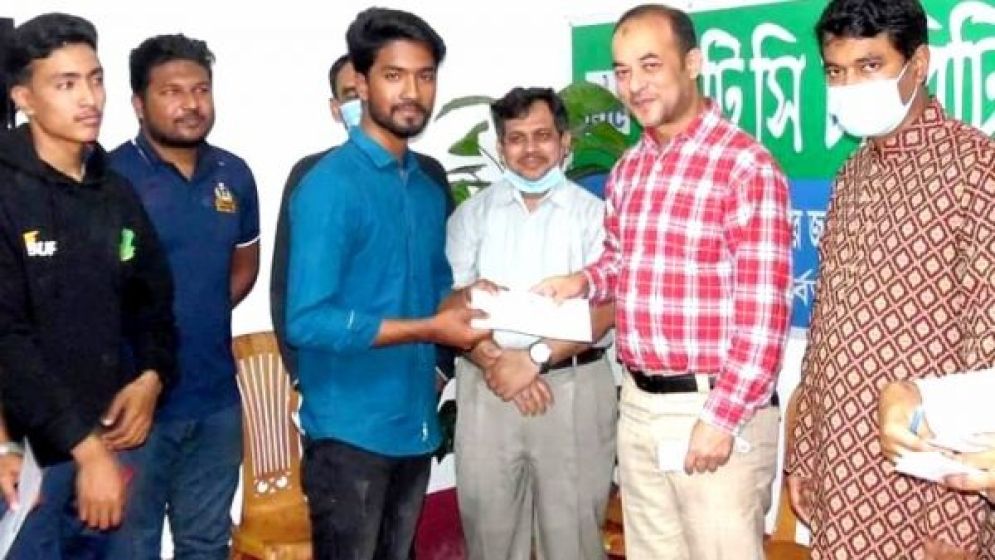
Bangla Press Desk: At first glance, the GTC Charity Home looks like any other modest building near the entrance of the Madhyapara Hard Rock Mine in Parbatipur, Dinajpur. But on any given weekday afternoon, elderly villagers limp in from distances of ten kilometres or more, drawn by something increasingly rare in rural Bangladesh: a qualified doctor, free of charge.
"The government hospital is far — I can't manage the journey," says Arzina Bewa, 67, a widow who walked from Pachpukur village to the charity clinic recently.
"Someone told me there was a big doctor here, for people like us. So I came."
She left with a prescription and, she says, with hope.
The facility is run by Germania-Trest Consortium, known as GTC — a joint venture between Bangladesh's Germania Corporation Limited and Belarusian state concern JSC Trest Shakhtospetssroy.
GTC is contracted to manage and operate Madhyapara, the country's only large-scale hard rock mine. It is a subsidiary arrangement under Madhyapara Granite Mining Company Limited, itself under the Petrobangla umbrella.
GTC employs more than 1,000 Bangladeshi miners who work underground extracting granite. Their wages, by most accounts, cover the basics — but only barely. It is against that backdrop that the company's social welfare arm has tried to fill the gap.
A mine turned around
When GTC took over mine operations in 2013, Madhyapara was haemorrhaging money — over a hundred crore taka in accumulated losses through six years of faltering output since stone extraction began in 2007.
GTC introduced three production shifts and set new records for daily and monthly stone extraction. The mine, community members say, has since posted profits for two consecutive fiscal years.
That commercial recovery appears to have created space for many things else. In 2013, GTC established the Charity Home adjacent to the mine entrance. Today, 52 students — children of mine workers pursuing higher education — receive monthly stipends. A qualified MBBS physician holds free consultations five days a week. The non-MPO Madhyapara College, whose teachers receive no government salary, gets a monthly financial grant.
‘No one thought of us in this way before’
Sultana Parvin, a university student whose father has worked at the mine for more than two decades, collected her stipend recently from the Charity Home.
"Before GTC, no one thought about the education and health of mine workers' families the way they do," she said. Her classmate Nahid Ahmed was equally direct: "We are grateful. My father has spent over twenty years in this mine. This scholarship means I can continue studying."
The local union leader for mine loading workers, Sadekul Islam, put it in comparative terms. "Right next to us is a coal mine," he said. "There's nothing like this for their community."
The Harirampura Union Parishad chairman, Masudur Rahman Shah, noted the geographic reality that makes the clinic significant. The nearest upazila hospital is 30 kilometres away. The hospital in the neighbouring Fulbaria upazila is 15 kilometres away. For elderly or unwell residents of Madhyapara and surrounding villages, those distances are not merely inconvenient — they are often prohibitive.
The broader question
GTC's Executive Director, Md Jabed Siddiqui, frames the Charity Home in terms of social obligation. "The people of this area have sacrificed and contributed a great deal for this mine," he told this correspondent. "We turned it profitable. But alongside that, we feel a responsibility to stand with the community — in education, in health."
Critics of extractive industry in Bangladesh have long argued that mining companies collect resources while leaving surrounding communities without adequate return. GTC's model at Madhyapara does not comprehensively resolve that critique — the mine remains state-owned, the contractor is commercially incentivised, and the Charity Home is funded at the company's discretion. Whether this kind of arrangement can be sustained, or scaled, remains an open question.
But for Safiron Bewa, who walked ten kilometres and came home with medicine, the debate is somewhat beside the point.
"May Allah do good for GTC," she said.
[Bangla Press is a global platform for free thought. It provides impartial news, analysis, and commentary for independent-minded individuals. Our goal is to bring about positive change, which is more important today than ever before.]
YOU MAY ALSO LIKE

Bangladesh
Weather office reveals when winter will set in across the country.
4 hours ago
by Bangla Press
.jpg)
Bangladesh
100 flights on Dhaka-Saudi route cancelled or suspended; 15,000 passengers face hardship.
5 hours ago
by Bangla Press
.jpg)
Bangladesh
Prime Minister Seeks Citizens’ Cooperation to Tackle Dengue Risks in Video Message
6 hours ago
by Bangla Press
.jpg)
Bangladesh
Market Irregularities: 120 Establishments Fined Nearly Tk 10 Lakh Across 46 Districts
17 hours ago
by Bangla Press
Sangeet Academy