

Handcuffs on My Pen
When the Reporter Became the Story

Bangla Press
Published: 23 August 2026, 02:40 AM
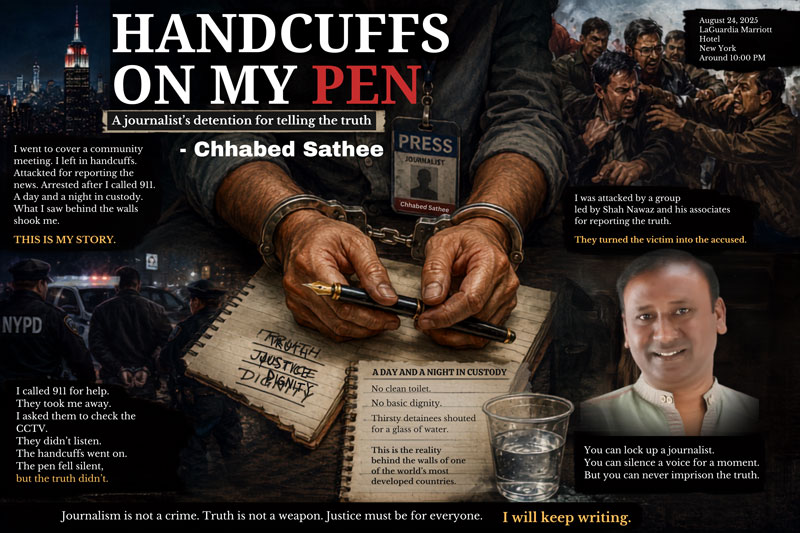
When the Reporter Became the Story
Chhabed Sathee
There are moments in a journalist’s career when the distance between reporter and story suddenly disappears. The person accustomed to asking questions, documenting events and reporting the experiences of others becomes the subject of the story himself.
For me, that moment came on the night of August 24, 2025, in New York.
For decades, I have believed that journalism carries a demanding obligation: report what you see, verify what you can, give people an opportunity to respond, and never allow fear or influence to determine what the public is permitted to know.
Journalists around the world have paid extraordinary prices for adhering to that principle. Some have been threatened. Some have lost their jobs. Some have been assaulted or imprisoned. Some have never returned home.
I never imagined that one day my own reporting would be followed by an assault, handcuffs and a night behind bars.
A News Report, Then a Confrontation
Nine days before my arrest, on August 15, I covered a community meeting in Jackson Heights, Queens, concerning allegations of offensive and derogatory social-media attacks against Bangladeshi-American businessman Asef Bari Tutul and his wife, Munmun Hasina Bari.
Participants at that meeting made serious allegations against several individuals. My responsibility as a journalist was to report what was said—not to become a participant in the dispute.
The report was published.
Nine days later, I attended a reunion of former officials of the Bangladesh Society of New York at the LaGuardia Marriott Hotel. I went there as a journalist. I expected to finish my work and return home.
Instead, I left in police custody.
As the evening progressed, I became concerned that several individuals were watching or following my movements. At approximately 10:20 p.m., as I attempted to leave the hotel for the parking area, I was confronted over previously published news reports.
The confrontation became physical. According to my recollection, Shah Nawaz arrived during the confrontation and shouted words encouraging others to attack me. I was then punched and struck by multiple individuals.
Fearing for my safety, I escaped into the hotel lobby.
I did what Americans are taught to do when they become victims of violence:
I called 911.
The 911 Caller in Handcuffs
Inside the hotel, I reported what had happened to employees. A security employee communicated with police, and I began completing the hotel's incident report.
Then police arrived.
While I was completing that report, Shah Nawaz entered the lobby accompanied by several officers and pointed toward me.
I tried to explain something that seemed extraordinarily important:
I was the person who had called 911. I was reporting that I had been attacked.
I asked the officers to examine the hotel's surveillance footage.
Nevertheless, after allegations were made against me, I was taken into police custody.
The handcuffs closed around my wrists.
At that moment, something changed beyond my physical circumstances.
The reporter had become the detainee.
The Silence Around Me
Physical pain eventually fades. Some other wounds remain much longer.
Journalists, colleagues, acquaintances and people who knew me were around the event. Some had witnessed portions of what happened before or after the confrontation.
Yet when I desperately needed someone to say, “Listen to him. He called 911. Find out what happened. Check the cameras,” I felt completely alone.
That silence taught me something uncomfortable about our profession.
Journalists are often courageous when injustice belongs to somebody else. We demand accountability from government. We question police. We defend due process. We condemn attacks against reporters thousands of miles away.
But our commitment to those principles is truly tested when defending them becomes uncomfortable—when the person needing someone to speak is standing only a few feet away.
Silence can sometimes hurt almost as much as a blow.
The America Behind the Cell Door
I spent approximately a day and a night in New York City police custody.
I had reported on America for years. Yet detention introduced me to another America—one largely invisible to people going about their ordinary lives.
For someone accustomed to carrying a notebook, telephone and camera, suddenly losing control over life's simplest decisions was startling.
Where you sit. When you move. When you sleep. When you use the toilet.
And whether you can obtain something as elementary as drinking water.
The detention conditions I encountered disturbed me. In my experience, the toilet facilities available to detainees were inadequately clean and deeply unpleasant. Basic sanitation and privacy seemed painfully distant.
But what remains most vivid in my memory is not the steel, the walls or the handcuffs.
It is the sound of people asking for water.
I heard thirsty detainees repeatedly calling out for something to drink.
Again and again.
A glass of water is something most Americans rarely think about. We turn a faucet and expect water to appear. Behind bars, I watched something so ordinary become something people had to plead for.
That experience raises a question larger than my own case:
What level of dignity does society owe a person once the cell door closes?
The answer should be simple.
An accusation does not erase humanity.
Handcuffs Are Not a Verdict
Before my detention, “innocent until proven guilty” was a phrase I had heard and written countless times.
Inside a cell, those words acquire a different meaning.
A person in handcuffs may never have been convicted of anything. An accusation may ultimately be rejected or dismissed. But the handcuffs are real. The cell is real. The humiliation is real. The anxiety experienced by family members is real.
And there is another danger.
To someone watching a person being placed into a police vehicle, the handcuffs themselves can look like evidence of guilt.
They are not.
An arrest is not a conviction. An accusation is not a verdict.
That distinction is fundamental to American justice, and journalists have a special responsibility to remember it.
Journalism Cannot Be Corrected With Fists
Journalists are not infallible. We make mistakes. We must verify information, distinguish allegation from established fact, seek responses and correct errors when warranted.
Those responsibilities are essential precisely because journalism has power.
But there is another principle that should be equally obvious:
Intimidation cannot become an editorial tool. Violence cannot become a correction policy.
If someone believes a journalist has published something inaccurate, democratic societies provide lawful remedies. A person can request a correction, submit a response, present contradictory evidence or pursue whatever legal remedies are available.
What cannot become acceptable is the idea that uncomfortable journalism should be answered through intimidation or violence.
Fists should never substitute for facts.
What One Night Changed
I entered the hotel carrying an identity I had known for decades: journalist.
I left wearing handcuffs.
That experience changed how I read every arrest story and how I look at every photograph of someone being led away by police.
Behind every photograph is a human being.
Behind every accusation may be another account that deserves to be heard.
Behind every cell door is a person who remains entitled to basic human dignity.
Perhaps journalists, particularly those of us who report crime and courts, should remember that more often.
Our responsibility is not merely to report who was arrested.
Our responsibility is to ask what happened, what the evidence shows, what the accused says, what the complainant says, and what can actually be established as fact.
That distinction is journalism.
My Pen Survived
The handcuffs eventually came off.
My pen remained.
I cannot erase my memories of August 24, 2025—the fear of the confrontation, the helplessness I felt after calling for help and finding myself detained, the silence around me, the conditions I encountered in custody, or the voices of thirsty detainees asking for water.
But I can write about them.
That is one of journalism's enduring powers.
A journalist can be criticized.
A journalist can be threatened.
A journalist can be assaulted.
A journalist can even be handcuffed.
But journalism survives only if the reporter, once those handcuffs are removed, is still willing to pick up the pen.
That night, they put handcuffs on my wrists.
For a moment, it felt as though someone had put handcuffs on my pen.
They had not.
Chhabed Sathee is a U.S.-based author, journalist and American political analyst. He is the Editor of Bangla Press.
Editor’s Note: This is a first-person opinion column based on the author’s account and experience. References to the conduct of other individuals are allegations from the author’s perspective and should not be interpreted as judicial findings of criminal liability.
Chhabed Sathee is a U.S.-based author, journalist and American political analyst. He is the Editor of Bangla Press.
Editor’s Note: This is a first-person opinion column based on the author’s account and experience. References to the conduct of other individuals are allegations from the author’s perspective and should not be interpreted as judicial findings of criminal liability.
*Copyright 2026 Bangla Press. All rights reserved. This material may not be published, broadcast, rewritten or redistributed.
BP/SM
[Bangla Press is a global platform for free thought. It provides impartial news, analysis, and commentary for independent-minded individuals. Our goal is to bring about positive change, which is more important today than ever before.]
YOU MAY ALSO LIKE


Column
Twenty-Six Years Alongside FOBANA Through Its Joys and Challenges
2 months ago
by Bangla Press

Column
FOBANA's Historic Legacy Faces Uncertain Future Amid Growing Divisions
2 months ago
by Bangla Press

Column
Government is buying your widely scattered data without a warrant
6 months ago
by Bangla Press
Sangeet Academy