

Hill People and Bengalis Deserve Equal Security in Chittagong Hill Tracts

Bangla Press
Published: 29 October 2026, 01:00 PM
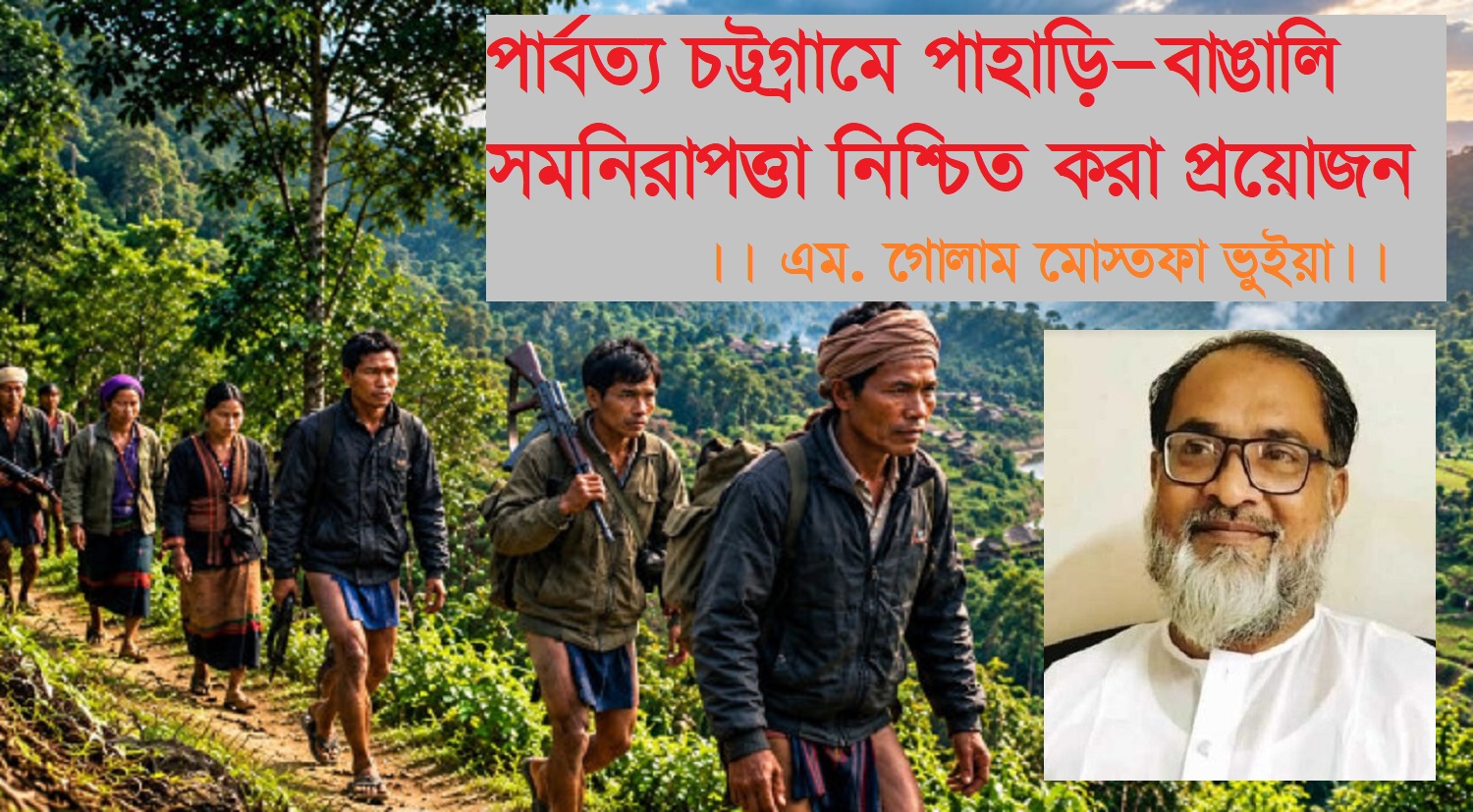
— M. Golam Mostafa Bhuiyan —
The public lacks a clear understanding of who is instigating instability and supplying weapons in the Chittagong Hill Tracts (CHT). It is the government’s responsibility to provide clarity on this matter. From time to time, attempts are made to suddenly disrupt the peace in the CHT; however, the underlying reasons for this unrest remain unclear to the general public. The government must reveal to the people who is fueling this instability, how separatist and terrorist groups are operating, and what conspiracies are being hatched.
For the past four decades, a significant number of people from the plains have settled in the three districts of the Chittagong Hill Tracts. Since the signing of the Chittagong Hill Tracts Peace Accord, the region has seen extensive development and the maintenance of peace and order. In fact, throughout the 15-year tenure of the ousted government, no significant unrest or disorder was observed in the hills. The question arises: why are there attempts to stir up unrest in the hills now—following the mass uprising of 2024—during the terms of the interim government and the current administration? Who is behind these efforts? It has been reported on social media that, following the formation of the interim government, a group of ethnic minority students from the CHT wrote a letter to Indian Prime Minister Narendra Modi. Has the conspiracy that fueled such audacity truly come to an end?
An indefinite blockade is currently underway on the road leading to the Sajek Valley tourist destination in the Baghaichhari Upazila of Rangamati. Since October 22, the 'Sajek Committee for the Protection of Public Rights' and the 'Sajek Karbari Association' have been enforcing this blockade—now in its third phase—to press for a five-point list of demands. Law enforcement personnel have been deployed at key locations. Due to security concerns, the Sajek tourist hub remains closed, halting both tourist travel and local businesses that depend on tourism. On October 26, a meeting was held at Ujo Bazar between representatives of the administration and the organizers of the blockade, aimed at resolving the crisis in Sajek. Present at the meeting were Abdul Wadud Bhuiyan, Member of Parliament for Khagrachhari and Chair of the Parliamentary Standing Committee on the Ministry of Chittagong Hill Tracts Affairs; Dipen Dewan, Member of Parliament for Rangamati; and the Deputy Commissioners and police officials from both districts.The meeting addressed the five-point demand put forward by those enforcing the blockade. In a statement following the meeting, Abdul Wadud Bhuiyan indicated that an agreement had been reached on four of the five demands, while the remaining point requires further discussion. As no final consensus was reached on the core demand, the protesters announced that the blockade would continue. Consequently, no immediate resolution was found to restore road connectivity. The crisis affecting tourism, the transport of goods, and the daily lives of the local population persists.
Sajek, in the hills, was once vibrant with the presence of tourists. Resorts and cottages were filled with guests, restaurants bustled with activity, and the livelihoods of hundreds of people depended on the tourism sector. Now, a heavy silence has descended upon Sajek. There are no guests in the resorts or cottages, the usual hustle and bustle in the restaurants has vanished, and stocks of essential commodities in shops are dwindling. With the absence of tourists, many have lost their source of income. Meanwhile, concerns are mounting regarding the supply of food, fuel, and essential medicines. Transporting someone to a hospital in the event of a serious illness or an accident has become a major challenge due to the disruption of transport and communication systems. If this situation persists in the remote, hilly region, the most vulnerable—children, the elderly, and the sick—will face the greatest hardship. Failure to resolve this issue promptly could lead to even more severe problems.
The crisis impacting tourism, the transport of goods, and the lives of local residents remains unresolved. Given this, there are growing calls for both political and administrative solutions to the blockade, alongside urgent measures to protect the livelihoods of ordinary people. It is particularly critical to take effective action—on humanitarian grounds—to ensure the delivery of food, life-saving medicines, and medical supplies. Most alarming, however, is that the deadlock—stemming from internal conflicts between regional factions in Sajek, Rangamati—has now spread beyond Sajek, bringing life to a standstill across vast areas of both Rangamati and Khagrachhari. An ongoing, indefinite road blockade has brought transport services to a halt; long-distance buses are not operating, and a tense, fearful atmosphere prevails across the hill region. Although law enforcement agencies claim to have the situation under control, there are no visible signs of any relief for the suffering of the general public.At the time of the signing of the Chittagong Hill Tracts (CHT) Peace Accord in 1997, the conflict was primarily internal in nature; the objective was to find a political resolution to an armed movement that was demanding autonomy from the state. The current situation is far more complex. A significant portion of Myanmar’s Rakhine State is now under the control of the Arakan Army. Consequently, a substantial stretch of the Bangladesh border now faces territory controlled by a non-state armed group. Meanwhile, within the Chittagong Hill Tracts, recent years have seen reports of attacks, killings, and armed activities linked to the Kuki-Chin National Front (KCNF). Alleged connections with various armed groups in Myanmar and India further complicate the situation. Given the risks associated with the movement of weapons, narcotics, and armed individuals across border regions, a security vacuum in one area can rapidly spread to others. Furthermore, among certain fringe groups in the broader region, separatist or religion-based geopolitical narratives centered on the Kuki-Chin-Mizo identity are being propagated. While there is no evidence of widespread public support for these ideas, armed groups or external actors could exploit such narratives within an unstable environment.
Beyond prioritizing border security and counter-terrorism—which are essential state responsibilities—equal importance must be placed on the security and trust of the people living in the hill tracts. Long-term stability cannot be achieved solely through military or law-enforcement measures. An integrated security framework is required, in which the military, civil administration, local institutions, and representatives of the hill communities work in collaboration. Alongside border security, the lives, property, rights, and safety of the local population must be ensured. Simultaneously, issues such as development, administrative capacity, infrastructure, and inter-communal trust must be incorporated into the national strategy.
The use of terms like "indigenous" versus "settler" is not logical; such a characterization is not supported by history, sociology, or anthropology. Everyone should be recognized as Bangladeshi and as a resident of the Chittagong Hill Tracts, while also being accorded the dignity due to distinct ethnic groups. To achieve a lasting resolution, the government could consider establishing a "Justice Commission," while ensuring that national security interests—which are non-negotiable—remain fully protected. A 'Justice Commission,' to be established as expeditiously as possible, shall investigate and uncover the truth regarding the oppression faced by all residents of the Chittagong Hill Tracts—whether perpetrated by state actors, private individuals, or organizations. To establish lasting peace, it is the state's responsibility to ensure equal security, civil rights, and peaceful coexistence for all—both Bengalis and non-Bengalis (indigenous/hill peoples)—in the region. The safety of ordinary citizens and their property, as well as the rule of law, must be guaranteed, irrespective of political affiliation or ethnic identity. Priority must be given to conducting joint operations aimed at curbing the pursuit of dominance, extortion, abductions, and armed violence in the hill tracts. Regardless of whether an offender is Bengali or indigenous, Hindu or Muslim, they must be brought to justice through a fair legal process. Protecting the fundamental human rights of its citizens is the primary duty of the state; the government must remain vigilant to ensure that this obligation never ceases to be a top priority.Previous governments have failed completely to establish stability and long-term peace in the Hill Tracts. The current government should pursue a political solution by engaging all stakeholders at the community level—a step essential for upholding Bangladesh’s national integrity and sovereignty. While remaining sensitive to the protection of civil rights, the government must also take robust measures to address threats to state stability and security. It is imperative to ensure that human rights are never compromised. Furthermore, while remaining vigilant against foreign conspiracies, the government must ensure that security forces operate in accordance with international human rights standards and globally accepted conventions. The 1997 Peace Accord has, in effect, led to the fragmentation of the hill communities; a radical revision of several of its provisions is now necessary. To this end, the government should establish a strong commission. By addressing the constitutional limitations of the Peace Accord, conducting a timely re-evaluation, ensuring equitable distribution among all ethnic groups, and fostering local leadership, it is possible to secure lasting peace and national unity in the region.
The patriotic military and law enforcement agencies should devise a well-structured strategy to ensure equal security for the hill peoples, Bengalis, and all other communities residing in the Chittagong Hill Tracts. Establishing peace in the region entails more than just halting gunfire; it requires ensuring human security, justice, rights, dignity, and economic opportunity. Regardless of an individual’s identity or political affiliation, legal action must be taken—based on evidence—against anyone who possesses illegal weapons, threatens the safety of ordinary citizens, or engages in armed violence. While ensuring that perpetrators are brought to justice, the rights and dignity of innocent individuals must be safeguarded. Great care must be taken to ensure that no innocent person is subjected to harassment or injustice in the name of establishing security. Simultaneously, it must be ensured that no armed group can evade accountability for illegal activities by invoking human rights concerns or ethnic identity. To establish lasting peace in the Chittagong Hill Tracts, it is essential to halt the proliferation of illegal arms, conduct impartial investigations into allegations of extortion, kidnapping, armed dominance, and intimidation, and ensure effective remedies. Simultaneously, initiatives must be taken to resolve long-standing issues—such as land-related disputes, political mistrust, crises concerning rights, and developmental disparities—through dialogue.The lives, dignity, and rights of all people—whether they are Bengali or non-Bengali inhabitants of the hill regions—are equally important. Establishing lasting peace requires more than just security measures; the government must take proactive steps to resolve long-standing issues such as land disputes, political mistrust, and developmental disparities. Given the conflicting accounts from various parties regarding recent events, a comprehensive, impartial, and credible investigation is essential to uncover the truth. It must be determined—based on evidence—who opened fire, who incited the violence, who endangered the safety of ordinary citizens, and whether any innocent individuals were subjected to unjust treatment. It should be remembered that security in the hill regions does not depend solely on the security forces stationed there. A security framework can only be sustainable if the people living in these border regions feel safe, secure, and perceive themselves as integral partners of the state. Therefore, the goal should not merely be to keep the hill regions secure, but to ensure their security by working together with the people who live there. Terms such as "indigenous," "ethnic group," "settler," or "Bengali settler" should be discarded in the context of the Chittagong Hill Tracts (CHT). To resolve the issues in the CHT, resources must be distributed equitably among all groups, and land must be provided to the landless. Rather than focusing exclusively on the Chakma community, the vision for the CHT must encompass all ethnic groups. Only then will it be impossible for neighboring states or Western powers to hatch conspiracies regarding the Chittagong Hill Tracts.
Many argue that they desire peace in the Chittagong Hill Tracts but oppose the presence of the military; however, the CHT is a unique and sensitive region. They often overlook the fact that it is precisely the presence of the military that has preserved the nation's sovereignty and territorial integrity. In the interest of national security, the administrative arrangements or protocols that existed around 1980 or 1990 should be reinstated. Through negotiation, the concerned parties must be brought to an understanding; this would prevent neighboring countries from orchestrating any further conspiracies. Whenever issues arise in the hill regions, some of our intellectuals issue one-sided statements or comments. By making such pronouncements without a proper understanding or knowledge of the facts, they inadvertently provoke a negative reaction among the people of Bangladesh.Intellectuals must be discouraged from issuing one-sided statements. Had all the provisions of the Peace Accord been implemented, the issues in the Hill Tracts would have been significantly mitigated. There are inherent problems—including constitutional contradictions—within the provisions of this accord. A re-evaluation or reconsideration of the Peace Accord is absolutely essential; without such a review, resolving the problems in the Hill Tracts will not be possible.
Establishing peace in the Chittagong Hill Tracts is not a new issue; it is a long-standing one. Political and security analysts have expressed concerns about whether this region can remain a part of Bangladesh’s future if peace is not established. It is hardly surprising that the region has become a target of international conspiracies—such schemes, orchestrated by both international actors and internal enemies of the nation, will likely continue. However, the most critical requirement to safeguard against these threats is national unity. On these matters, everyone—regardless of political affiliation, ideology, or background—must come together. Our politicians, in particular, must unite.
BP > SP
[Bangla Press is a global platform for free thought. It provides impartial news, analysis, and commentary for independent-minded individuals. Our goal is to bring about positive change, which is more important today than ever before.]
YOU MAY ALSO LIKE



Column
Twenty-Six Years Alongside FOBANA Through Its Joys and Challenges
2 months ago
by Bangla Press

Column
FOBANA's Historic Legacy Faces Uncertain Future Amid Growing Divisions
3 months ago
by Bangla Press

Column
Government is buying your widely scattered data without a warrant
7 months ago
by Bangla Press
Sangeet Academy