
Twenty-Five Years at the World Assembly
Watching the World from the Corridors of the United Nations

Bangla Press
Published: 18 September 2026, 11:27 PM
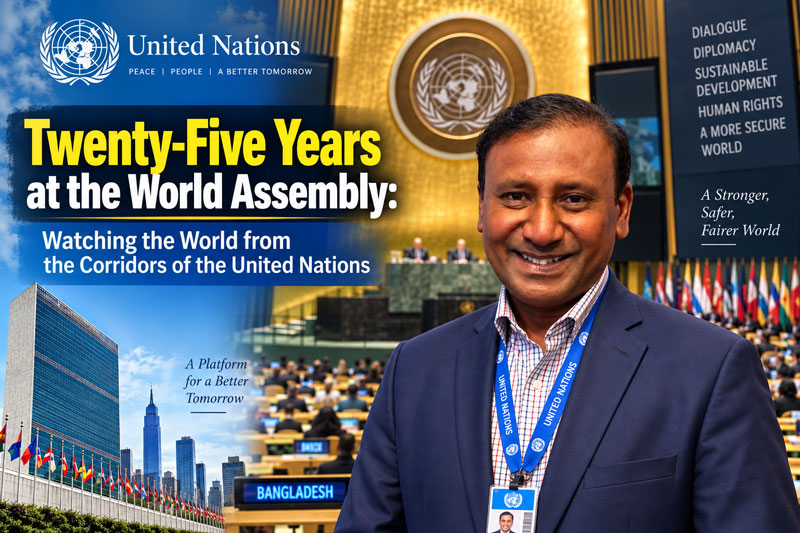
World’s largest diplomatic stage—the United Nations General Assembly
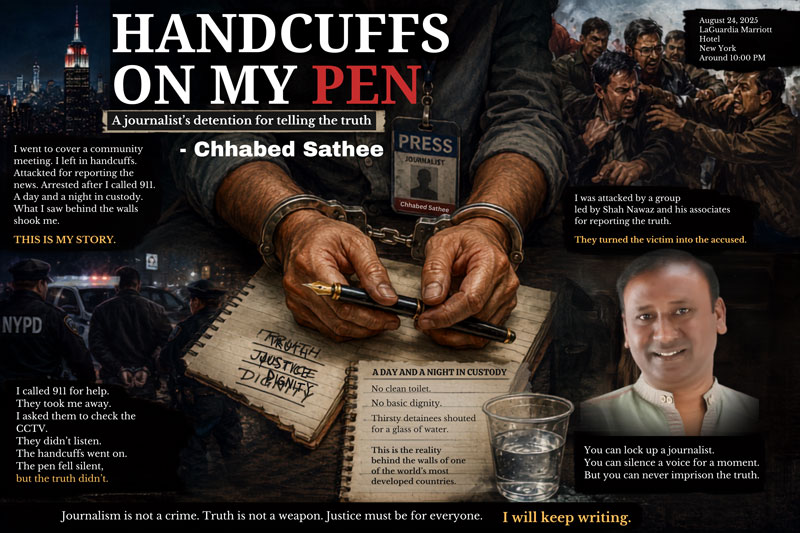
Chhabed Sathee
When I began my journey in journalism in a small town in Dinajpur, Bangladesh, I could never have imagined that one day it would take me to the world’s largest diplomatic stage—the United Nations General Assembly. I certainly never imagined that covering this global gathering would become an integral part of my life for twenty-five consecutive years.
My journalism career began in 1985 with Daily Karatoa, one of the most popular newspapers in northern Bangladesh. I later worked in Dhaka for national newspapers including Ajker Kagoj, The Independent, The Observer, and Daily Rupali. In 1998, I had the good fortune to immigrate to the United States through the Diversity Visa, or DV Lottery. I left behind a familiar country and a familiar world of journalism and stepped into an entirely new life.
But journalism never left me. Instead, New York opened another enormous door in my career—the United Nations.
The Building Where the World Gathers
The United Nations General Assembly is far more than an annual gathering where presidents and prime ministers deliver speeches. Every September, the UN headquarters on the East River in Manhattan effectively becomes the diplomatic and political capital of the world.
Heads of state and government, foreign ministers, diplomats, and representatives of international organizations from nearly every country gather in one city. War and peace, poverty and development, climate change, refugee crises, human rights, food and energy security, the global economy, technology, and the future of humanity are all discussed there.
But the speeches delivered from the General Assembly podium are only part of the story. Over my twenty-five years of experience, I have learned that meetings outside the main chamber can sometimes be just as important. Encounters in the corridors, bilateral meetings, closed-door discussions in small rooms, press conferences, and even unexpected diplomatic conversations can become the source of major news.
For a journalist, therefore, the United Nations is not merely a conference venue. It is an extraordinary reservoir of news.
A Small-Town Journalist Enters the World Stage
I began covering the UN General Assembly in 2001. At the time, I was working as a freelancer for several national newspapers in Dhaka.
I still remember the feeling of entering the United Nations headquarters during those early years. It seemed as though the young journalist from Dinajpur had suddenly found himself standing at the center of the world map.
On one side might be the prime minister or foreign minister of Bangladesh; on another, the president of a global power. A head of state, the leader of an international organization, or a renowned diplomat might walk past you. All around were journalists representing hundreds of countries and media organizations.
Standing there, I repeatedly realized that journalism has no geographical boundaries. Where a journalist comes from is not what ultimately matters; what matters is how sincerely and professionally that journalist pursues the news.
Beginning in 2010, I took on responsibilities as New York correspondent for major Bangladeshi newspapers, including Kaler Kantho and Samakal, as well as several other publications. From then on, my visits to the United Nations became even more regular. For the next fifteen years, every September, one week of my life revolved almost entirely around the UN.
A 250-Mile Journey and a Seven-Day Battle
I live in Connecticut. A round trip to New York is approximately 250 miles. During the high-level week of the General Assembly, making that journey every day while covering events was nearly impossible.
So every year, I would take seven days off from my regular workplace. Those seven days became, for me, a kind of journalistic battle.
From morning onward, I would be at the United Nations, moving from one event to another—following the Bangladesh delegation’s schedule, speeches by world leaders, bilateral meetings, and press conferences.
In those earlier years, smartphones and instant digital communication were nowhere near as advanced or convenient as they are today. Gathering information, writing the story, and transmitting it quickly to Dhaka created a different kind of pressure.
The official day might end, but a journalist’s work did not.
When My Car Became My Hotel
One of the most difficult memories of these twenty-five years involves finding a place to stay.
During the UN General Assembly, hotel rooms in New York are both difficult to find and extremely expensive. For a working expatriate journalist like me, staying at a Manhattan hotel every year was simply not practical.
Many nights, by the time I had finished writing my reports and sending them to Dhaka, it was already very late when I returned from Manhattan to Jackson Heights. I would eat dinner at a Bangladeshi restaurant and then sleep in my own car parked along the street.
I would recline the seat, and that became my bed for the night.
In other years, a friend might offer me a small basement room. Sometimes I slept on a sofa bed beside a kitchen. In the morning, I would wash up, have a quick breakfast, and rush back to the United Nations headquarters in Manhattan.
Looking back today, I no longer think of those experiences simply as hardship. They have become some of the most valuable memories of my journalistic life.
Those Nights in Jackson Heights
Returning to Jackson Heights after an exhausting day at the United Nations brought its own kind of joy.
In this Bangladeshi neighborhood of New York, conversations about Bangladesh, politics, journalism, and immigrant life often continued late into the night. I would spend time talking with friends, only to wake up early the next morning and head back to the world assembly.
Sometimes my body told me I could not continue.
But the journalist in me would say: Tomorrow, something may happen that becomes history.
That possibility kept drawing me back to the United Nations year after year.
Why the General Assembly Matters to Bangladesh
For a country such as Bangladesh, the United Nations General Assembly carries particular significance. It provides a platform where a small or medium-sized nation can present its views before the world alongside the major global powers.
For Bangladesh, issues such as the Rohingya crisis, climate change, peacekeeping, development, migration, overseas employment, international cooperation, and global economic fairness can be raised before an international audience.
But diplomatic success is not achieved merely by delivering a speech at the United Nations. What ultimately matters is how many meaningful meetings take place, what is discussed with other countries, what international support is secured on important issues, and how much of that diplomacy produces tangible results afterward.
The journalist’s responsibility is equally important. Journalism is not simply reproducing an official press release. A journalist must ask: What was said? Why was it said? What was left unsaid? And what is the real significance of the announcement?
Seeing Bangladesh from the World Stage
Over twenty-five years, I have had the opportunity to observe the UN visits of different Bangladeshi governments, heads of state and government, and official delegations at close range. Governments changed, political circumstances changed, and members of delegations changed—but the importance of Bangladesh’s presence at the United Nations did not.
I have also witnessed another reality: a Bangladeshi leader’s visit to New York rarely remains confined to the United Nations headquarters. It inevitably intersects with New York’s large Bangladeshi diaspora.
There have been receptions, protests, political gatherings, and community events. Diplomacy inside the United Nations and the politics of expatriate Bangladesh outside its walls often seem to unfold side by side. As a journalist, I have had to observe both worlds.
The United Nations Has Changed—and So Has Journalism
Journalism in 2001 was very different from journalism in 2026.
There was a time when the main task was to gather a story, write it, and send it to Dhaka. Today, news can spread across social media within seconds of an event. Live video, mobile journalism, online news portals, and social media have fundamentally transformed the speed of reporting.
Journalists once had more time. Today, the competition is measured in seconds.
But that speed has created another danger—the temptation to publish information before verifying it.
Twenty-five years of covering the United Nations have taught me one enduring lesson:
Being accurate is far more important than being first.
At a place like the United Nations, even a single incorrect word can alter the diplomatic meaning of a statement. A misquotation can create confusion at the international level. Technology may change, but the fundamental principles of journalism cannot: verification, impartiality, and a commitment to truth.
A Press Pass Is Not a Privilege Alone—It Is a Responsibility
While working in Bangladesh, I witnessed the enormous interest among journalists in obtaining an opportunity to cover the UN General Assembly. Every year, journalists still travel from Dhaka to New York for the event.
But I have also witnessed another reality. Some journalists who arrived to cover the General Assembly did not return home. Some sought asylum in the United States, some joined Bangla-language media outlets or IPTV channels in New York, and others eventually left journalism for different professions.
There can be many personal circumstances behind such decisions. It is not my purpose to judge them.
But for me, a United Nations press credential has never been merely an opportunity to enter New York or the UN headquarters. It has represented a journalistic responsibility.
Having access to this world forum means being there as the eyes and ears of readers back home.
Looking Back After Twenty-Five Years
From 2001 to 2026—twenty-five years. The number is easy to write. The journey was not. So many Septembers have come and gone. I have listened to countless world leaders. I have waited through innumerable press conferences. I have stood behind security barriers for hours. I have written stories through sleepless nights. And so many times, I have left the lights of Manhattan behind and returned to Jackson Heights after midnight.
I have slept in my car. I have slept in friends’ basements. I have slept on sofas beside kitchens.
And the next morning, I went back to the United Nations.
Why?
Because journalism was never merely a profession for me. It became a passion, a responsibility, and a desire to witness history as it unfolded.
If the young journalist who began his career in Dinajpur in 1985 had asked me then, “Will you one day spend twenty-five years reporting from the world’s largest diplomatic gathering?”
I probably would have laughed and said, “Could that really be possible?”
Today, I can say: It was possible.
The World Assembly Will Continue—and So Will the Journalist’s Journey
The United Nations is not a perfect institution. Its effectiveness, the structure of the Security Council, the veto power of its permanent members, and the influence of major powers have long been debated. The organization has also faced criticism for failing to meet expectations in preventing or ending wars and humanitarian catastrophes.
Yet one question remains: without the United Nations, where else would nearly every country in the world sit beneath one roof?
Where else would representatives of countries at war stand in the same chamber and present their positions? Where else would smaller nations have such a global platform to make their voices heard?
That is why, despite its limitations, the United Nations General Assembly remains one of the world’s broadest multilateral forums.
And for me?
That glass building beside the East River stands as a silent witness to twenty-five years of my journalistic life.
From Dinajpur to Dhaka, from Dhaka to New York, and from New York to the United Nations—it has been a long journey. I did not become a statesman. I am not a diplomat. I am simply a journalist who has stood near the doorway of history, carrying a notebook, wearing a press credential, and driven by an unrelenting desire to find and report the news.
After twenty-five years, perhaps this is my greatest reward: I could not change the world, but when the world gathered under one roof to speak, I was there as a journalist—and I was able to carry the story of those moments to my readers.
That is my good fortune. And that is one of the most treasured chapters of my life in journalism.
Chhabed Sathee is a U.S.-based author, journalist and American political analyst. He is the Editor of Bangla Press.
*Copyright 2026 Bangla Press. All rights reserved. This material may not be published, broadcast, rewritten or redistributed.
BP/SM
[Bangla Press is a global platform for free thought. It provides impartial news, analysis, and commentary for independent-minded individuals. Our goal is to bring about positive change, which is more important today than ever before.]
YOU MAY ALSO LIKE

Column
Twenty-Six Years Alongside FOBANA Through Its Joys and Challenges
2 months ago
by Bangla Press

Column
FOBANA's Historic Legacy Faces Uncertain Future Amid Growing Divisions
2 months ago
by Bangla Press

Column
Government is buying your widely scattered data without a warrant
6 months ago
by Bangla Press
Sangeet Academy