

Healthcare Facilities Should Handle Birth, Death Records: Call

Bangla Press
Published: 08 July 2026, 08:21 AM
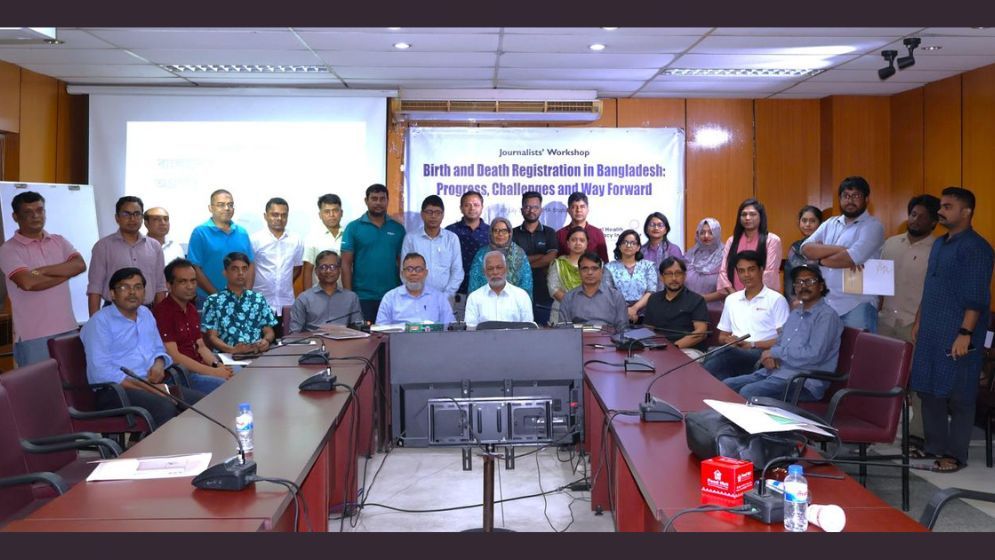
Bangla Press Desk: Speakers have urged the government to assign healthcare facilities the responsibility of registering citizens’ births and deaths to help ensure access to fundamental rights, including education, healthcare, inheritance, and voting.
They said registration data is also crucial for national planning, good governance, and budget preparation.
According to speakers, birth and death registration rates in Bangladesh currently stand at 50% and 47%, respectively which is significantly lower than the global and regional averages. However, the government is committed to scaling up this rate to 100% by 2030.
Experts said amending the “Birth and Death Registration Act, 2004” to legally mandate hospital authorities to carry out registration would fast-track the achievement of this target. Concurrently, it will accelerate Sustainable Development Goal (SDG) Target 16.9, which aims to ensure legal identity for all.
The observations were made on Wednesday at a journalists' workshop titled "Birth and Death Registration in Bangladesh: Progress, Challenges, and Way Forward," held at the BMA Bhaban in the capital.
The workshop was organised by PROGGA (Knowledge for Progress) with support from the Global Health Advocacy Incubator (GHAI). A total of 30 journalists representing print, television, and online media participated in the event.
It was highlighted during the workshop that under the existing law, the primary responsibility of reporting births and deaths rests solely on the family, rather than the health department. However, if healthcare facilities are tasked with registration responsibilities, approximately 67% of the country's children born under their care can easily be brought under registration. Many countries in the Asia-Pacific region have successfully achieved universal registration by adopting this approach.
Muhammad Ruhul Quddus, Bangladesh country lead of GHAI, said, "To achieve universal registration, there is no alternative to legally empowering hospitals and healthcare centres with registration responsibilities."
Md Nazrul Islam, country coordinator of Vital Strategies, emphasised, "Alongside strengthening the law, its proper implementation must be ensured. In this regard, addressing manpower shortages, technological limitations, and lack of inter-sectoral coordination is critically urgent."
Md Monir Hossain Liton , head of online (Bangla) at the Daily Times of Bangladesh, said, "Media outlets need to regularly publish news highlighting the loopholes in the registration process and the subsequent public suffering. This will create positive pressure to drive policy changes."
Among others present as discussants at the workshop was ABM Zubair, executive director of PROGGA, while Mashiat Abedin, coordinator, delivered the thematic presentation before the media professionals.
[Bangla Press is a global platform for free thought. It provides impartial news, analysis, and commentary for independent-minded individuals. Our goal is to bring about positive change, which is more important today than ever before.]
YOU MAY ALSO LIKE

Bangladesh
Weather office reveals when winter will set in across the country.
2 hours ago
by Bangla Press
.jpg)
Bangladesh
100 flights on Dhaka-Saudi route cancelled or suspended; 15,000 passengers face hardship.
2 hours ago
by Bangla Press
.jpg)
Bangladesh
Prime Minister Seeks Citizens’ Cooperation to Tackle Dengue Risks in Video Message
3 hours ago
by Bangla Press
.jpg)
Bangladesh
Market Irregularities: 120 Establishments Fined Nearly Tk 10 Lakh Across 46 Districts
14 hours ago
by Bangla Press
Sangeet Academy