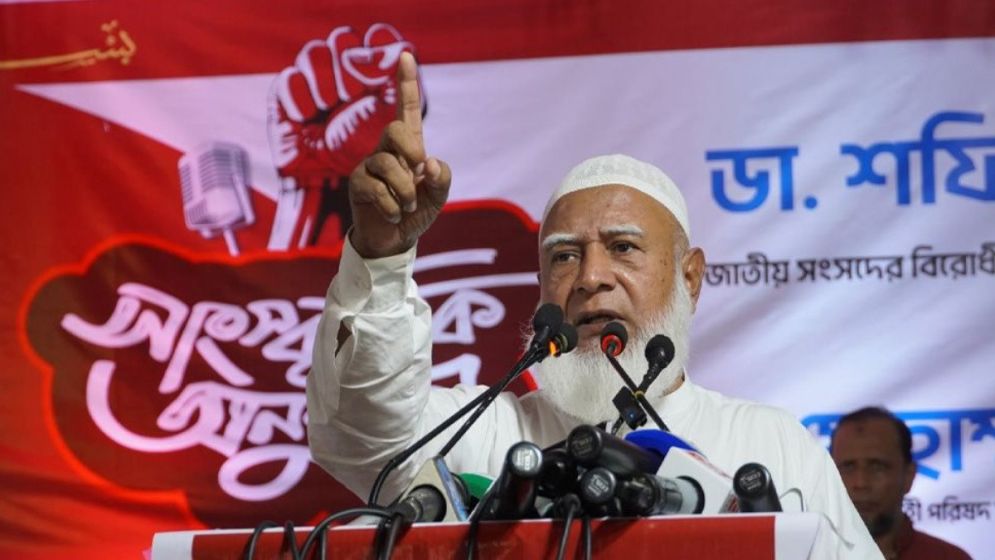
Bangla Press Desk: Jamaat-e-Islami Ameer Dr Shafiqur Rahman has said that imams and khatibs must not be reduced to figures dependent on the sympathy of others, stressing that they deserve their rightful honour and a central role in guiding society.
“We do not want to see our imams and khatibs become objects of pity. Their true status must be restored. Imams and khatibs must take responsibility for this society,” he said at the “National Imam-Khatib Conference” on Sunday.
Held at the China-Bangladesh Friendship Conference Centre in the capital, the event was presided over by Baitul Mukarram National Mosque’s senior imam, Maulana Muhibbullahil Baqi An-Nadwi.
Leaders from various Islamic organisations also addressed the gathering, including Hefazat-e-Islam Ameer Allama Shah Muhibbullah Babunagari, Islami Andolon Bangladesh Ameer Mufti Syed Muhammad Rezaul Karim (Pir of Charmonai), Jamiat Ulema-e-Islam President Maulana Ubaidullah Farooq, Bangladesh Khelafat Majlis Ameer Maulana Mamunul Haque, and Jamiat Ulema’s Secretary General Maulana Manjurul Islam Afendi. The programme was conducted by Mufti Azharul Islam and Mufti Sharifullah.
At the conference, a roadmap was presented highlighting key issues such as safeguarding the country’s independence and sovereignty, protecting the religious rights of the Muslim population, ensuring social security and dignified allowances for imams and khatibs, and formulating a modern framework for mosque administration.
Dr Rahman said that the Prophet Muhammad (peace be upon him) constructed a mosque immediately upon receiving divine responsibility and established it as the central institution of governance. “There was no separate cabinet house, nor offices for a president or prime minister. All state affairs were conducted from Masjid-e-Nabawi,” he said. Delegations of diverse faiths and regions met the Prophet at the mosque, he noted, adding that any society built by ignoring this prophetic model and relying on artificial ideologies would fail to bring peace or dignity to the world.
During the conference, imams and khatibs placed a seven-point set of demands. These include: prioritising Islamic Shariah—while preserving the rights of all religions—in state governance; ensuring the participation of imams and khatibs in welfare activities; and involving them in law and order committees, village courts, disaster management groups, and union-level service initiatives.
They also demanded that all madrasa electricity bills be brought under the same subsidised category as mosques, and that water bills for mosques and madrasas be reduced by 50 percent.
BP/TD
[Bangla Press is a global platform for free thought. It provides impartial news, analysis, and commentary for independent-minded individuals. Our goal is to bring about positive change, which is more important today than ever before.]

 E-paper
-6ab3842955219.webp)