Spain Defeats Argentina to Win the 2026 FIFA World Cup
Bangla Press
Published: 19 July 2026, 06:29 PM
SHARE
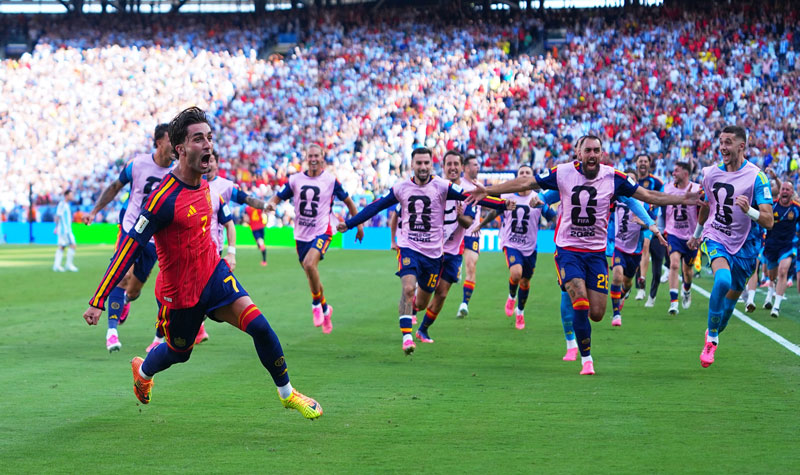
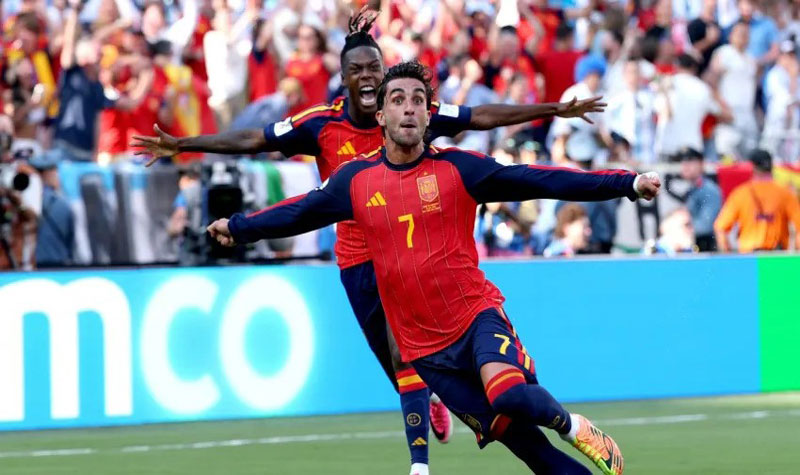
Spain's Ferran Torres celebrates scoring his team's first goal during the 2026 World Cup final
Chhabed Sathee: A tournament that began as a grand experiment across three countries ended with a finish worthy of all its sprawl: Spain beating Argentina, 1-0, in extra time.
After years of planning, months of training, weeks of playing and days of game-planning, the largest, loudest and most scrutinized World Cup ever staged came down to the final minutes.
Ferran Torres, Spain’s flashy 26-year-old forward, put the ball high into the net in the 106th minute of Sunday’s World Cup final, breaking a scoreless tie and sending all of Spain into delirium.
And with that, a tournament that began as a grand experiment across three countries ended with a finish worthy of all its sprawl: Spain beating Argentina, 1-0, in extra time to win its first World Cup title since 2010 and deny Lionel Messi one more implausible addition to his legend.
When the final whistle sounded, Spain’s players spilled across the grass, a new generation in red having interrupted one of the most enchanted late-career stories soccer has ever seen. To get here, Spain masterfully navigated the biggest, most complicated World Cup the sport has seen, bouncing across a continent, slaying the game’s giants and adding both theatrics and closure to a tournament that was never short on drama.
The World Cup around them had arrived with questions attached to every border crossing and kickoff: more teams, more games, more miles, more heat, more security demands, more politics. There were immigration debates, geopolitical tensions, concerns about midsummer heat and the persistent question of whether a World Cup stretched across an entire continent could still feel like a World Cup rather than a logistical nightmare.
Somehow, North America pulled it off. By the final weekend, attendance had topped 6.7 million, surpassing the combined total of the 2018 and 2022 World Cups and nearly doubling the previous single-tournament record set at the 1994 tournament in the United States.
For Messi and Argentina, Sunday’s loss closed off a historic possibility. Messi had been trying to stretch his final act into something beyond even his own standards — a second straight title, four years after he had lifted the trophy in Qatar. Across six weeks, he had played less like a fading legend than a grand conductor: walking, scanning, waiting and then summoning the game to him at precisely the moment Argentina needed him.
But Argentina, trying to become the first country since Brazil in 1962 to defend its World Cup title, spent most of regulation struggling to mount an attack and almost never threatening Spain’s goal. The defending champions went more than 100 minutes without taking a serious shot — the longest such drought the country had ever endured in a World Cup match — and failed to put a shot on goal in regulation.
Spain’s chances came in waves then — corner kicks, crosses, headers, loose balls skittering across the area — equal parts nail-biting and breathtaking. Again and again, Argentina goalkeeper Emiliano Martínez batted them away or swallowed them whole. But Argentina could not relieve the pressure with any sustained attack of its own.
Then, three minutes into extra time, the match seemed to finally crack open. Argentina midfielder Enzo Fernández sent Pau Cubarsí flipping head over heels and was shown a red card, forcing Argentina to play the rest of the final a man down. A match that had been slow and methodical suddenly became urgent and uneven.
Spain nearly pulled ahead early in the extra period, when Nico Williams rolled a shot into the net. But it was quickly waved off for a foul, and Argentina survived yet another scare.
Then, in the opening minute of the second extra period, Torres, who started the game on the bench, provided a fitting final note on both the match and the tournament. He immediately zipped across the field in celebration with his teammates over a shot his country will replay on loop for years to come.
By the time Argentina and Spain reached Match No. 104, the tournament had moved from the highways and airports of North America to the streets of New York. Over the weekend, Times Square and the surrounding blocks filled with bright red Spain jerseys and light blue Argentina ones, a rolling soccer party that finally made its way across the Hudson and through the long security lines in New Jersey. Tens of thousands without tickets, meanwhile, flooded into Central Park on Sunday.
The final brought American spectacle, too: President Donald Trump attended his first World Cup match of the tournament and planned to take part in the trophy ceremony, after having already stirred controversy by pressing FIFA President Gianni Infantino to review an American red card earlier in the tournament. Post Malone performed before the game, and a halftime show featuring Madonna, Shakira and Justin Bieber gave the night a Super Bowl sheen.
Yet the field remained the center of gravity. That was the trick of this World Cup. It was too big, too complicated and too commercial to be romanticized too easily. But again and again, it found its way back to the simplest things the sport has to offer.
*Copyright 2026 Bangla Press. All rights reserved. This material may not be published, broadcast, rewritten or redistributed.
BP/SM
[Bangla Press is a global platform for free thought. It provides impartial news, analysis, and commentary for independent-minded individuals. Our goal is to bring about positive change, which is more important today than ever before.]
Comments (0)
Join the Conversation
Please log in to share your thoughts and engage with other readers.

 E-paper


.webp)