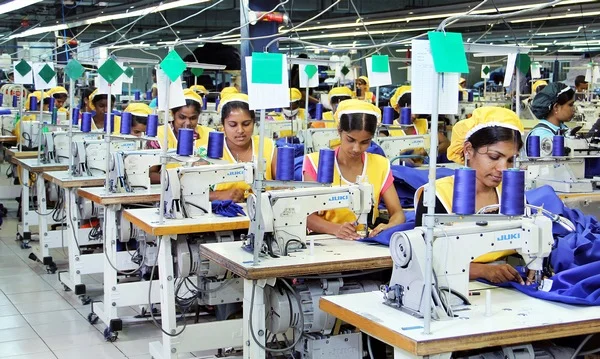
Bangla Press Desk: Tasks in garment factories that once required a large workforce can now be performed by fewer employees thanks to the increased use of automated machinery. While the adoption of technology creates new industrial possibilities by boosting production, it simultaneously poses a threat to workers' employment.
Without the provision of necessary training and alternative job opportunities, a vast number of workers in Bangladesh's ready-made garment sector could face the risk of losing their jobs.
A study by the Centre for Policy Dialogue (CPD) indicates that automation could put up to 1.22 million jobs in Bangladesh's garment sector at risk by 2041. Female workers face a particularly high risk; the study suggests that approximately 60 percent of female workers in the garment sector could see their employment jeopardized by technological changes.
It is not just the garment sector; artificial intelligence (AI) is transforming labor markets across Asia. While the demand for hiring in certain professions is declining due to AI, the need for workers with technology-related skills is rising. Consequently, experts emphasize the importance of workers acquiring new skills and adapting to the evolving labor market to retain their employment.
These findings were highlighted yesterday, Monday, during a presentation titled "Asia's Labor Market in the Age of AI: Challenges and Opportunities" at the International Monetary Fund's (IMF) annual meeting in Bangkok, Thailand.
Divya Kirti, an economist with the IMF’s Asia and Pacific Department, delivered the presentation. By analyzing data from millions of online job advertisements across various Asian countries, the study outlined the impact of AI on the labor market and identified necessary policy measures to enhance worker skills.
The IMF study revealed that the demand for AI-related skills in professions heavily impacted by AI is nearly double that of professions less affected by the technology. Meanwhile, hiring demand in certain AI-impacted professions has dropped by approximately 10 percent—though this does not imply a 10 percent decline in overall employment. Rather, it highlights the shifting demands of employers and the necessity for workers to acquire new skills.
Traditional work patterns are evolving alongside the increasing use of technology. Simultaneously, there is a growing demand for skilled workers capable of managing AI, analyzing data, overseeing production, and handling other technology-driven tasks. Consequently, those who successfully acquire new skills in a timely manner will have a better chance of remaining competitive in the job market.
The ready-made garment (RMG) industry is a cornerstone of Bangladesh's export earnings and employment sector. While a vast number of women have long been employed in this industry, the increased adoption of automation in production processes could jeopardize the jobs of a significant portion of them.
This CPD study was conducted by Debapriya Bhattacharya, Taufiqul Islam Khan, Mamtazul Jannat, and Maliha Rahman. It analyzes various potential scenarios for the future of Bangladesh's labor market, identifying critical challenges such as skills gaps, limitations in education and training systems, and inadequate social protection for workers.
A key reason for the heightened risk faced by female workers is that many are engaged in repetitive production tasks that can easily be automated. Conversely, opportunities for the training and career advancement required to transition into roles involving advanced technology operation, production planning, and management are not equally accessible to everyone.
As a result, even with the rise of technology, a segment of female workers risks falling behind if they fail to acquire the skills needed for the evolving workplace. Addressing this situation requires not only expanding training opportunities but also ensuring access to workplace skill development and career advancement.
The IMF study emphasizes the importance of foundational knowledge in AI, specialized technical skills, and the organizational capacity to integrate AI into workflows.
These factors are equally significant for Bangladesh's labor market. As automation expands within the garment industry, there will be a demand for skilled workers capable of operating machinery, ensuring quality control, managing data, and handling technology-driven production planning. Therefore, providing workers with timely and relevant training is essential.
At the same time, fostering greater coordination among industrial enterprises, the government, and training institutions is crucial. Alongside enhancing workers' skills, it is crucial to prioritize creating alternative employment opportunities and ensuring social protection for those who may lose their jobs due to technological changes. Developing nations in Asia, including Bangladesh, face the challenge of generating approximately 150 million new jobs over the next decade. At a time when a vast number of young people are entering the labor market, the rapid expansion of AI is creating new uncertainties. On one hand, the adoption of technology can boost productivity and generate new types of employment; on the other, a segment of the youth risks missing out on job opportunities if they lack the necessary skills.
Given this situation, rather than attempting to halt the adoption of technology, it is essential to build the capacity to adapt to it.
BP/TD
[Bangla Press is a global platform for free thought. It provides impartial news, analysis, and commentary for independent-minded individuals. Our goal is to bring about positive change, which is more important today than ever before.]

 E-paper